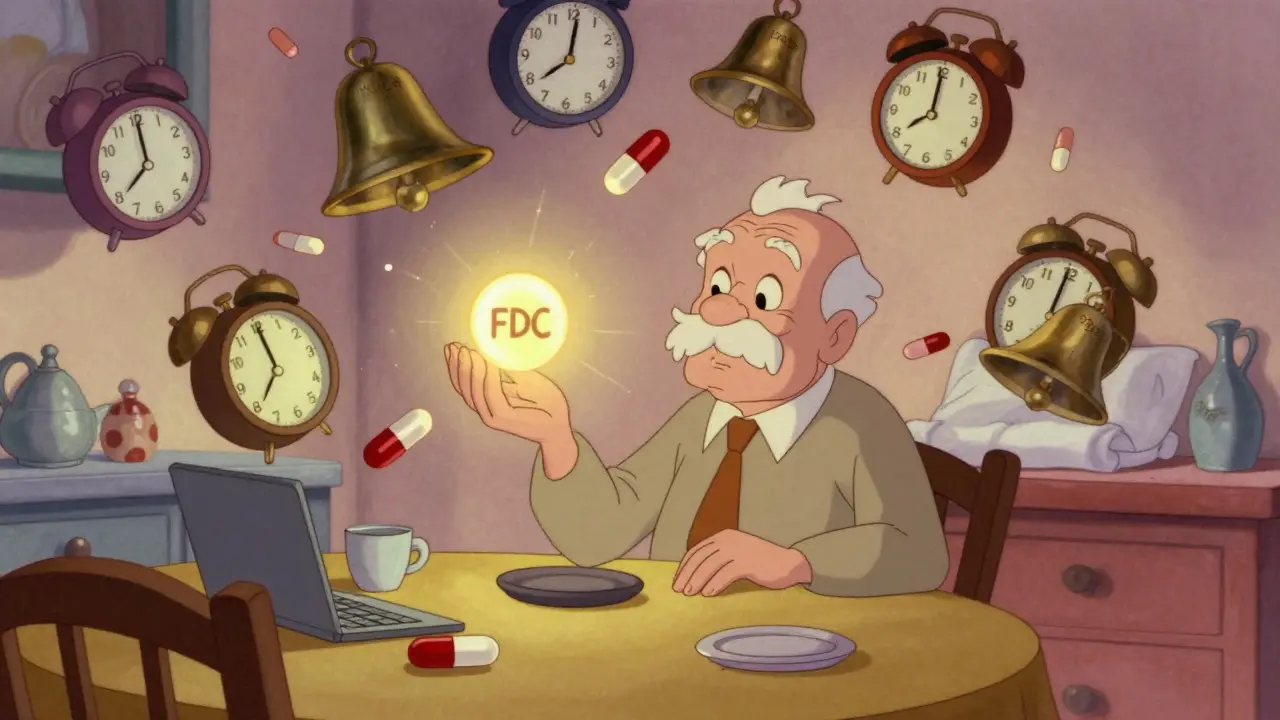
Imagine taking 12 pills a day-some in the morning, some after lunch, others at bedtime, and a few scattered throughout the afternoon. Now imagine forgetting one. Or mixing them up. Or running out because the refills are on different days. This isn’t rare. It’s the daily reality for millions of older adults and people managing chronic conditions. The good news? You don’t have to live like this. Simplifying your medication routine isn’t just about fewer pills-it’s about fewer daily doses, fewer mistakes, and more freedom.
Why Fewer Daily Doses Matter More Than Fewer Pills
People often think reducing the total number of pills is the goal. But it’s not. It’s about reducing how many times you have to stop what you’re doing to take medicine. Taking four pills once a day is easier than taking two pills six times a day. Why? Because your brain doesn’t have to remember six different triggers. Your routine doesn’t get interrupted. You’re less likely to miss a dose. Studies show that when patients go from seven or more daily doses to four or fewer, adherence improves by nearly 35%. That’s not a small win. It means fewer hospital visits, fewer emergencies, and better control over conditions like high blood pressure, diabetes, or HIV. The key isn’t just cutting pills-it’s cutting times.Four Proven Ways to Cut Daily Doses
There are four main strategies that work-and they’re backed by real data from hospitals, pharmacies, and patient studies.1. Fixed-Dose Combinations (FDCs)
This is when two or more medications are combined into one pill. For example, instead of taking a blood pressure pill and a cholesterol pill separately, you take one pill that does both. About one-third of all successful simplifications use this method. FDCs work best when the medications have similar dosing schedules and don’t interfere with each other. They’re common in HIV treatment, heart disease, and diabetes. In one study, switching to FDCs boosted adherence by 18-25%. But they’re not always available. Insurance might not cover the combo version, or your doctor might not know it exists. Ask your pharmacist: “Is there a combo pill for these meds?”2. Once-Daily Dosing
Many medications come in extended-release forms that last 24 hours. That means you can switch from taking something twice a day to once a day. This works for many blood pressure drugs, antidepressants, and even some antibiotics. But not all meds can be changed. Some need to be taken multiple times because they break down too fast. That’s where a pharmacist’s expertise matters. A 2018 study found that even when patients took their ART meds once daily instead of twice, adherence jumped-but their viral load didn’t always improve. Why? Because taking a pill once a day doesn’t fix the root problem if the dose isn’t right. Always check with your provider before switching.3. Medication Synchronization
This isn’t about changing pills-it’s about changing your calendar. If your blood pressure med is due every 30 days, your diabetes med every 28, and your painkiller every 14, you’re juggling three different refill dates. That’s a recipe for running out. Synchronization means getting all your prescriptions due on the same day each month. Most pharmacies offer this for free. You call once a month, pick up everything, and never worry about missing a refill. One study showed this cuts pharmacy visits by 60%. It’s simple, free, and underused. Ask your pharmacy: “Can you sync my refills?”4. Multi-Dose Compliance Packaging
Think of this as a weekly pill organizer, but professionally made. Pharmacies fill blister packs with compartments for morning, noon, evening, and bedtime. You open one section, and everything you need for that time is right there. Studies show this improves adherence by 22-30%, especially in older adults with memory issues. One caregiver on AgingCare.com said it “changed everything” for her mother. But there’s a catch: it costs $15-$20 extra per month. Medicare doesn’t always cover it. Medicaid might. Some pharmacies offer discounts if you pay upfront. If you’re on a tight budget, ask if your pharmacy has a low-cost program.The Universal Medication Schedule: A Simple Framework
The FDA and the American Geriatrics Society recommend using four standard times to organize meds:- Morning (with breakfast)
- Noon (with lunch)
- Evening (with dinner)
- Bedtime

What Doesn’t Work (And Why)
Not every simplification attempt succeeds. Here’s where things go wrong:- Combining meds that shouldn’t be taken together: Some drugs interact if taken at the same time. One survey found 42% of patients accidentally mixed incompatible pills after switching to a pill organizer.
- Ignoring insurance barriers: A 2020 study showed 45% of Medicare Advantage patients were denied access to once-daily versions because their plan didn’t cover them.
- Assuming adherence = better outcomes: Just because you take your pills doesn’t mean your numbers improve. Dosing, timing, and interactions still matter.
- Skipping medication reconciliation: Doctors often write prescriptions based on old records. Patients may be taking something they stopped, or not taking something they were prescribed. A typical patient has six discrepancies between their list and what’s in the chart. You can’t simplify a broken list.
How to Start: A 5-Step Plan
You don’t need a doctor’s order to begin. Here’s what to do:- Make a full list: Write down every medication, supplement, and over-the-counter pill you take. Include dose and time. Don’t guess-check the bottle.
- Compare with your doctor: Bring this list to your next visit. Say: “I want to simplify my routine. Are any of these meds safe to combine or switch to once-daily?”
- Ask your pharmacist: Pharmacists are trained in this. Ask: “Can you check for fixed-dose combos? Can you sync my refills? Can you prepare a weekly organizer?”
- Test one change at a time: Don’t try to switch everything at once. Start with one med. See how it goes.
- Track your progress: Use a calendar or app. Note if you missed doses before and after. Did your energy improve? Any side effects?
Who Should Lead This Change?
You might think your doctor should handle this. But in reality, pharmacists are the experts in medication logistics. They see your full list. They know which combos exist. They can talk to your insurance. Yet studies show that when only the pharmacist recommends simplification, only 12% of the changes get implemented. When the doctor, pharmacist, and patient all agree, it jumps to 50%. So be the bridge. Ask your doctor to consult your pharmacist. Ask your pharmacist to call your doctor. Make it a team effort.
Real Stories, Real Results
One user on Reddit, a nurse who works with HIV patients, said switching to once-daily antiretroviral therapy dropped missed doses from 12% to 4% monthly. But 30% of patients couldn’t get the new pills because their insurance denied coverage. The solution? They appealed-many won. Another story: a 78-year-old woman with diabetes, high blood pressure, and osteoporosis was taking 14 pills a day. After a pharmacist review, she was switched to three fixed-dose combos, synced refills, and got a weekly organizer. She went from 12 doses to 4-and no longer needed alarms. “I finally feel like I’m in control,” she said.What’s Next?
New tools are coming. Some pharmacies now use smart pill boxes that text you if you miss a dose. AI tools can scan your meds and suggest simplifications in seconds. Medicare is starting to pay pharmacists for these services. But right now, the best tool is still you-asking questions, speaking up, and refusing to accept a complicated routine as normal. You don’t need to take 10 pills at 8 a.m., 5 more at noon, and another 3 at 8 p.m. That’s not medicine. That’s a full-time job. Simplifying your regimen isn’t about cutting corners. It’s about reclaiming your time, your peace of mind, and your health.Can I just combine my pills myself at home?
No. Never crush, split, or mix pills at home unless your pharmacist or doctor says it’s safe. Some pills are designed to release slowly-crushing them can cause dangerous overdoses. Others can’t be combined because they react chemically. Always use professional multi-dose packaging or approved fixed-dose combinations.
Does simplifying my meds lower my treatment effectiveness?
Not if done correctly. Studies show that when simplification is guided by a pharmacist and based on pharmacokinetics, effectiveness stays the same or improves because you’re taking your meds consistently. The risk comes from poorly planned changes-like switching to once-daily without checking half-life or interactions. Always work with a professional.
Will my insurance cover combo pills or pill organizers?
It depends. Fixed-dose combinations are often covered if they’re FDA-approved and on your plan’s formulary. Pill organizers are rarely covered by insurance, but many pharmacies offer them for $10-$20 per month. Medicaid and some Medicare Advantage plans may cover them for high-risk patients. Always ask your pharmacist to check your plan’s coverage before agreeing to pay.
How long does it take to simplify a medication regimen?
It can take as little as one appointment if your meds are simple and your insurance approves the changes. But most cases take 2-6 weeks. You need time for your doctor to review, your pharmacist to check interactions, insurance to approve new formulations, and the new pills to arrive. Be patient, but stay persistent. Don’t give up if the first try fails.
What if my doctor says my regimen can’t be simplified?
Ask why. Sometimes it’s because they don’t know about newer combo pills or extended-release versions. Ask for a referral to a clinical pharmacist or medication therapy management (MTM) program. These services are free for Medicare Part D beneficiaries and are designed exactly for this purpose. You have a right to ask for a second opinion on your regimen.
Next Steps for Different Situations
- If you’re on 5+ meds daily: Schedule a medication review with your pharmacist. Bring your pill bottles or a list. Ask about FDCs and synchronization.
- If you’re caring for an elderly parent: Set up a weekly pill organizer. Use a phone alarm labeled “Morning Meds” and “Bedtime Meds.” Track missed doses for two weeks.
- If you’re struggling with refills: Call your pharmacy. Say: “Can you sync all my refills to the same day each month?” Most can do it in 10 minutes.
- If you’re on Medicare: Ask if you qualify for Medication Therapy Management (MTM). It’s free, includes a full regimen review, and often leads to simplification.




Comments
Danielle Stewart
December 18, 2025
This post hit me right in the feels. My mom was taking 17 pills a day until her pharmacist synced everything and switched her to two combo pills. She stopped setting six alarms and started actually enjoying her mornings again. No more panic when the refill date slipped. Just breakfast, lunch, dinner, bed. Simple. Human. I wish every family had access to this kind of care.
Sajith Shams
December 20, 2025
You're all missing the real issue. This 'simplification' nonsense ignores pharmacokinetics. You can't just slap two drugs together because they're convenient. Half-lives, CYP450 interactions, food effects-none of that matters to you, does it? I've seen patients on FDCs crash because their renal clearance changed. This is dangerous oversimplification disguised as empowerment.
Glen Arreglo
December 22, 2025
Look, I get where you're coming from-but let’s be real. In the US, insurance is the real villain here. I had a client who needed a once-daily HIV combo, but his plan only covered the brand-name version. The generic? $800/month out of pocket. So he took the two separate pills twice a day. That’s not patient failure. That’s system failure. We need policy change, not just pill organizers.
And yes, pharmacists should lead this. But they need paid time to do it. Right now, they’re rushed. This isn’t a patient problem-it’s a healthcare infrastructure problem.
shivam seo
December 23, 2025
Wow. Another feel-good article for people who can’t follow basic instructions. If you can’t remember to take your meds, maybe you shouldn’t be managing them. Maybe you need a guardian. Or a lobotomy. I’m tired of coddling adults who treat their bodies like a vending machine. Just take the damn pills on time or deal with the consequences.
benchidelle rivera
December 24, 2025
As a geriatric nurse practitioner, I’ve witnessed the devastating effects of polypharmacy. The four-time schedule is not just a suggestion-it’s evidence-based best practice. But what frustrates me is how often clinicians dismiss pharmacist recommendations. We are not just dispensers. We are clinical decision-makers. If your doctor won’t collaborate with your pharmacist, find a new doctor. Your life depends on it.
Matt Davies
December 25, 2025
This is the kind of post that makes you want to hug a pharmacist. Seriously. I had no idea syncing refills was a thing-my aunt’s been missing doses for years because her blood pressure med was due on the 3rd and her diabetes med on the 17th. One phone call. One day. Done. She’s now got her meds in a little box and she’s dancing in the kitchen again. It’s not magic. It’s just… kindness. And competence.
Ashley Bliss
December 26, 2025
Let’s be honest-this isn’t about simplification. It’s about society’s refusal to accept aging, illness, and mortality. We want a pill to fix everything, then we get mad when the system can’t magically make it all easy. We’ve turned healthcare into a consumer product, and now we’re shocked when it fails us? Wake up. No amount of pill organizers will fix a culture that treats the sick as burdens. This post is a Band-Aid on a hemorrhage.
Dev Sawner
December 26, 2025
While the methodology presented is superficially appealing, it lacks rigorous scientific grounding in pharmacoeconomic modeling. The cited 35% adherence improvement is derived from observational cohort studies with significant selection bias. Furthermore, the assumption that reduced dosing frequency directly correlates with improved clinical outcomes ignores confounding variables such as socioeconomic status, health literacy, and access to monitoring. Until peer-reviewed RCTs confirm causality, this approach remains anecdotal at best.
Moses Odumbe
December 27, 2025
Just tried the pill organizer thing for my dad. Best $15 I ever spent. 🙌 He actually took his meds for a whole week. No more "I forgot" or "I thought I already took it." Now he’s asking if we can get one with a little alarm. Also, his pharmacist found a combo pill he didn’t even know existed. Like… why don’t doctors just tell you this stuff? 🤦♂️
Meenakshi Jaiswal
December 28, 2025
I work in a community pharmacy in Bangalore, and this is daily life here. Families come in with 10+ bottles. We sync refills, explain FDCs, and sometimes even hand-write a schedule on a sticky note because they don’t have smartphones. The real win? When a grandmother says, "I can finally help my grandchild with homework now-I don’t need to nap after lunch because I’m too dizzy from my meds." That’s the real metric. Not adherence rates. Real life.
Write a comment