
When it comes to clearing acne and reducing wrinkles, two names come up again and again: tretinoin and adapalene. Both are retinoids - compounds derived from vitamin A - but they’re not the same. One is a prescription powerhouse with decades of proof behind it. The other is an over-the-counter favorite that’s gentle enough for beginners. Choosing between them isn’t about which is ‘better.’ It’s about what your skin needs right now.
How Retinoids Actually Work
Retinoids don’t just sit on the surface. They slip into skin cells and change how they behave. Think of them as messengers that tell your skin to stop acting old and start acting young again. They speed up cell turnover, which means dead skin flakes off faster, unclogging pores and revealing smoother skin underneath. They also boost collagen production - the protein that keeps skin firm and plump. And they help fade dark spots by regulating pigment cells. Tretinoin and adapalene both bind to retinoic acid receptors in your skin, but they do it differently. Tretinoin works deeper, reaching into the dermis where wrinkles form. Adapalene sticks closer to the surface, focusing on the epidermis where acne starts. That’s why one’s better for aging skin, and the other’s gentler for sensitive, acne-prone skin.Tretinoin: The Gold Standard for Aging Skin
Tretinoin has been around since the 1970s. It was the first retinoid approved by the FDA for acne, but its real superpower is reversing sun damage. Studies show that after 24 weeks of using 0.05% tretinoin cream, users see up to 42% improvement in fine lines and 58% reduction in mottled pigmentation. That’s not a small gain - it’s noticeable. It comes in strengths from 0.01% to 0.1%. The higher the strength, the faster the results - but also the higher the chance of irritation. That’s why many dermatologists start patients on 0.025% or 0.05%. There’s also a microsphere version, like Retin-A Micro or Altreno, which releases the active ingredient slowly. This cuts down on redness and peeling without losing effectiveness. But tretinoin is fragile. It breaks down in sunlight and air. That’s why it’s always packaged in opaque tubes and meant to be applied at night. You also can’t mix it with benzoyl peroxide unless you use a special formulation - otherwise, they cancel each other out.Adapalene: The Gentle Starter
Adapalene was developed later, in the 1990s, and became available over-the-counter in 2016. That changed everything. Suddenly, people could try a retinoid without a doctor’s visit. Differin Gel (0.1%) became the top dermatologist-recommended acne treatment in 2023. It’s stable. You can leave it on your counter. You can even use it with benzoyl peroxide - that’s why Epiduo (adapalene + benzoyl peroxide) works so well. It’s also less irritating. In clinical trials, adapalene caused 15% less redness, 12% less peeling, and 8% less stinging than tretinoin. For people with sensitive skin, rosacea, or eczema, adapalene is often the only retinoid they can tolerate. It’s not as strong for deep wrinkles. A 2018 study found adapalene 0.3% improved fine lines by 35% after 24 weeks - good, but not as good as tretinoin’s 42%. If your main goal is fading wrinkles, adapalene will help, but it won’t transform your skin the way tretinoin can.Real People, Real Results
Look at Reddit threads, Amazon reviews, and dermatology surveys. The pattern is clear: people who start with tretinoin often quit because their skin flares up. One user wrote: “I had to stop tretinoin after two weeks. My face looked like I’d been sandblasted.” Then they switched to Differin. Eight weeks later: “Clear skin. Only dry on two nights a week.” But the reverse happens too. People who use adapalene for acne and then try to tackle wrinkles often hit a wall. “It cleared my breakouts,” one reviewer said, “but my wrinkles stayed. I switched to Retin-A Micro. After five months, I could see the lines softening.” The truth? Most people need to start slow. The first 2-6 weeks are rough. You’ll get dryness, flaking, maybe even a temporary breakout - that’s called “purging.” It’s not a reaction. It’s your skin clearing out clogged pores. If you quit then, you’ll never see the results.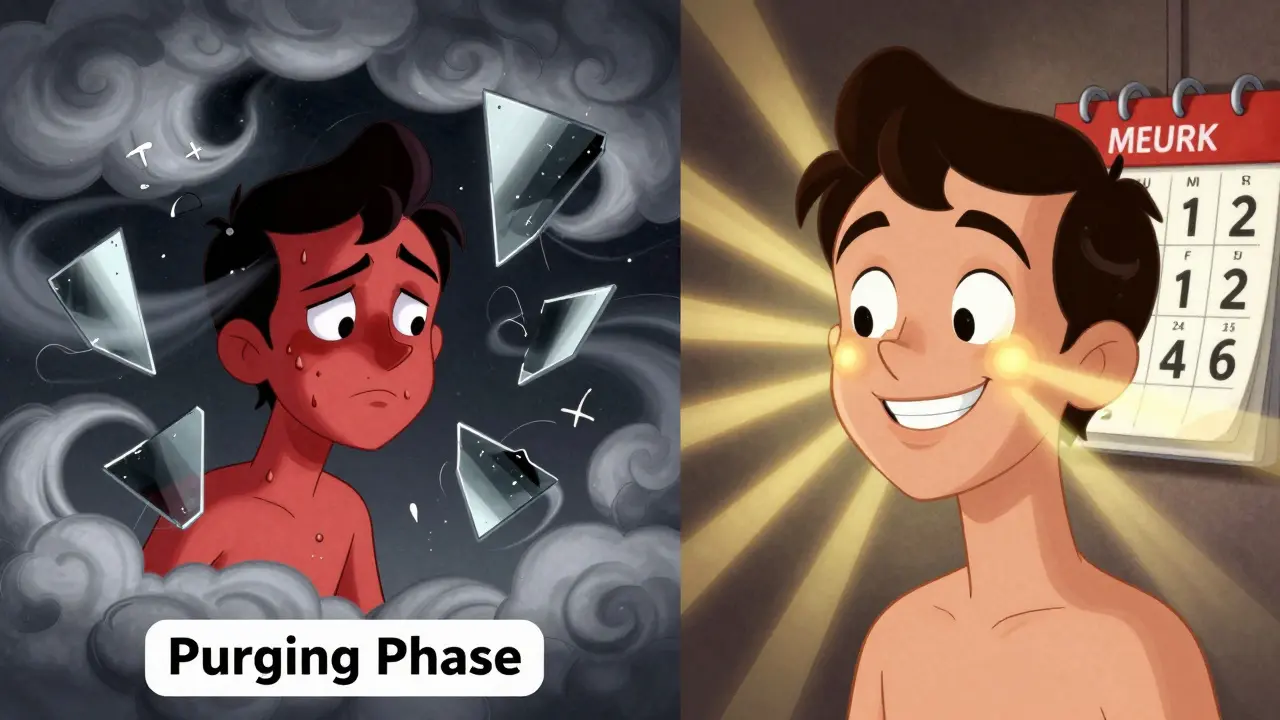
How to Use Them Right
Here’s what actually works, based on what dermatologists and users who stuck with it say:- Start with a pea-sized amount for your whole face. More doesn’t mean faster results - it just means more irritation.
- Apply to clean, dry skin. Wet skin increases absorption and irritation.
- Use it 2-3 nights a week at first. If your skin tolerates it after 2-4 weeks, go to every other night, then nightly.
- Use the “sandwich method”: moisturizer → retinoid → moisturizer. This cuts irritation by nearly half.
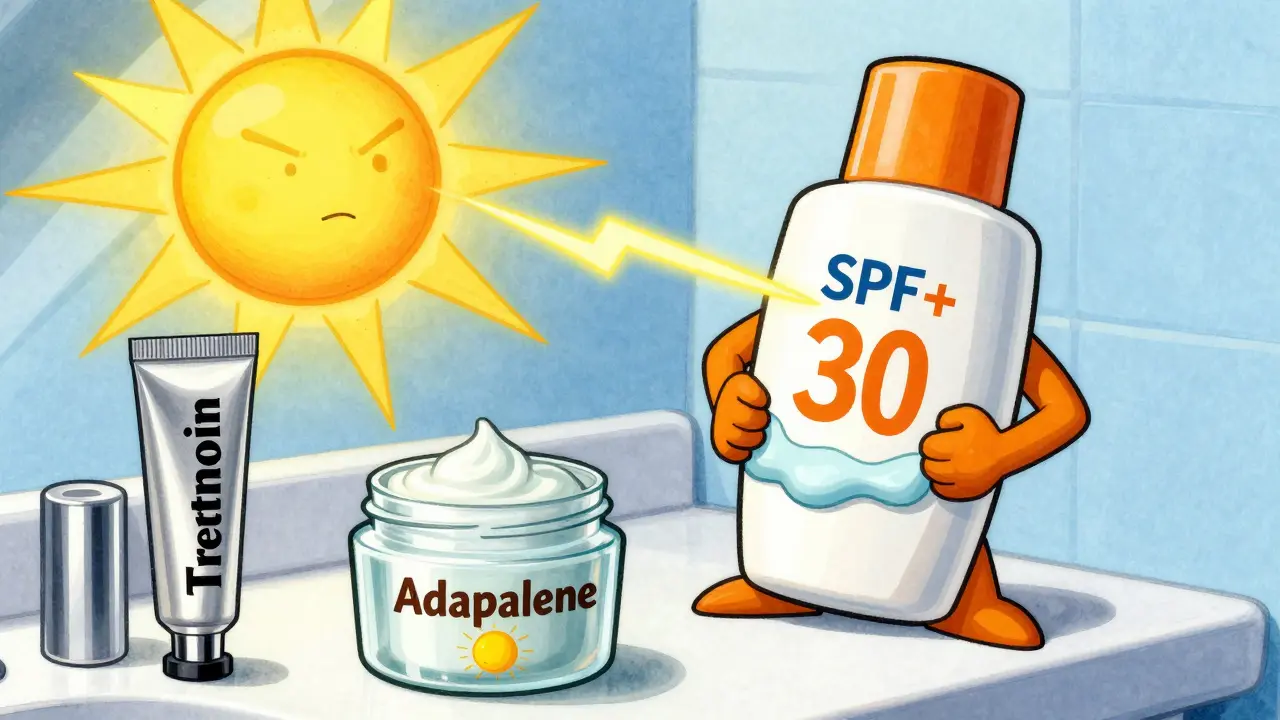
- Wear SPF 30+ every single day. Retinoids make your skin more sensitive to the sun. Skip this, and you risk burns, dark spots, and undoing all your progress.
- Don’t use other harsh products (like salicylic acid or physical scrubs) on the same night. Give your skin a break.
Cost, Availability, and What’s New
Tretinoin costs more - around $45 for a tube without insurance. But with insurance, it can drop to $10-20. Adapalene 0.1% gel? $15 at the pharmacy. No prescription needed. Newer options are emerging. Altreno (0.05% tretinoin lotion) came out in 2022 and causes 35% less irritation than traditional tretinoin. Epiduo (adapalene + benzoyl peroxide) clears acne faster than either alone - 81% of users saw results in 12 weeks. But here’s the thing: even with new products, tretinoin and adapalene are still the foundation. Why? Because we’ve studied them for 50 years. We know how they work, how to manage side effects, and how to get the best results. Newer retinoids like tazarotene work faster but cause more irritation. For most people, the trade-off isn’t worth it.Who Should Use What?
- Choose adapalene if: You’re new to retinoids, have sensitive skin, struggle with mild to moderate acne, or want something gentle you can buy without a prescription.
- Choose tretinoin if: You have moderate to severe acne, visible sun damage, deep wrinkles, or dark spots that haven’t improved with other treatments.
- Use both? Maybe later. Some dermatologists prescribe adapalene first, then switch to tretinoin after 6-12 months if acne is under control but aging signs remain.
What About Pregnancy?
Both tretinoin and adapalene are Category C during pregnancy. That means animal studies showed risk, but human data is limited. Dermatologists require a negative pregnancy test before prescribing. If you’re pregnant or planning to be, skip both. Use azelaic acid or niacinamide instead - they’re safe and still effective.Why So Many People Quit Too Soon
A 2023 survey found 63% of people stopped retinoid therapy within four weeks. Why? They expected instant results. They didn’t know about the purging phase. They didn’t use sunscreen. They applied too much. The truth? Retinoids are a marathon, not a sprint. You won’t see changes in two weeks. You won’t see them in four. It takes 8-12 weeks to notice a difference. Real transformation takes 6-12 months. The people who stick with it? They’re the ones with clearer skin, fewer wrinkles, and no more breakouts.Final Thought: Start Smart, Stay Consistent
You don’t need the strongest retinoid to get results. You need the right one for your skin - and the patience to use it properly. Adapalene is the smart first step for most people. Tretinoin is the next step for those who need deeper results. Neither is magic. But together with sunscreen and consistency, they’re the closest thing we have to a time machine for your skin.Can I use adapalene and tretinoin together?
No. Using both at the same time increases irritation without improving results. If you want to switch from one to the other, wait at least 2-4 weeks after stopping the first before starting the second. Always consult a dermatologist before making changes to your routine.
How long does it take to see results from tretinoin or adapalene?
You’ll start noticing changes after 8-12 weeks of consistent use. For acne, this means fewer breakouts. For wrinkles and dark spots, it takes longer - usually 4-6 months. Maximum results often require 6-12 months. Patience is key.
Is adapalene strong enough for acne?
Yes. Adapalene 0.1% is as effective as tretinoin 0.025% for treating mild to moderate acne, with significantly less irritation. For severe acne, a dermatologist may prescribe adapalene 0.3% or combine it with other treatments like benzoyl peroxide.
Can I use retinoids if I have rosacea or eczema?
Adapalene is often better tolerated than tretinoin for sensitive skin conditions like rosacea or eczema. Start with the lowest strength (0.1%), apply only 1-2 nights a week, and use the sandwich method. If irritation persists, stop and talk to a dermatologist. Tretinoin is usually too harsh for these conditions.
Do I need to use sunscreen every day with retinoids?
Absolutely. Retinoids make your skin more sensitive to UV rays. Without daily SPF 30+, you risk sunburn, dark spots, and faster aging - which defeats the whole purpose. Use a broad-spectrum mineral sunscreen with zinc oxide or titanium dioxide for the best protection.
What’s the difference between retinol and retinoids like tretinoin and adapalene?
Retinol is a weaker form of vitamin A found in over-the-counter products. Your skin has to convert it into retinoic acid before it works - and that conversion is inefficient. Tretinoin and adapalene are already in the active form, so they work faster and more reliably. Retinol is gentler but slower. Prescription retinoids are stronger and proven.




Comments
Lynsey Tyson
December 19, 2025
I started with adapalene after my dermatologist told me to ease in - and honestly, I thought it was too gentle. But after three months, my skin stopped acting like a drama queen. No more red patches, no more flaking. Just... calm. I didn’t even need to use the sandwich method. Just a light moisturizer before and after. It’s not magic, but it’s real.
Allison Pannabekcer
December 21, 2025
For anyone scared to start retinoids - you’re not alone. I cried the first time I used tretinoin. My face looked like a pepperoni pizza after a week. But I stuck with it. Cut back to twice a week. Used a ton of ceramide cream. And then - boom - six months later, my coworkers asked if I got a facial. Nope. Just patience and sunscreen. Seriously, don’t quit at week two.
anthony funes gomez
December 22, 2025
Retinoid pharmacodynamics are fundamentally mediated via RAR-α/β/γ receptor binding, which modulates transcriptional activity of genes involved in keratinocyte differentiation and collagen synthesis - but the clinical efficacy ceiling for adapalene is constrained by its epidermal specificity, whereas tretinoin’s dermal penetration enables MMP-1 suppression and fibroblast activation. That’s why the 42% wrinkle reduction isn’t anecdotal - it’s mechanistically inevitable. The OTC vs Rx distinction isn’t regulatory whim - it’s bioavailability math.
Dikshita Mehta
December 23, 2025
Adapalene 0.1% works great for acne - I’ve recommended it to 3 friends in India with sensitive skin. But if you’re 30+ and seeing fine lines? Don’t expect miracles. I switched to tretinoin 0.05% after 8 months. Took 3 weeks to adjust. Now my skin looks like it’s been paused on the aging timeline. Sunscreen is non-negotiable - I use zinc oxide every single day. No exceptions.
Gloria Parraz
December 24, 2025
Let me tell you about the purge. I thought I was allergic. My face was on fire. I wanted to throw the tube out. But I didn’t. I cried. I prayed. I applied moisturizer like it was holy water. And then - one morning - I woke up and my skin was… calm. Clear. Alive. It took 11 weeks. But it happened. You can do this. Don’t give up before the magic starts.
Sahil jassy
December 24, 2025
adapalene for acne, tretinoin for wrinkles - simple. use sunscreen or go back to looking like you lost a fight with the sun. also, stop using vitamin c at night. it fights retinoids. i learned the hard way.
Carolyn Benson
December 25, 2025
Everyone’s acting like this is some deep revelation. Retinoids have been around since the 70s. You’re just now learning this because you’re too lazy to read a dermatology textbook. And the sandwich method? That’s not innovation - that’s basic skin barrier science. Stop acting like you discovered fire.
Chris porto
December 26, 2025
I tried adapalene first. It worked for my breakouts, but my forehead lines didn’t budge. Switched to tretinoin 0.025%. First month was rough. Second month, my skin felt tighter. Third month, people started asking if I was using a new face cream. It’s not glamorous. But it works. Just don’t rush it.
Aadil Munshi
December 27, 2025
Adapalene is basically tretinoin’s nice cousin who doesn’t know how to handle real problems. You want to fix wrinkles? Use the real stuff. The fact that people think OTC is ‘gentle enough’ is why skin care has become a cult. You don’t get results by being polite to your skin. You get results by being consistent - and sometimes, brutal.
Frank Drewery
December 27, 2025
My mom started adapalene at 58. Had rosacea. Thought she couldn’t use anything. Now she says her skin feels like it’s breathing again. She uses it twice a week. Moisturizes like it’s her job. And wears SPF like armor. No drama. No flaking. Just quiet, steady improvement. Proof that you don’t need to burn to heal.
Write a comment