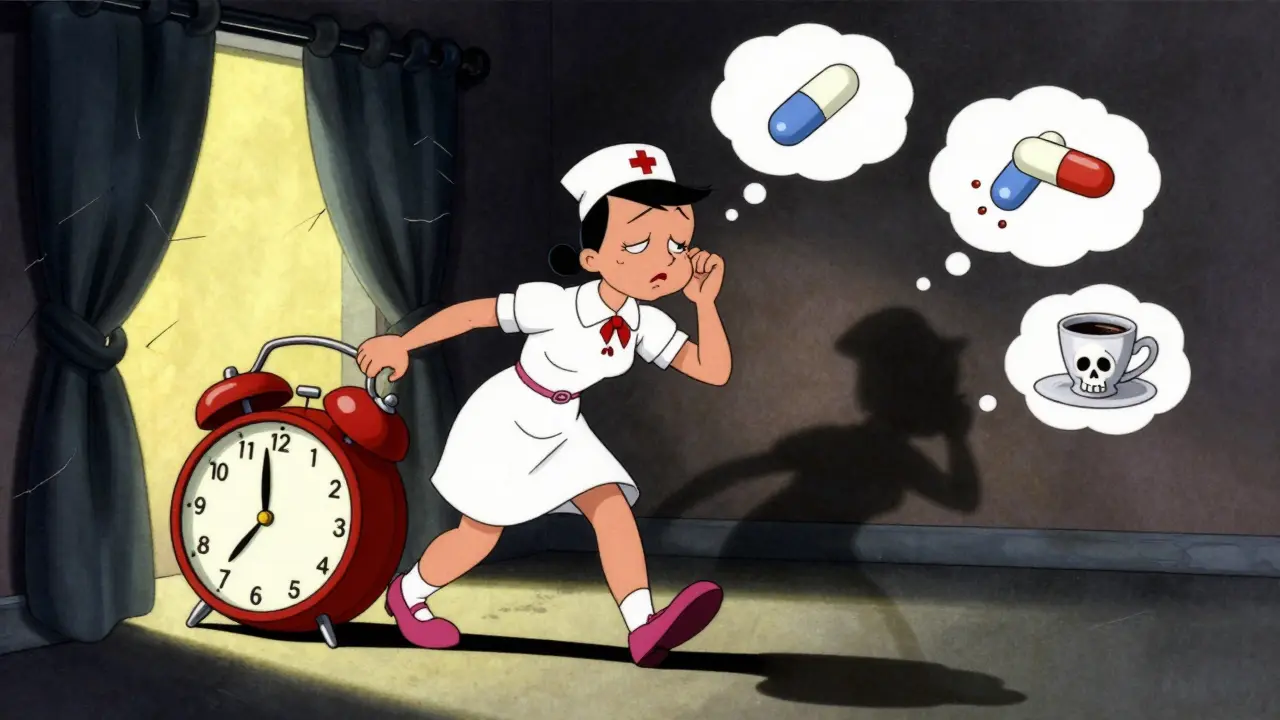
Working nights isn’t just tough-it’s physically unnatural. Your body wasn’t built to be awake when the sun’s down and asleep when it’s up. Yet millions of people do it every day: nurses, truck drivers, factory workers, emergency responders. And for a lot of them, the sleep they get doesn’t fix the damage. That’s not just being tired. That’s shift work sleep disorder-a real, medically recognized condition that messes with your brain, your health, and your safety.
What Exactly Is Shift Work Sleep Disorder?
Shift work sleep disorder (SWSD) isn’t just having trouble falling asleep after a late shift. It’s when your internal clock-your circadian rhythm-is constantly out of sync with your work schedule. Your body thinks it’s nighttime when you’re at work, and daytime when you’re trying to sleep. This isn’t something you can just ‘power through.’ Your brain is fighting biology.
The American Academy of Sleep Medicine officially recognized SWSD as a disorder in 2005. Since then, studies have shown that 20-30% of night and rotating shift workers develop it. That’s 1 in every 4 people working outside normal hours. And it’s not just about being groggy. People with SWSD lose 1 to 4 hours of sleep every night. Over time, that adds up to hundreds of hours of lost rest per year.
Here’s what it feels like: You get home from your 11 p.m. to 7 a.m. shift, pull the blackout curtains, turn on the white noise machine, and still can’t sleep past 4 a.m. You drag yourself through the next shift, nodding off at the controls, forgetting names, making mistakes. You’re irritable. Your digestion is off. You’ve stopped hanging out with friends because you’re always sleeping or recovering.
Why Your Body Can’t Adapt (Even After Years)
Many people think, ‘I’ve been on nights for five years-I’m used to it.’ But science says otherwise. Dr. Charles Czeisler from Brigham and Women’s Hospital found that only 2-5% of night shift workers ever fully adapt their circadian rhythms. That means 95% of people who think they’ve adjusted? They’re still running on borrowed sleep.
Your body runs on two key hormones: melatonin and cortisol. Melatonin tells your body it’s time to sleep. Cortisol wakes you up. Normally, melatonin rises around 9 p.m. and drops by 7 a.m. But if you’re working nights, your melatonin peaks when you’re supposed to be alert-and crashes when you’re trying to sleep. Cortisol does the opposite. It stays low when you need energy and spikes when you need rest.
Light is the biggest disruptor. Even a little bit of indoor light at night-your phone, a dim lamp, the glow of a monitor-can suppress melatonin by up to 85%. That’s why blackout curtains alone aren’t enough. You need total darkness, and you need to protect it like a secret.
How SWSD Hits Your Health-Beyond Tiredness
SWSD doesn’t just make you sleepy. It’s a silent threat to your long-term health. The International Agency for Research on Cancer (IARC) classified shift work as ‘probably carcinogenic’ in 2007. Why? Because disrupted sleep messes with your immune system, your metabolism, and your DNA repair cycles.
People with chronic SWSD have a higher risk of:
- Heart disease
- Type 2 diabetes
- Obesity
- Depression and anxiety
- GI problems like ulcers and IBS
- Lower vaccine response and slower recovery from illness
And it’s not just you. Fatigue from SWSD causes workplace errors. One case study in a Midwest factory found a single sleep-deprived worker caused a $2.3 million equipment failure. In healthcare, nurses with SWSD are 3 times more likely to make medication errors. The National Safety Council estimates these mistakes cost U.S. businesses $13 billion a year.
Who’s Most at Risk?
Not everyone who works nights gets SWSD. But some groups are far more vulnerable:
- Women are 28% more likely to develop it than men-possibly due to hormonal differences and caregiving responsibilities.
- People over 50 have a 34% chance of developing SWSD, compared to just 15% for those under 30. Your body’s internal clock naturally slows down with age.
- Morning people (‘larks’) struggle more than night owls. Research from the University of Munich shows night owls adapt 37% better to night shifts.
- Rotating shift workers suffer worse than those on fixed nights. Constantly switching schedules prevents any real adaptation.
And here’s the kicker: Only 22% of shift workers have access to a dark, quiet place to sleep during breaks-exactly what NIOSH recommends. Most workplaces don’t even try to help.
What Actually Works: Proven Strategies
If you’re reading this, you’ve probably tried blackout curtains, earplugs, and chamomile tea. None of those are enough on their own. Real improvement comes from a system-not a single trick.
1. Light Therapy During Your Shift
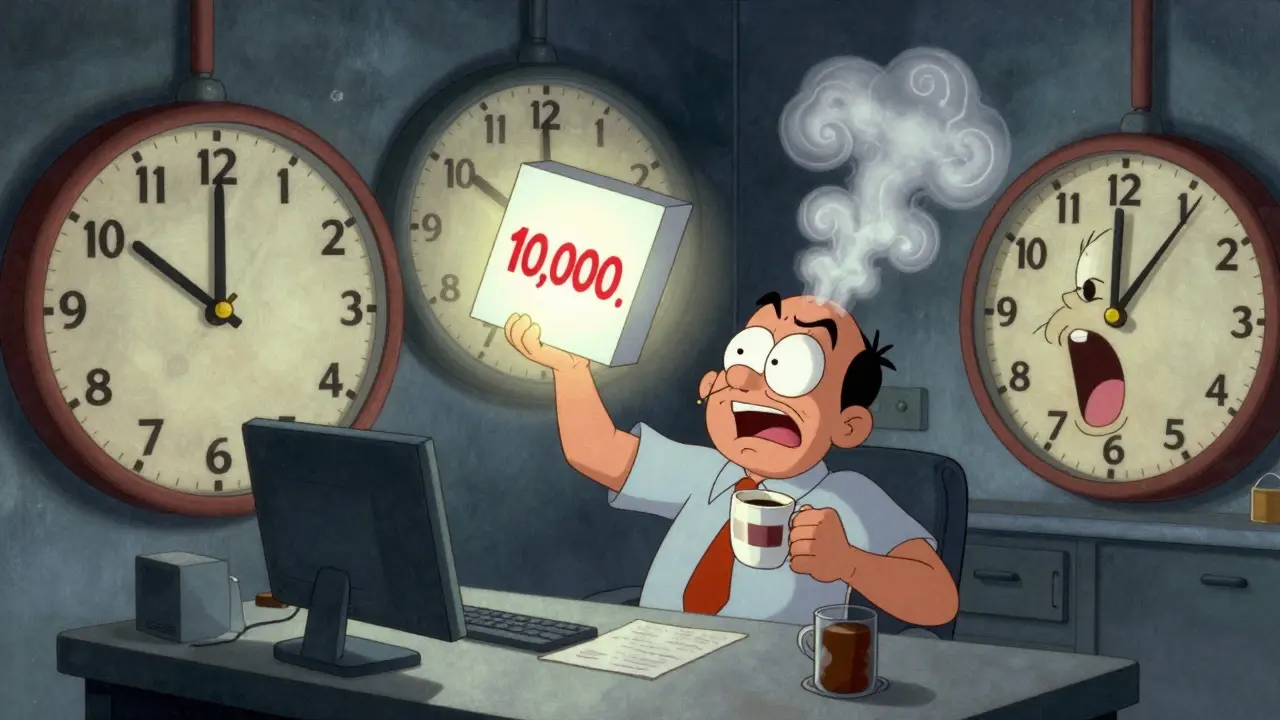
Use bright light (10,000 lux) during your night shift. This tricks your brain into thinking it’s daytime. A 30-minute session every 2 hours is ideal. You don’t need expensive gear-a simple light box from a medical supplier works. Many hospitals now give these to night staff. If your workplace won’t provide one, bring your own.
2. Melatonin Before Daytime Sleep
Take 0.5 to 5 mg of melatonin 30 minutes before you go to bed during the day. Don’t take it at night-that’ll mess up your rhythm even more. Studies show this helps people fall asleep 20-30 minutes faster and increases total sleep time by up to 45 minutes per night.
3. Caffeine Timing Is Everything
Use caffeine early. One cup (about 100 mg) at the start of your shift helps. A second cup halfway through might be okay. But after 3 a.m.? Don’t. Caffeine lasts 6-8 hours. If you drink it too late, you’ll be wide awake when you need to sleep. Stick to under 200 mg per shift.
4. Naps Before and During Your Shift
A 20-30 minute nap before your shift can boost alertness by 50%. A short nap during a break (even 10 minutes) helps too. Don’t nap longer than 30 minutes-longer naps leave you groggy.
5. Protect Your Sleep Like a Fort
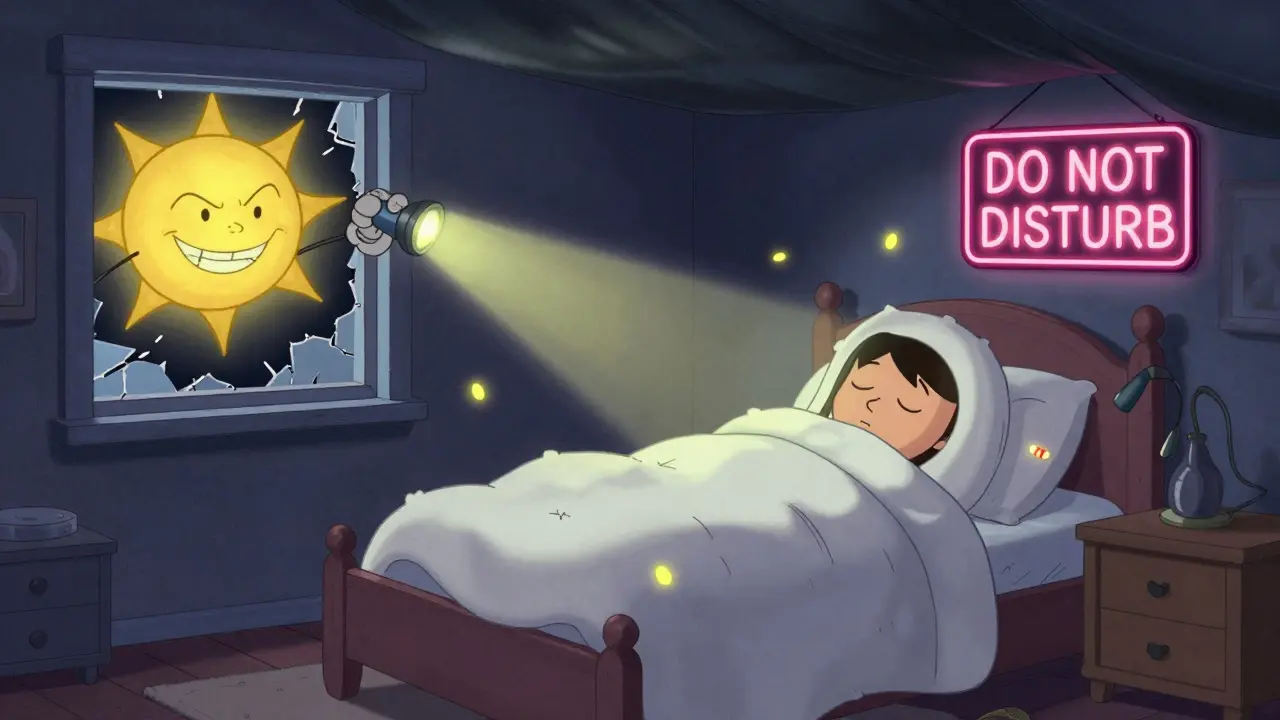
Your bedroom needs to be a cave. Blackout curtains. White noise machine. Door sign: ‘Do Not Disturb-Sleeping Until 5 p.m.’ Tell your family. Block your phone. Use an old-school alarm clock. Even sunlight seeping through a crack can ruin your sleep. One nurse in a Reddit thread said she used a tarp over her windows-and finally slept 6 hours straight for the first time in 3 years.
What Doesn’t Work (And Why)
Many people try quick fixes that backfire:
- Alcohol: It might help you fall asleep, but it destroys deep sleep and REM cycles. You’ll wake up more tired.
- Sleeping pills: They don’t fix circadian misalignment. They just mask the problem-and can be addictive.
- Going to bed at the same time every day: If you rotate shifts, that’s impossible. Instead, match your sleep schedule to your work schedule, even on days off.
- Just ‘toughing it out’: This leads to burnout, health collapse, or accidents. It’s not a character flaw-it’s biology.
New Treatments on the Horizon
In May 2023, the FDA approved sodium oxybate for SWSD-related excessive sleepiness. It’s the first new drug for this condition in nearly a decade. It’s not a cure, but it helps people stay awake during shifts without the jittery side effects of stimulants like modafinil.
Researchers are also testing genetic-based treatments. Some people have a gene variant (PER3) that makes them more sensitive to sleep disruption. In the future, doctors might test your DNA and tailor your light, melatonin, and schedule plan to your biology.
Wearable tech is catching up too. By 2025, 68% of major healthcare systems plan to use devices that track your circadian rhythm-monitoring light exposure, body temperature, and movement to give you personalized sleep advice.
What Employers Should Do (And Rarely Do)
This isn’t just your problem-it’s your employer’s responsibility. The CDC and NIOSH have clear guidelines:
- Limit consecutive night shifts to 3-4 days max
- Provide dark, quiet sleep rooms for on-site breaks
- Offer bright light therapy devices
- Train managers to recognize signs of fatigue
- Allow flexible scheduling when possible
Only 47% of U.S. hospitals screen for SWSD today-up from 12% in 2018. That’s progress, but it’s not enough. If your workplace doesn’t support you, you’re being set up to fail.
When to See a Doctor
If you’ve been struggling with sleep for more than a month-and it’s affecting your work, relationships, or health-it’s time to see a sleep specialist. Bring your sleep log. Record when you’re awake, when you sleep, how you feel, and what you’ve tried. A sleep study (actigraphy) can confirm SWSD and rule out other disorders like sleep apnea.
Don’t wait until you’ve made a mistake at work, or until you’re diagnosed with high blood pressure or prediabetes. SWSD is treatable. But only if you act before it becomes chronic.
Final Thought: You’re Not Lazy
Working nights is one of the hardest things your body can do. If you’re tired, it’s not because you’re weak. It’s because your biology is screaming at you to stop. The fact that you’re reading this means you’re already trying to fix it-and that’s the first step.
There’s no perfect solution. But with the right tools-light, melatonin, naps, and total sleep protection-you can reclaim your rest. And that’s not just about feeling better. It’s about staying alive, staying healthy, and staying safe-for yourself and everyone around you.
Can you ever fully adapt to night shifts?
Only 2-5% of people ever fully adapt to night shifts, even after years. Your body’s internal clock is wired to follow daylight. While you can improve your sleep and alertness with strategies like light therapy and melatonin, your biology will always be fighting against the schedule. That’s why rotating shifts are worse than fixed nights-you never give your body a chance to settle.
Is melatonin safe for long-term use in shift workers?
Yes, melatonin is generally safe for long-term use at low doses (0.5-5 mg) when taken correctly-30 minutes before daytime sleep. It’s not addictive like sleeping pills. Studies show it helps shift workers fall asleep faster and sleep longer without major side effects. Always start low and talk to your doctor if you’re on other medications.
Why do I feel worse on my days off?
Because your sleep schedule changes. On days off, you might try to sleep at night like everyone else, but your body is still on a night-shift rhythm. This creates a ‘social jet lag’ effect-like constantly flying across time zones. The best fix is to keep your sleep schedule as consistent as possible, even on days off. If you sleep from 9 a.m. to 5 p.m. on workdays, try to sleep from 10 a.m. to 6 p.m. on your days off.
Does caffeine help or hurt shift workers?
Caffeine helps if used strategically. One or two cups early in your shift can boost alertness. But drinking it after 3 a.m. will ruin your ability to sleep during the day. The key is timing: use it to stay awake during work, not to fight sleep after work. Never use it as a substitute for sleep.
Are there any jobs where night shifts are safer than others?
No job is truly safe if you’re chronically sleep-deprived. But roles with predictable, fixed night schedules (like 7 p.m. to 7 a.m. every day) are easier to manage than rotating shifts. Healthcare, transportation, and manufacturing carry higher risks because of the physical demands and potential for error. If you can choose, fixed nights are better than rotating. And if you can avoid nights entirely? That’s the healthiest option.


Comments
Jenna Allison
January 24, 2026
Light therapy during shifts is a game-changer. I work ER nights and got a 10,000 lux box last year. Didn’t believe it at first, but after two weeks, I stopped crashing at 3 a.m. and actually felt alert during handoffs. Also, melatonin at 5 a.m. before bed-0.5 mg, no more. Works like a charm. No pills, no booze. Just science.
Gina Beard
January 24, 2026
Truth is, we’re all just borrowing time from our future selves.
Darren Links
January 26, 2026
They say shift work is carcinogenic? That’s just woke science. Back in my day, we worked nights and didn’t whine about it. Now everyone needs a light box and a melatonin prescription. Grow a spine. Sleep when you’re dead.
Elizabeth Cannon
January 26, 2026
Y’all are overcomplicating this. I’m a single mom who works 11-7 at a warehouse. I don’t have time for fancy light boxes. I use my phone’s red light filter, wear sunglasses on the way home, and tell my kids ‘mommy’s sleeping’ with a sticky note on the door. I nap before I leave. I drink water. I don’t eat heavy food after midnight. It’s not perfect, but I sleep 5 hours. And that’s enough. You don’t need a PhD to survive nights.
Phil Maxwell
January 28, 2026
I’ve been on nights for 8 years. Still can’t fully adapt. But I noticed something-when I avoid screens after my shift and just sit in total dark for 20 minutes before bed, I fall asleep faster. No melatonin. Just quiet. Weird how simple fixes work when you stop overthinking it.
Karen Conlin
January 28, 2026
TO EVERYONE ON NIGHTS: YOU ARE NOT ALONE. I WAS A NURSE FOR 15 YEARS. I THOUGHT I WAS JUST ‘TOO TIRED.’ TURNED OUT I HAD SWSD. I STARTED USING LIGHT THERAPY + MELATONIN + BLACKOUT CURTAINS + A DOG THAT BARKS IF ANYONE KNOCKS. I SLEPT 6 HOURS FOR THE FIRST TIME IN 7 YEARS. YOU CAN DO THIS. YOUR BODY ISN’T BROKEN. THE SCHEDULE IS. AND YOU DESERVE BETTER. 💪🌙
Sawyer Vitela
January 30, 2026
Only 2-5% adapt? That’s not a surprise. Most people are lazy. If you can’t hack it, quit. No one’s forcing you to work nights. And melatonin? That’s just a supplement you can buy at GNC. Stop pretending it’s medicine. Also, sodium oxybate? That’s GHB. You’re literally promoting a controlled substance as a fix. Real helpful.
venkatesh karumanchi
January 31, 2026
Bro, I work night shift in Mumbai call center. 10pm to 6am. I use blue light blocker glasses. Sleep with earplugs. Eat banana before bed. No caffeine after 2am. I sleep 5 hours. Not perfect. But I live. You don't need fancy gadgets. Just discipline. 🙏
Himanshu Singh
February 2, 2026
It’s not about fighting biology… it’s about listening to it. Your body isn’t broken, it’s whispering. You just stopped hearing it. Light. Silence. Routine. These aren’t tricks-they’re homecoming. 🌙
Helen Leite
February 2, 2026
Did you know the government knows this is happening? They’re using shift work to control the population’s sleep cycles so we’re too tired to protest. That’s why they don’t fund sleep rooms. That’s why they won’t fix the clocks. Wake up. The lights aren’t just for you-they’re for THEM. 🕵️♀️👁️
Izzy Hadala
February 4, 2026
While the article presents a compelling narrative regarding circadian misalignment, it is imperative to acknowledge the methodological limitations of self-reported sleep data in the cited studies. Furthermore, the recommendation of exogenous melatonin as a therapeutic intervention lacks longitudinal, double-blind, placebo-controlled validation in heterogeneous shift populations. One must exercise caution before endorsing pharmacological adjuncts without rigorous clinical trial evidence.
Marlon Mentolaroc
February 5, 2026
lol at people spending $300 on light boxes. I just turn on my TV and watch reruns of The Office while I nap. Works better than melatonin. Also, I drink coffee at 2am. Who cares if I sleep at 6am? I’m not a robot.
Don Foster
February 5, 2026
Everyone’s acting like this is some new discovery. People have worked nights since the industrial revolution. You want to sleep? Don’t work nights. Simple. No light boxes. No melatonin. No sodium oxybate. Just don’t do it. Your body didn’t evolve for this. So why are you surprised it’s mad at you?
siva lingam
February 6, 2026
So you're telling me I need to buy a $200 light box to stay awake while I count bolts? What a joke. I just drink 3 Red Bulls and call it a day. 😴
Write a comment