Ever wondered why your prescription costs a fraction of the original brand-name price? The answer usually lies in a specific regulatory process called the ANDA, or Abbreviated New Drug Application. This isn't just bureaucratic jargon; it is the primary mechanism that allows generic drugs to enter the U.S. market safely and affordably. If you are a patient, a healthcare professional, or someone interested in how pharmaceuticals work, understanding this pathway clarifies why generics are so prevalent and reliable.
The core idea behind an ANDA is simple but powerful: if a drug has already been proven safe and effective by the FDA, do we really need to test it again from scratch? No. The ANDA process lets manufacturers prove their version is equivalent to the original without repeating expensive human trials. This saves time, money, and resources, ultimately lowering the cost for consumers.
Key Takeaways
- ANDA is a regulatory submission to the FDA seeking approval to market a generic drug that is equivalent to an approved brand-name drug.
- It was established by the Hatch-Waxman Act of 1984 to increase competition and lower drug prices.
- Manufacturers must prove Bioequivalence, meaning the generic drug releases its active ingredient into the bloodstream at the same rate and extent as the brand-name version.
- The process is significantly faster and cheaper than developing a new drug, taking roughly 3-4 years compared to 10-15 years for novel drugs.
- Generic drugs approved via ANDAs account for about 90% of all prescriptions filled in the United States.
What Exactly Is an ANDA?
An Abbreviated New Drug Application (ANDA) is a formal request submitted to the U.S. Food and Drug Administration (FDA) to get permission to sell a generic version of a medication that has already been approved. Think of it as a shortcut. Instead of proving a drug works for the first time, the applicant shows that their product is essentially the same as the existing "reference-listed drug" (RLD).
This pathway was created by the Hatch-Waxman Act, officially known as the Drug Price Competition and Patent Term Restoration Act, which went into effect in 1984. Before this law, getting a generic drug approved was difficult and slow. The act changed the rules to encourage more companies to make affordable versions of popular medications. Today, the FDA's Center for Drug Evaluation and Research (CDER) handles these applications through its Office of Generic Drugs.
How the ANDA Process Works
Submitting an ANDA isn't just filling out a form; it requires rigorous scientific proof. The manufacturer must demonstrate two main things: pharmaceutical equivalence and bioequivalence.
- Pharmaceutical Equivalence: The generic drug must contain the same active ingredient, dosage form (like a tablet or capsule), strength, and route of administration (how it's taken) as the brand-name drug.
- Bioequivalence: This is the critical step. It proves that the body absorbs the generic drug in the same way as the brand-name version. Researchers conduct studies on healthy volunteers to measure how much of the drug gets into the blood and how fast. The data must show that the difference between the two is within a strict statistical range, typically 80-125%.
If the data meets these standards, the FDA reviews the application. The review timeline is generally around 10 months under current user fee agreements. Once approved, the drug receives a unique six-digit number, such as ANDA 214,455, which identifies it in the FDA's database.
ANDA vs. NDA: What’s the Difference?
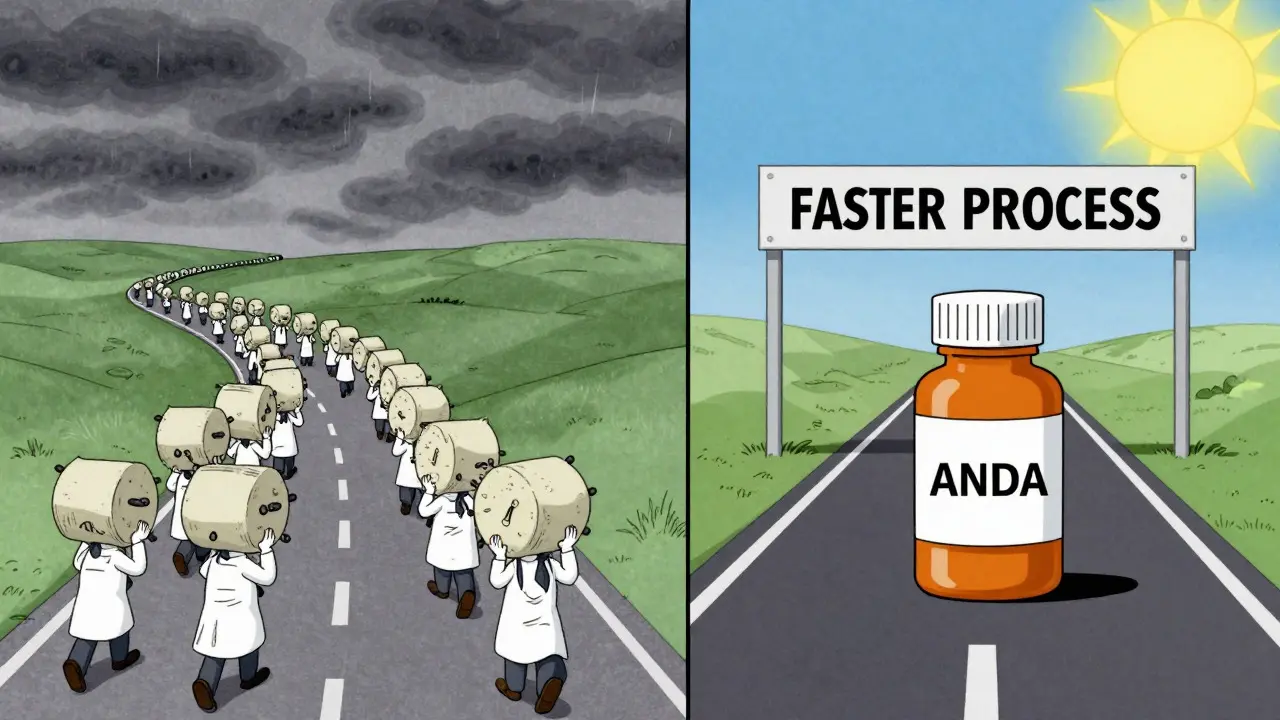
To truly understand what makes an ANDA special, it helps to compare it with a standard New Drug Application (NDA). An NDA is used when a company invents a completely new drug. That process involves years of animal testing and multiple phases of human clinical trials to ensure safety and efficacy. It can take over a decade and cost billions of dollars.
In contrast, an ANDA relies on the fact that the safety and efficacy of the reference drug are already established. Therefore, the "abbreviated" part refers to skipping those massive clinical trials. Here is a quick comparison:
| Feature | ANDA (Generic) | NDA (Brand-Name) |
|---|---|---|
| Purpose | Approve generic equivalents | Approve novel drugs |
| Clinical Trials Required | No (Bioequivalence studies only) | Yes (Phase I, II, III trials) |
| Development Time | 3-4 years | 10-15 years |
| Estimated Cost | $1-5 million | $2.6 billion+ |
| Market Impact | Lowers prices, increases access | Introduces new treatment options |
This distinction explains why generics are so much cheaper. Since the R&D costs are drastically lower, the final price tag reflects that savings.
Why Bioequivalence Matters to You
You might ask: if the pill looks different or tastes different, does it still work? Yes, provided it meets bioequivalence standards. Minor differences in inactive ingredients (like dyes or fillers) or packaging are allowed as long as they don't affect how the drug works. For example, a generic aspirin might have a different coating color than the brand-name version, but the amount of aspirin released in your stomach will be virtually identical.
However, not all drugs fit neatly into this category. Complex generics, such as inhalers or topical creams, can be trickier because measuring absorption is harder. The FDA has developed specific guidelines for these products to ensure they are just as effective as the originals. For most standard pills and liquids, though, the system works well, maintaining a high therapeutic equivalence rate.
The Economic and Health Impact
The impact of the ANDA pathway on the U.S. healthcare system is massive. Generic drugs currently account for approximately 90% of all prescriptions filled in America. Despite this huge volume, they represent only about 23% of total drug spending. This disparity highlights the significant cost savings. According to recent estimates, generic drugs save the U.S. healthcare system hundreds of billions of dollars annually.
For patients, this means better access to essential medications. When a brand-name drug's patent expires, generic manufacturers can file ANDAs to bring their versions to market quickly. This competition drives prices down further. For instance, when multiple companies approve a generic version of a popular cholesterol medication, the price often drops by 80% or more within the first year.
Common Challenges and Limitations
While the ANDA process is efficient, it isn't without hurdles. One major challenge is the patent certification process. Before filing, applicants must check if any patents protect the brand-name drug. If they certify that the patent is invalid or won't be infringed, the brand-name holder might sue. This can lead to a legal stay on approval, delaying the generic's entry into the market.
Another issue is manufacturing quality. The FDA frequently issues "complete response letters" to ANDA applicants, asking for more data. Common reasons include inadequate manufacturing controls or insufficient stability data. Companies that invest in specialized regulatory teams tend to have higher success rates on their first try, highlighting the importance of expertise in navigating this complex landscape.
Frequently Asked Questions
Is a generic drug exactly the same as the brand-name drug?
Not necessarily identical in appearance or inactive ingredients, but therapeutically equivalent. They must contain the same active ingredient, dose, and route of administration, and they must release the drug into the body at the same rate and extent.
How long does it take for an ANDA to be approved?
The FDA aims to review standard ANDAs within 10 months of receiving a complete application. However, the total time from starting development to market launch is typically 3 to 4 years, including formulation and study design.
Can every drug have a generic version?
Most small-molecule drugs can. However, biologics (complex proteins like antibodies) follow a different pathway called BLA (Biologics License Application) rather than ANDA, although biosimilars serve a similar role. Some complex delivery systems may also face challenges in proving bioequivalence.
What happens if a generic fails the bioequivalence test?
The FDA will issue a Complete Response Letter (CRL), telling the applicant what needs to be fixed. The company can then resubmit with additional data. If the drug consistently fails, it may never be approved.
Who benefits the most from the ANDA process?
Patients and payers (insurance companies/government programs) benefit most due to lower costs. Generic manufacturers also benefit by entering markets with lower R&D barriers. The overall healthcare system benefits from reduced spending and increased drug availability.




Comments
Michael Smith
August 17, 2026
finally someone explaining the boring parts of pharma without making it sound like a magic trick. i guess that's why my blood pressure meds cost $4 instead of $120 now. thanks for the info
Rachel Robinson Interiors
August 18, 2026
This is an excellent summary of a process that often goes unnoticed by the general public. It is truly remarkable how much of our healthcare affordability relies on this specific regulatory framework. The explanation regarding bioequivalence is particularly clear and accessible.
Jw George John Warren
August 19, 2026
oh look another generic drug miracle 🙄 you all are so naive thinking these pills actually work the same way. its just cheaper trash with a different label 😂 #bigpharmalies
Jesse Barlau
August 20, 2026
While it is easy to dismiss the process due to occasional manufacturing hiccups, the statistical data presented here is quite compelling, suggesting that the vast majority of generic drugs perform identically to their brand-name counterparts in clinical settings. The Hatch-Waxman Act was indeed a pivotal moment in pharmaceutical history, balancing innovation incentives with consumer access effectively. It is worth noting that the rigorous testing required for bioequivalence is not a mere formality but a scientifically robust method for ensuring therapeutic equivalence across diverse patient populations. Without this streamlined pathway, the cost of essential medications would likely be prohibitive for many households today. The distinction between NDA and ANDA processes highlights the efficiency gained by leveraging existing safety data rather than duplicating expensive trials unnecessarily. This approach has fundamentally reshaped the global pharmaceutical market structure over the last four decades. Understanding these nuances helps patients make informed decisions when their pharmacists substitute prescriptions. The system is not perfect, but it remains the most effective mechanism for controlling drug prices in the United States currently. We should appreciate the complexity involved in maintaining such a large-scale regulatory compliance network. It is a testament to the collaborative effort between regulators, manufacturers, and clinicians. The impact on public health outcomes is substantial and well-documented in peer-reviewed literature. Let us hope for continued improvements in the approval timeline as technology advances. The current ten-month review period is already a significant improvement over previous decades. This stability encourages investment in generic manufacturing facilities worldwide. Ultimately, the goal is affordable access to proven therapies for all citizens. The ANDA process serves this noble purpose remarkably well despite its bureaucratic reputation. It is a cornerstone of modern medical economics that deserves more recognition.
olatunde oluranti
August 20, 2026
sure they say it works the same but have you checked the fillers? probably some kind of chalk or worse. big pharma hates competition so they delay the generics until the patent expires then sue them into oblivion. classic move. 👀
teresa baldini
August 21, 2026
Oh, wonderful! Another post pretending that 'bioequivalence' means 'identical'! As if we don't know that the FDA is just a rubber stamp for Big Pharma's friends! But sure, let's pretend the 80-125% range isn't basically saying 'close enough for government work'! 🤡
Daniel Cook
August 21, 2026
fair point about the range but for most common meds it seems to hold up pretty well in practice
Eunice Chen
August 23, 2026
totally agree with the above. i switched to generics years ago and never had a issue. its all in your head mostly
Usha Ranji
August 24, 2026
Hello everyone. From an Indian perspective, we see similar systems at play, though the regulations differ slightly. It is fascinating to compare how different countries handle generic approvals. In India, the process can sometimes be faster due to different patent laws, which allows for more affordable medicines globally. However, the core principle of proving equivalence remains the same. It is important to remember that while the US system is robust, other regions may have varying standards. This global exchange of knowledge helps improve drug access everywhere. I hope this adds a bit of international context to the discussion. Thank you for sharing such a detailed article.
Marc-Alexandre Rizzo
August 25, 2026
Great breakdown. For those in Canada, the Health Canada process is a bit different but shares the same spirit. We call it a Generic Drug Application (GDA) here. The timelines are comparable, though the patent linkage mechanisms vary. It's interesting to see how North American regulations influence each other. The economic benefits are undeniable for both sides of the border. We also rely heavily on imported generics from India and other countries. This creates a complex supply chain that requires careful monitoring. But ultimately, the goal is the same: keeping medicine affordable. Thanks for the educational read!
Simon-Pierre Bouchard
August 26, 2026
so basically, we trust the FDA to do the math right? because if they mess up the stats, who's checking the checker? 🤔
Write a comment