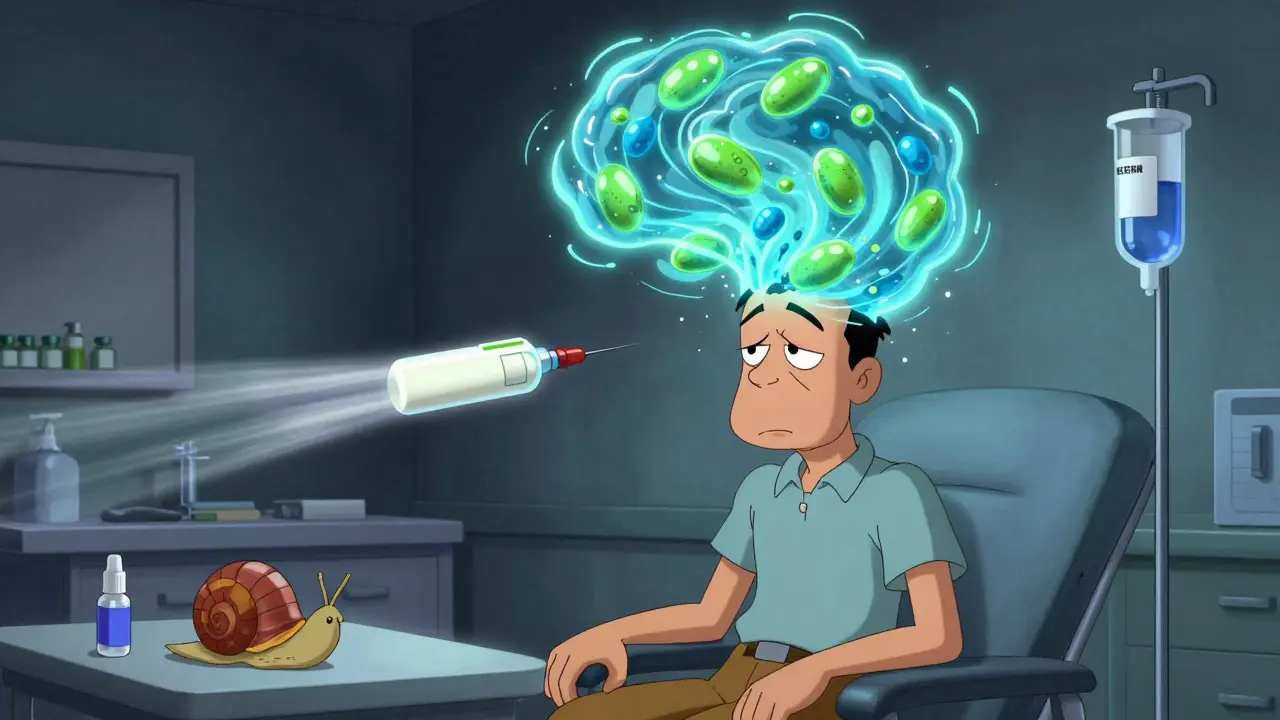
When standard antidepressants fail, people with severe depression often face months-or years-of trial and error. For many, the wait is too long. That’s where ketamine and esketamine come in. Unlike traditional pills that take weeks to work, these drugs can lift depression within hours. They’re not magic, but they’re among the fastest-acting tools we have today for people who’ve run out of options.
How They Work (And Why They’re Different)
Both ketamine and esketamine target the brain’s glutamate system, not serotonin like most antidepressants. Glutamate is a key chemical for brain communication, and when it’s out of balance, it can lock people into deep depressive states. These drugs help reset that system, sparking new connections between brain cells. It’s not just chemistry-it’s like rebooting a frozen computer.
But here’s the catch: they’re not the same drug. Ketamine is a racemic mixture-it contains two mirror-image molecules: (R)-ketamine and (S)-ketamine. Esketamine is just the (S)-version, purified and packaged as Spravato®. That small difference changes everything. The full ketamine mix seems to pack a stronger punch, but it also brings more side effects. Esketamine is milder, but sometimes less effective.
How They’re Given
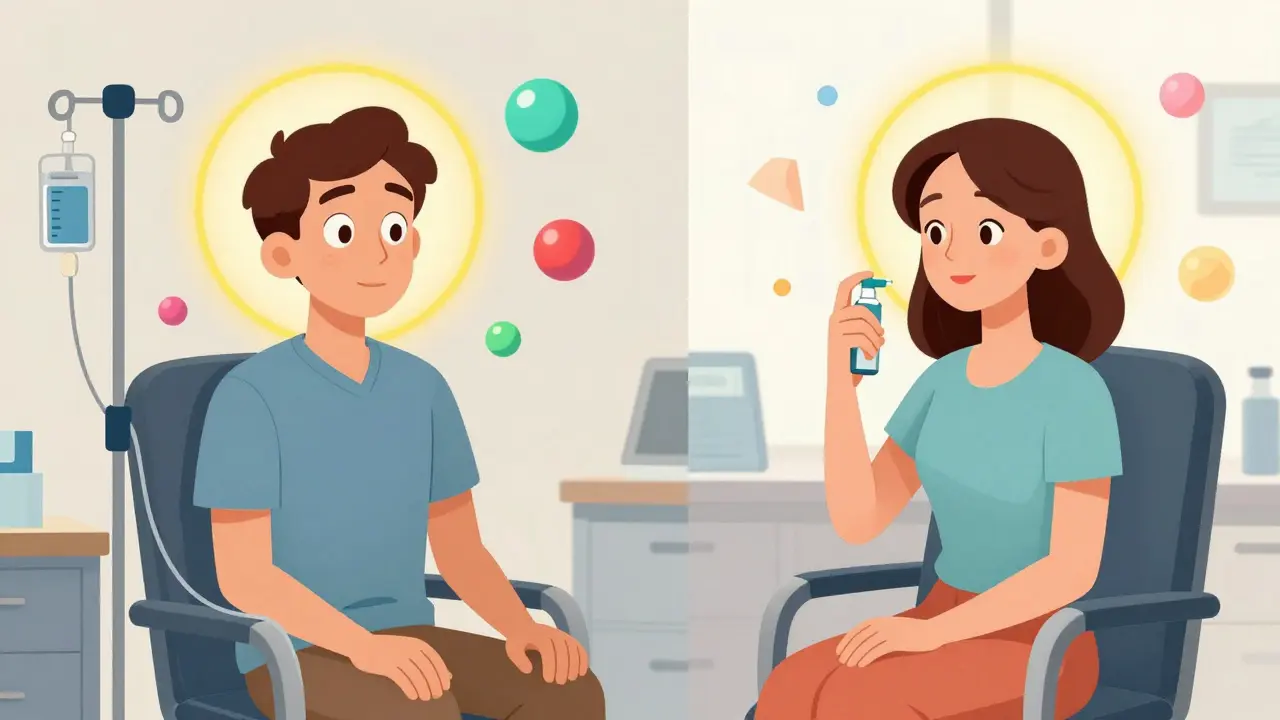
IV ketamine is delivered through an IV drip over about 40 minutes. You’re in a quiet room, monitored by a nurse, and you might feel like you’re floating or seeing colors. It’s intense, but it usually wears off in under an hour. Most patients get six to eight treatments over three weeks, then maintenance doses every few weeks.
Esketamine is a nasal spray. You sit in a doctor’s office, spray one or two doses into each nostril, and wait under supervision for two hours. It’s less invasive, no needles, and you can go home afterward. But you need to do it twice a week during the first month. That’s a lot of trips to the clinic.
Which One Works Better?
A major 2025 study from Mass General Brigham tracked 153 people with treatment-resistant depression. 111 got IV ketamine. 42 got nasal esketamine. The results were clear: ketamine won.
- IV ketamine reduced depression scores by 49.22% after the full course.
- Esketamine dropped scores by 39.55%.
Ketamine also worked faster. Some patients felt better after just one session. Esketamine users needed at least two doses before they noticed any change. A 2020 meta-analysis of over 20 studies backed this up: IV ketamine consistently outperformed nasal esketamine across all time points-from 24 hours to eight weeks.
But numbers don’t tell the whole story. On patient forums, 63% of IV ketamine users said they felt relief within 24 hours. For esketamine, it was 52%. Still, 78% of esketamine users rated their overall experience as good or excellent. Why? Because the side effects were less scary.
Safety and Side Effects
Both drugs can cause dissociation-feeling detached from your body or surroundings. With IV ketamine, it happened in 42.3% of patients. For esketamine? 28.7%. That’s a big difference.
Hallucinations, dizziness, nausea, and elevated blood pressure are common with both. But because esketamine is a single molecule and given in controlled doses, it’s less likely to trigger severe reactions. That’s why the FDA approved it for people with acute suicidal thoughts. It’s safer to monitor in an outpatient setting.
IV ketamine carries a higher risk of abuse. It’s been used recreationally for decades. That’s why clinics require strict screening and follow-up. Esketamine is tightly controlled-only available through certified centers, and you can’t take it home.
Cost and Insurance
This is where things get messy.
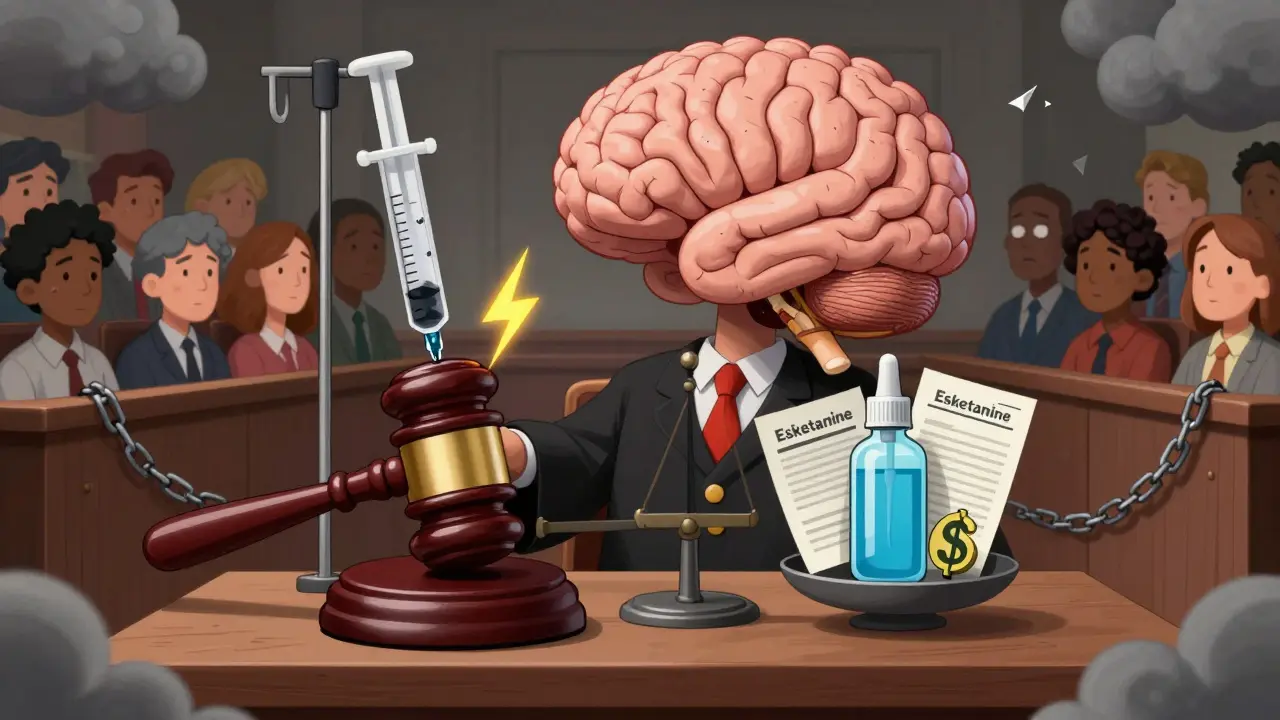
A full course of eight IV ketamine infusions costs between $4,200 and $5,600. Spravato®? Around $5,800 to $6,900. At first glance, esketamine is more expensive. But here’s the twist: 67.4% of commercial insurers cover Spravato®. Only 38.2% cover IV ketamine.
So if you have insurance, esketamine might cost you less out of pocket. Without insurance? IV ketamine is cheaper. A 2025 JAMA Psychiatry analysis found IV ketamine delivers more value per dollar-$14,327 per quality-adjusted life year gained versus $18,764 for esketamine.
Who Gets Which Treatment?
Experts don’t agree on one-size-fits-all. Dr. John Krystal from Yale says: “IV ketamine’s superior efficacy makes it preferable for life-threatening depression.” If someone is actively suicidal and needs a fast response, IV ketamine is often the go-to.
Dr. Christine Denny from Columbia puts it differently: “Esketamine’s safety and convenience make it better for maintenance therapy.” If you’ve already stabilized with IV ketamine, switching to nasal esketamine for ongoing care is common.
For many, it comes down to personal tolerance. If you can handle a strong dissociative experience, IV ketamine might be worth it. If you’re anxious about needles, or you’ve had bad reactions before, esketamine is a gentler path.
Access Is Still a Big Problem
Even though ketamine clinics have exploded-from 142 in 2020 to over 1,000 in 2025-most of them are in big cities. Only 12.4% of U.S. counties have a certified Spravato® center. Rural areas? Almost none. And even if you live near one, wait times can be months.
Insurance hurdles make it worse. If your plan doesn’t cover ketamine infusions, you’re paying thousands out of pocket. Some clinics offer payment plans, but not all. And Medicare? It doesn’t cover IV ketamine for depression at all.
What About Long-Term Results?
Neither drug is a cure. Both require maintenance. A 2024 study followed patients for six months. Of those who responded to IV ketamine, 56.3% stayed in remission with monthly or biweekly sessions. For esketamine? 48.7%.
That’s not bad. But it means most people need ongoing treatment. There’s no evidence yet that either drug permanently rewires the brain. They’re tools-not fixes.
The Future Is Coming
The FDA just accepted Janssen’s application for a higher-dose Spravato® (112 mg), which could improve effectiveness. Researchers are also testing intramuscular ketamine-injections into the muscle-as a middle ground between IV and nasal. Early results suggest it’s as effective as IV, with fewer side effects.
And there’s exciting brain research. Scientists found that people who respond to ketamine show increased gamma wave activity in certain brain regions after treatment. That might one day let doctors predict who will benefit-before they even start.
Final Thoughts
Ketamine and esketamine aren’t for everyone. They’re not first-line treatments. You need to have tried at least two antidepressants without success. But if you’re stuck in deep depression and time is running out, they offer something no pill does: speed.
IV ketamine works faster and stronger. Esketamine is easier to tolerate and easier to access-if your insurance covers it. Neither is perfect. But for the right person, either one could mean the difference between surviving and starting to live again.
Comments
Katherine Farmer
February 26, 2026
Let's be real-this whole ketamine trend is just pharmaceutical capitalism repackaging a party drug as a miracle cure. The data is cherry-picked, the long-term effects are unknown, and yet we're treating this like it's penicillin. People are paying thousands for a high that lasts 45 minutes and calling it therapy. Where's the ethics review? Where's the regulation? This isn't medicine-it's a luxury service for the emotionally desperate with credit cards.
And don't get me started on the insurance bias. Esketamine gets coverage because Janssen paid off the right people. IV ketamine? Too raw. Too unpatentable. Too real. They want you hooked on a branded nasal spray, not a generic compound you can get from a clinic in Tijuana.
Also, 'rebooting a frozen computer'? That's not science. That's a TED Talk metaphor. Glutamate isn't a Windows update. You're not fixing a glitch-you're chemically seducing your brain into temporary compliance.
Full Scale Webmaster
February 27, 2026
Okay but let’s unpack this because I’ve been through all of it and I’m here to tell you the truth no one else will: IV ketamine didn’t just lift my depression-it obliterated the part of my mind that had been whispering suicide for 11 years. First session? I cried for 20 minutes while floating above my own body. Second session? I laughed for the first time since 2018. Third? I called my mom and didn’t hang up crying.
Esketamine? I tried it. Sat there for two hours in a sterile room with a nurse who checked my BP every 15 minutes like I was a nuclear reactor. Felt like a zombie in a waiting room. No dissociation. No breakthrough. Just… numb. And I paid $800 out of pocket for that.
Yes, the side effects are wild. Yes, it’s not FDA-approved for home use. But if you’re on your deathbed emotionally, who cares if you see a kaleidoscope? I’d rather see colors than ghosts. And if you’re saying ‘but what about addiction?’-I’ve been sober 5 years. I don’t do drugs. I do survival.
Also-rural access? My town has zero clinics. I drove 200 miles every other week. No one helped. No one cared. This isn’t a debate. It’s a lifeline. Stop talking. Start funding.
Ajay Krishna
February 28, 2026
I appreciate how thorough this breakdown is, especially the comparison between IV ketamine and esketamine. As someone who’s worked in mental health outreach in rural India, I can tell you that access is the real crisis-not efficacy. Even if IV ketamine works better, if you can’t get to a clinic, it doesn’t matter.
What’s fascinating is how the science mirrors real-world needs: the more invasive the treatment, the more it requires infrastructure. That’s why intramuscular ketamine could be a game-changer. Simple injection, minimal monitoring, portable. Could be delivered by community health workers with proper training.
Also, the gamma wave research? That’s the future. Imagine a simple EEG headband that tells you if you’re likely to respond before you even take the first dose. That’s precision medicine. And honestly? It’s more humane than forcing people to choose between bankruptcy and despair.
Sumit Mohan Saxena
February 28, 2026
It is imperative to emphasize that the clinical data presented in this article, while compelling, must be contextualized within the broader framework of evidence-based psychiatric practice. The 2025 Mass General Brigham study, while methodologically sound, exhibits a sample size imbalance between the IV ketamine cohort (n=111) and the esketamine cohort (n=42), which may introduce selection bias.
Furthermore, the assertion that IV ketamine demonstrates superior efficacy is contingent upon the use of the HAM-D scale, which has known limitations in capturing dissociative and somatic symptomatology. The FDA's approval of esketamine for acute suicidal ideation is grounded not in comparative efficacy, but in risk mitigation protocols and outpatient feasibility.
Additionally, the cost-effectiveness analysis referenced (QALY) is derived from U.S. healthcare pricing models and is not generalizable to international contexts. For example, in India, where ketamine is available as a generic injectable at $15 per dose, the economic calculus shifts dramatically.
It is therefore premature to recommend one modality as universally superior without considering regional pharmacoeconomic realities, regulatory frameworks, and cultural attitudes toward dissociative experiences in therapeutic settings.
bill cook
March 1, 2026
Y’all are acting like this is some miracle cure. Have you ever heard of bladder damage from ketamine? Or cognitive fog that lasts months? I did 12 sessions. Lost 3 months of memory. My wife said I forgot how to be a dad. Now I’m on SSRIs again. The system sold me a dream and took my brain.
And don’t even get me started on the clinics. They’re all owned by some dude who used to sell ecstasy at raves. They’re not doctors. They’re influencers with IVs. They tell you to ‘trust the process’ while you’re screaming in a dark room.
This isn’t treatment. It’s a cult with a billing code.
Byron Duvall
March 3, 2026
Big Pharma doesn’t want you to know this, but ketamine is a military experiment gone rogue. The government used it in Vietnam to suppress trauma. Now they’re selling it back to veterans and depressed millennials as a ‘new antidepressant.’
Ever wonder why esketamine is nasal? Because it’s easier to track. You have to go to a center. You have to sign forms. You have to be monitored. That’s not safety-that’s control. They want you dependent. They want you coming back every week.
And the ‘gamma wave’ research? That’s just EEG data they’re using to sell more machines. The real breakthrough isn’t in the brain-it’s in the bank account of the company that owns the patent.
They’re not healing you. They’re monetizing your pain.
Lisa Fremder
March 5, 2026
Why are we letting foreigners decide what treatment Americans need? IV ketamine works better. End of story. Esketamine is a foreign drug with a fancy name and a price tag. We should ban it. We should fund real American clinics with real American doctors giving real American ketamine. This isn’t healthcare. It’s corporate globalization wrapped in a white coat.
And don’t tell me about ‘access’-if you can’t drive to a clinic, maybe you shouldn’t be allowed to live here. Get a job. Get insurance. Stop whining.
Also-why are we letting people spray drugs up their nose? That’s not medicine. That’s a TikTok trend. We need rules. We need borders. We need America back.
Justin Ransburg
March 5, 2026
Thank you for presenting this information with such clarity and depth. As a clinician who has witnessed the transformative potential of these treatments, I wish to underscore a critical point often lost in the noise: while efficacy and cost are vital metrics, the human dimension remains paramount.
One patient, a 68-year-old veteran, described his first IV ketamine session as ‘the first time in 40 years I didn’t feel like a ghost.’ He has since returned to gardening, reconnected with his grandchildren, and stopped hoarding pills. No statistic captures that.
Similarly, a young woman with treatment-resistant depression, after three esketamine sessions, wrote in her journal: ‘I cried today. Not because I was sad-but because I felt something.’ That is not a placebo. That is reawakening.
Our goal should not be to pit one treatment against another, but to expand access, reduce stigma, and honor the dignity of those for whom time is the most precious and scarce resource.
Let us not mistake complexity for contradiction. The path forward lies not in ideology, but in compassion, evidence, and unwavering commitment to the individual.
Write a comment