Dopamine Conflict Simulator
Adjust the sliders below to simulate how different medication dosages affect the brain's dopamine balance. Moving away from the center represents increasing dosage of either medication. Observe how treating one condition can inadvertently worsen the other.
Motor Function (Movement)
Psychiatric Status (Perception)
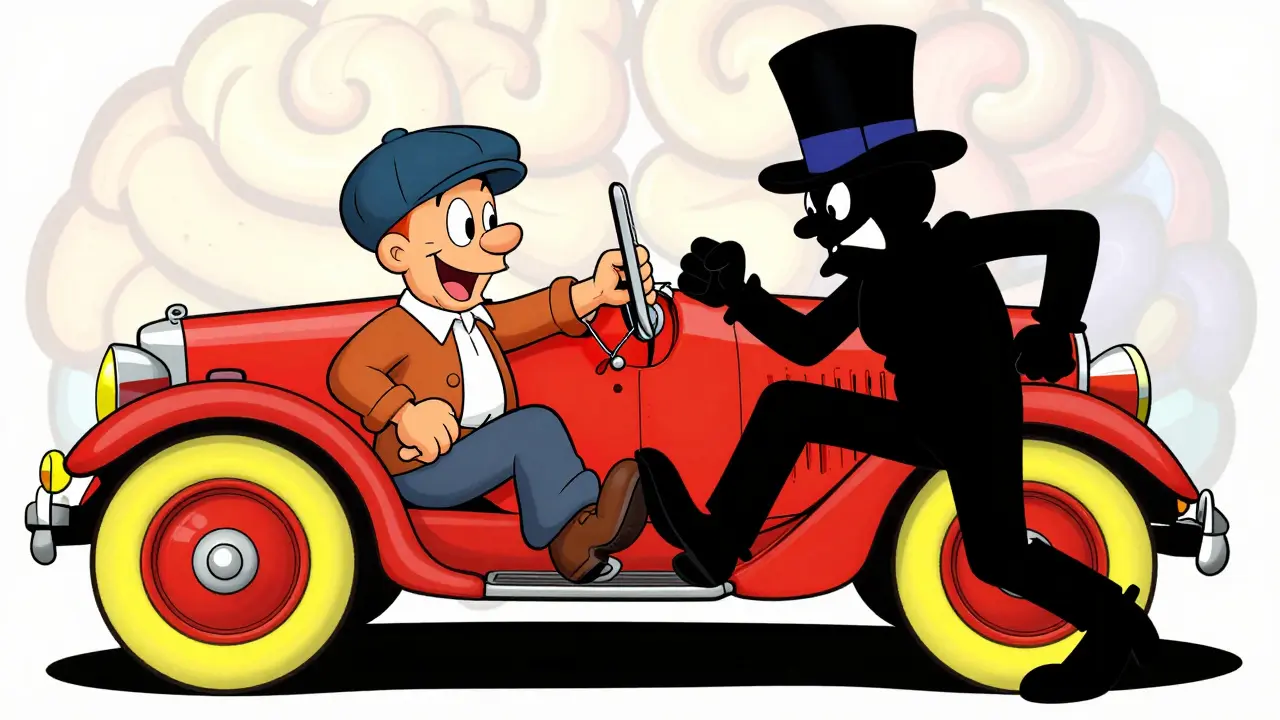
Imagine trying to start a car while someone else is simultaneously pulling the brake. That is essentially what happens in the brain when Levodopa, a medication used to treat Parkinson’s disease, meets antipsychotic drugs. These two classes of medications work on the same chemical messenger-dopamine-but they do so in completely opposite directions. One tries to boost dopamine levels to help you move; the other blocks dopamine receptors to calm hallucinations or delusions. When these opposing forces collide, the result is often not a balance, but a worsening of symptoms for both conditions.
This conflict creates one of the most difficult puzzles in modern neurology and psychiatry. Patients with Parkinson’s disease frequently develop psychosis as the disease progresses or as a side effect of their treatment. Meanwhile, patients with schizophrenia sometimes develop movement disorders that look like Parkinson’s. Treating one condition often aggravates the other, leaving clinicians and patients walking a tightrope. Understanding this mechanism is crucial for anyone managing these complex health issues.
The Dopamine Dilemma: How Levodopa Works
To understand the conflict, we first need to look at how Levodopa (L-3,4-dihydroxyphenylalanine) functions in the body. First synthesized by Marcus Guggenheim in 1913 and introduced clinically in 1967, levodopa is a precursor to dopamine. It crosses the blood-brain barrier and is converted into dopamine by an enzyme called aromatic-L-amino-acid decarboxylase (AADC). In a healthy brain, dopamine neurons regulate the release and storage of this neurotransmitter carefully. However, in Parkinson’s disease, these neurons die off. As a result, the brain loses its ability to buffer dopamine levels.
When a patient takes levodopa, it doesn't just replace missing dopamine; it causes sharp spikes in synaptic dopamine levels. Research by de la Fuente-Fernández et al. published in *Brain* (2004) showed that identical doses of levodopa induce increasingly larger changes in dopamine as the disease progresses. This leads to "peak-dose dyskinesias," where involuntary movements occur because the dopamine surge is too strong for the remaining neural pathways to handle. The half-life of levodopa is short, only 1 to 3 hours, which means patients experience pulsatile stimulation rather than a steady flow. This erratic pattern makes the brain exquisitely sensitive to any interference from other drugs.
How Antipsychotics Block the Signal
On the other side of the equation are Antipsychotics, also known as neuroleptics. These drugs, starting with chlorpromazine in the 1950s, primarily work by blocking dopamine D2 receptors. The theory behind treating schizophrenia is that excess dopamine activity in certain brain pathways causes positive symptoms like hallucinations. By occupying these receptors, antipsychotics prevent dopamine from binding and signaling. For a therapeutic effect, typical antipsychotics need to block 60-80% of these receptors.
However, blocking these receptors has unintended consequences. According to a 2021 review in PubMed, antipsychotics can increase dopamine release and turnover by blocking autoinhibitory D2 receptors. This triggers the brain to upregulate, or create more, post-synaptic D2 receptors in an attempt to compensate. If the medication is stopped abruptly, this upregulation can lead to severe withdrawal effects or even Neuroleptic Malignant Syndrome (NMS), a life-threatening condition characterized by high fever, rigidity, and altered mental status. This compensatory mechanism sets the stage for a direct clash when levodopa is present.

The Clinical Clash: Worsening Symptoms
When these two drug classes meet, the clinical results can be dramatic. In patients with Parkinson’s disease who develop psychosis-a complication affecting 30-40% of cases according to a 2019 *Movement Disorders* study-adding a standard antipsychotic often backfires. A study by Fernandez et al. (*Neurology*, 2015) found that administering antipsychotics to Parkinson’s patients worsened motor symptoms by 25-35% on the Unified Parkinson’s Disease Rating Scale (UPDRS). Essentially, the antipsychotic blocks the very dopamine signal that levodopa is struggling to provide, causing tremors, stiffness, and slowness to return or intensify.
Conversely, giving levodopa to a patient with schizophrenia can trigger a psychotic break. A double-blind trial by Kane et al. (*American Journal of Psychiatry*, 1988) demonstrated that levodopa could exacerbate positive symptoms by 20-40% on the Positive and Negative Syndrome Scale (PANSS). Dr. Jeffrey Lieberman noted that administering levodopa to schizophrenia patients serves as a pharmacological model of psychosis, with 60% of patients experiencing symptom exacerbation at doses as low as 300 mg/day. This bidirectional worsening highlights why simply adding a drug to treat a side effect is rarely a simple solution.
| Feature | Levodopa | Typical Antipsychotics |
|---|---|---|
| Primary Target | Dopamine Precursor | D2 Receptor Antagonist |
| Effect on Dopamine | Increases availability/spikes | Blocks receptor binding |
| Main Use | Parkinson’s Motor Symptoms | Schizophrenia/Psychosis |
| Risk when Combined | Worsens psychosis | Worsens parkinsonism/motor function |
| Half-Life | 1-3 hours | Varies (e.g., Haloperidol ~14-36 hrs) |
Navigating Parkinson’s Psychosis
Managing psychosis in Parkinson’s patients requires extreme caution. The therapeutic window is incredibly narrow. Quetiapine is often used off-label because it has a lower affinity for D2 receptors, but even then, doses must be kept low (12.5-75 mg/day) to avoid worsening motor function. Case reports from the Cleveland Clinic describe patients whose mobility scores dropped significantly within 72 hours of starting risperidone, a common second-generation antipsychotic.
A major breakthrough came with the approval of Pimavanserin (Nuplazid) in 2016. Unlike traditional antipsychotics, pimavanserin does not block dopamine receptors. Instead, it acts as an inverse agonist at serotonin 5-HT2A receptors. This mechanism allows it to treat psychosis without interfering with the dopamine needed for movement. While it represents a significant advance, it is expensive and not effective for everyone. The market for Parkinson’s psychosis treatments is projected to reach $2.3 billion by 2027, reflecting the urgent need for safer options.

New Horizons: Beyond Dopamine
Recognizing the limitations of manipulating dopamine, researchers are looking elsewhere. The FDA’s 2022 guidance emphasizes "dopamine-sparing" approaches. One promising development is KarXT (xanomeline-trospium), a muscarinic agonist-antagonist combination. A phase 3 trial published in the *New England Journal of Medicine* in May 2023 showed a 25% reduction in psychosis symptoms in Parkinson’s patients without worsening motor function. This suggests that targeting cholinergic pathways might bypass the dopamine conflict entirely.
Another avenue is alpha-synuclein-targeted therapies. Since Parkinson’s is driven by the accumulation of alpha-synuclein protein clumps, drugs that address this underlying pathology could potentially reduce psychosis without needing to adjust dopamine levels. The Michael J. Fox Foundation supports research into biomarkers like dopamine transporter (DAT) SPECT imaging, which may help predict which patients will suffer severe motor worsening if given antipsychotics. This precision medicine approach aims to personalize treatment, reducing the trial-and-error nature of current care.
Practical Steps for Patients and Caregivers
If you or a loved one is dealing with these overlapping conditions, communication is key. Never stop or change medication doses without consulting your doctor. Abrupt withdrawal of levodopa can trigger NMS, a medical emergency with a mortality rate of 10-20%. Similarly, stopping antipsychotics suddenly can cause rebound psychosis.
Keep a detailed log of symptoms. Note when motor symptoms worsen and when psychotic symptoms appear. This data helps doctors distinguish between disease progression and drug side effects. Be aware that non-medical factors like infections, dehydration, or poor sleep can also trigger psychosis in Parkinson’s patients. Addressing these basic health needs can sometimes resolve symptoms without adding risky medications.
Finally, seek out specialists. General neurologists may not feel fully equipped to manage Parkinson’s psychosis. Fellowship-trained movement disorder specialists have deeper expertise in balancing these competing needs. They can access newer therapies like pimavanserin or clinical trials for emerging drugs, offering hope where traditional methods fall short.
Can I take levodopa and quetiapine together?
Yes, but with caution. Quetiapine is often prescribed for Parkinson’s psychosis because it has a lower risk of worsening motor symptoms compared to other antipsychotics. However, it can still cause some deterioration in mobility. Your doctor will likely start with a very low dose (e.g., 12.5 mg) and monitor you closely for any changes in tremor, stiffness, or balance. Never adjust the dose yourself.
What is Neuroleptic Malignant Syndrome (NMS)?
NMS is a rare but life-threatening reaction to antipsychotic drugs, especially in people taking levodopa. Symptoms include high fever, muscle rigidity, confusion, and rapid heart rate. It is a medical emergency requiring immediate hospitalization. The risk increases if levodopa is withdrawn abruptly while on an antipsychotic. Treatment involves stopping the offending drug and supportive care, sometimes including dopamine agonists.
Why does levodopa cause psychosis in some people?
As Parkinson’s disease progresses, the brain loses its ability to regulate dopamine. Levodopa causes sharp spikes in dopamine levels, which can overstimulate receptors in areas of the brain involved in perception and mood. This excessive stimulation can lead to hallucinations, delusions, or paranoia. The risk is higher in advanced stages of the disease when fewer dopamine neurons remain to buffer these fluctuations.
Is Pimavanserin safe for all Parkinson’s patients?
Pimavanserin is generally safer for motor function than traditional antipsychotics because it does not block dopamine receptors. However, it is not suitable for everyone. It can interact with other medications metabolized by the CYP3A4 enzyme and may take several weeks to show full effect. It is also expensive and not covered by all insurance plans. Always discuss potential interactions with your pharmacist or doctor.
How long should I wait before switching antipsychotics?
There is no one-size-fits-all answer, but guidelines often suggest a careful transition period. The American Academy of Neurology recommends considering a washout period when transitioning between certain medication classes to prevent complications like NMS, though this must be balanced against the risk of untreated psychosis. Any switch should be done under strict medical supervision, with daily monitoring of motor and psychiatric symptoms during the first two weeks.