Opioid-Induced Androgen Deficiency (OPIAD) Symptom Checker
OPIAD Symptom Assessment Tool
Select the symptoms you are currently experiencing to assess potential risk.
Sexual Health Issues
Low libido, erectile dysfunction, or reduced sexual desire.
Body Composition Changes
Decreased muscle mass despite exercise, increased belly fat.
Mental & Emotional Shifts
Persistent fatigue, irritability, depression, or poor concentration.
Bone Health Concerns
Unexplained joint pain, history of fractures, or diagnosed osteoporosis.
Signs of Anemia
Shortness of breath, pale skin, or diagnosed low hemoglobin levels.
Assessment Result
Recommended Next Steps:
Disclaimer: This tool provides educational information based on general medical data. It is not a substitute for professional medical advice, diagnosis, or treatment. Always seek the advice of your physician regarding any medical condition.
You might be taking opioids for chronic pain or addiction treatment, but you’re feeling drained, losing muscle, or struggling with intimacy. It’s easy to blame the stress of living with pain or the stigma of addiction. But there is a biological culprit that many doctors overlook: opioid-induced androgen deficiency (OPIAD). This condition silently suppresses your body’s ability to produce testosterone, leading to a cascade of physical and mental health issues that go far beyond just “feeling tired.”
OPIAD is not a rare side effect; it is a widespread endocrine disorder affecting up to 90% of long-term opioid users. Understanding how opioids hijack your hormonal system is the first step toward reclaiming your energy, strength, and quality of life. Let’s break down what happens in your body, how to spot the signs, and what real-world treatment options exist.
How Opioids Shut Down Testosterone Production
To understand why this happens, we need to look at the command center of your hormones: the hypothalamic-pituitary-gonadal (HPG) axis. Think of this as a three-step relay race. First, your hypothalamus releases gonadotropin-releasing hormone (GnRH). Second, this signals your pituitary gland to release luteinizing hormone (LH). Finally, LH tells your testes to produce testosterone.
Opioids disrupt this chain at the very beginning. When opioids bind to mu-opioid receptors in the hypothalamus, they reduce the pulsatility of GnRH secretion. Without those regular pulses, the signal never reaches the pituitary, LH production drops, and testosterone synthesis grinds to a halt. A meta-analysis published in the Journal of the Endocrine Society in 2021 compared 800 patients on opioids to nearly 2,000 controls. The result was stark: opioid users had approximately half the testosterone levels of the control group.
The type of opioid matters too. Long-acting medications like methadone cause more profound suppression than shorter-acting ones because they provide continuous exposure, cumulatively dampening GnRH pulsatility. In fact, studies show that men on methadone maintenance therapy often have average total testosterone levels around 245 ng/dL, well below the normal range of 300-1000 ng/dL for adult males. Those on buprenorphine fare slightly better, averaging around 387 ng/dL, but still face significant risk if untreated.
Recognizing the Symptoms of OPIAD
The symptoms of low testosterone develop insidiously, usually over 3 to 6 months of continuous therapy. Because these changes happen slowly, patients and providers often attribute them to aging, depression, or the underlying pain condition itself. However, the pattern is distinct.
| Symptom Category | Specific Manifestation | Prevalence/Impact |
|---|---|---|
| Sexual Health | Low libido, erectile dysfunction | Affects 60-85% of affected males |
| Physical Composition | Decreased muscle mass, increased visceral fat | Lean mass loss, fat gain despite diet/exercise |
| Bone Health | Osteoporosis, reduced bone density | 15-20% reduction in lumbar spine density |
| Mental & Emotional | Fatigue, irritability, depression, poor concentration | Fatigue scores 2.5x higher than normal |
| Hematologic | Anemia | Hemoglobin averages 12.3 g/dL vs. normal 14-18 g/dL |
If you are experiencing unexplained fatigue that doesn’t improve with sleep, or if you notice your clothes fitting differently due to muscle loss and belly fat accumulation, these could be red flags. For women, while testosterone plays a smaller role than in men, OPIAD can still lead to decreased libido, mood disturbances, and bone density loss. In such cases, dehydroepiandrosterone (DHEA) supplementation may be considered, though evidence is less robust than for male testosterone replacement.
Diagnosis: Getting the Right Tests
Screening for OPIAD should be standard practice for anyone on long-term opioid therapy. However, diagnosis requires precision. You cannot rely on a single blood test taken at random times.
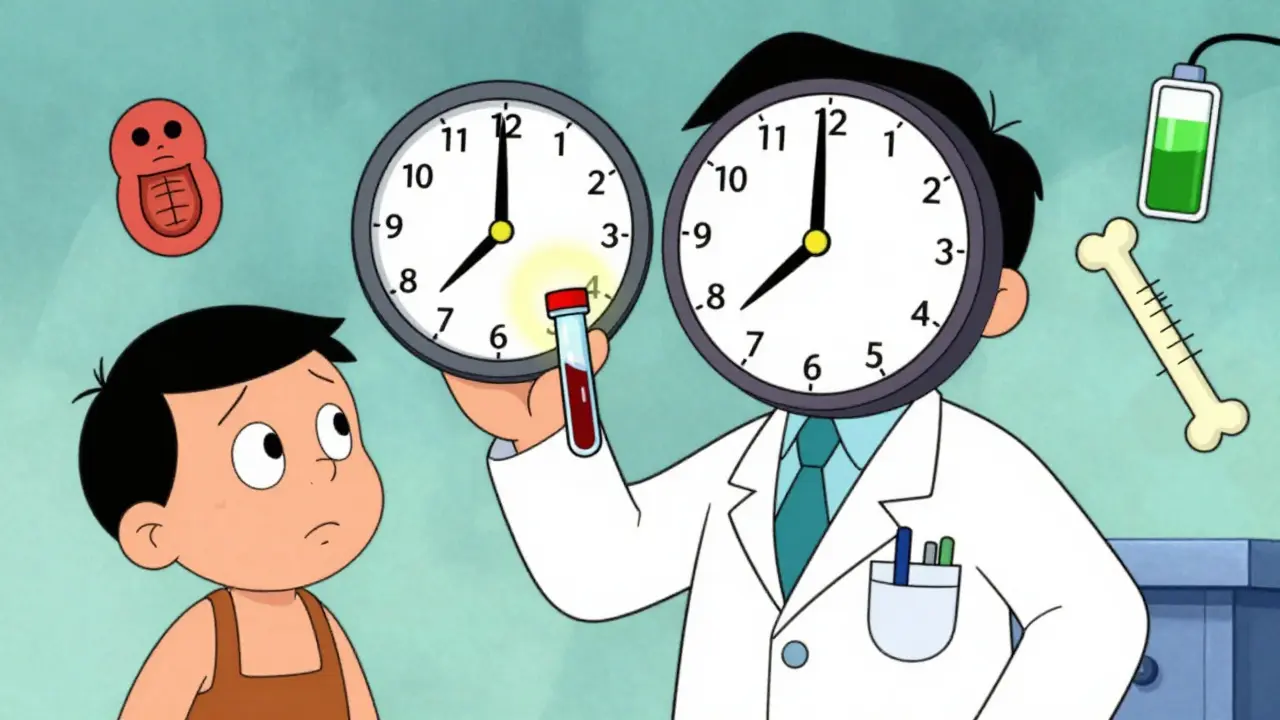
Testosterone levels fluctuate throughout the day, peaking in the morning. Therefore, serum testosterone must be measured between 7 AM and 10 AM. The Endocrine Society recommends obtaining two separate low measurements before confirming a diagnosis of hypogonadism. Both total and free testosterone should be checked, as binding proteins can sometimes mask true availability of the hormone.
Clinicians also use validated tools like the Androgen Deficiency in Aging Males (ADAM) questionnaire. If you answer “yes” to three or more questions regarding sexual function, energy, and mood, laboratory testing is warranted. Early detection is critical because untreated OPIAD leads to irreversible bone loss and increased cardiovascular risk over time.
Treatment Options: Replacing What’s Lost
Once diagnosed, the primary treatment is Testosterone Replacement Therapy (TRT). The goal is to restore levels to the mid-normal range (350-750 ng/dL), which has been shown to significantly improve quality of life. According to randomized controlled trials cited in the Journal of the Endocrine Society, TRT in opioid users improves sexual function, reduces pain sensitivity by up to 30%, and enhances body composition by increasing lean mass and decreasing fat mass.
There are several delivery methods for TRT, each with pros and cons:
- Intramuscular Injections: Typically 100-200 mg of testosterone cypionate or enanthate every 1-2 weeks. This method provides stable levels but requires clinic visits or self-injection skills.
- Transdermal Gels: Applied daily (50-100 mg), providing 4-6 mg of absorption. Convenient but carries a risk of transfer to partners or children through skin contact.
- Patches: Deliver 5-7.5 mg daily. Less common due to potential skin irritation.
- Buccal Tablets: Placed against the gum twice daily (30 mg). Avoids liver metabolism but can cause gum irritation.
Monitoring is non-negotiable. Serum testosterone levels should be rechecked 3-6 months after starting therapy and annually thereafter. Hematocrit levels must also be monitored, as TRT can cause polycythemia (thickened blood) in 15-20% of users, increasing clotting risk.
Risks and Controversies: Is TRT Safe?
While TRT offers significant benefits, it is not without risks. The FDA has issued black box warnings regarding potential cardiovascular risks, including stroke and heart attack. Data from the FDA adverse event reporting system suggests a relative risk increase of 1.3-1.8x for stroke and 1.4-2.0x for venous thromboembolism in some users. Additionally, TRT can lower HDL (“good”) cholesterol by 10-15 mg/dL and cause acne in about 25% of transdermal users.
Crucially, TRT is contraindicated in men with active prostate cancer or high-risk breast cancer. Before starting, all men over 50 or those with risk factors must undergo prostate-specific antigen (PSA) testing. PSA levels should be monitored every 6 months during treatment. Despite these risks, a landmark study in JAMA Network Open (2019) found that testosterone recipients among long-term opioid users had significantly lower all-cause mortality (hazard ratio 0.51) and fewer major adverse cardiac events compared to non-recipients. This suggests that when managed correctly, the benefits may outweigh the risks for many patients.
Natural Approaches and Lifestyle Changes
Not everyone wants or needs pharmaceutical intervention immediately. The VA Whole Health Library emphasizes exploring non-pharmacological approaches first, noting that external testosterone inhibits natural production. While lifestyle changes alone may not fully reverse severe OPIAD, they can support overall hormonal health and amplify the effects of medical treatment.
- Weight Management: Maintaining a BMI under 25 is associated with 20-30% higher testosterone levels. Visceral fat converts testosterone into estrogen, worsening the deficiency.
- Resistance Exercise: Strength training three times a week can boost testosterone by 15-25%. Focus on compound movements like squats and deadlifts.
- Sleep Optimization: Aim for 7-9 hours per night. Poor sleep correlates with a 20% drop in testosterone levels.
- Avoid Toxins: Smoking lowers testosterone by 15-20%, and excessive alcohol (more than 14 drinks/week) reduces it by 25%.
- Blood Sugar Control: Diabetes is linked to 25-35% lower testosterone. Managing insulin resistance through diet helps preserve hormonal balance.
Next Steps for Patients and Providers
If you suspect OPIAD, start by discussing screening with your healthcare provider. Request morning testosterone tests and share any symptoms related to energy, mood, or sexual function. If you are already on TRT, ensure you are getting regular follow-ups for hematocrit and PSA levels.
For providers, integrating OPIAD screening into routine care for long-term opioid patients is essential. Untreated hypogonadism reduces quality of life and complicates pain management. By addressing this hidden side effect, clinicians can help patients regain vitality and adhere better to their overall treatment plans.
How long does it take for testosterone levels to recover after stopping opioids?
Recovery varies widely depending on the duration of opioid use and individual physiology. In some cases, HPG axis function begins to normalize within weeks of cessation, but full recovery can take 6 to 12 months or longer. Chronic users may require temporary TRT to jumpstart natural production.
Can I take testosterone supplements over the counter?
Over-the-counter "testosterone boosters" typically contain herbs like fenugreek or D-aspartic acid. Evidence for their efficacy in treating clinical OPIAD is weak. They do not replace prescribed TRT and should not be used as a substitute for medical evaluation and treatment.
Does buprenorphine cause less testosterone suppression than methadone?
Yes. Studies indicate that buprenorphine, a partial opioid agonist, causes less profound suppression of the HPG axis compared to full agonists like methadone. Average testosterone levels are higher in buprenorphine users, though monitoring is still necessary as many remain below normal ranges.
What are the risks of combining TRT with opioid therapy?
The main risks include polycythemia (thickened blood), elevated PSA levels, and potential cardiovascular strain. Close monitoring of hematocrit, lipid profiles, and prostate health is required. There is no direct dangerous drug interaction between testosterone and most opioids, but both can affect sedation levels indirectly via improved energy and mood.
Is OPIAD reversible without medication?
In mild cases, lifestyle changes such as weight loss, exercise, and sleep optimization can improve testosterone levels. However, in cases of significant suppression caused by long-term opioid use, natural methods alone are rarely sufficient to restore levels to a healthy range, making TRT a necessary intervention for many.