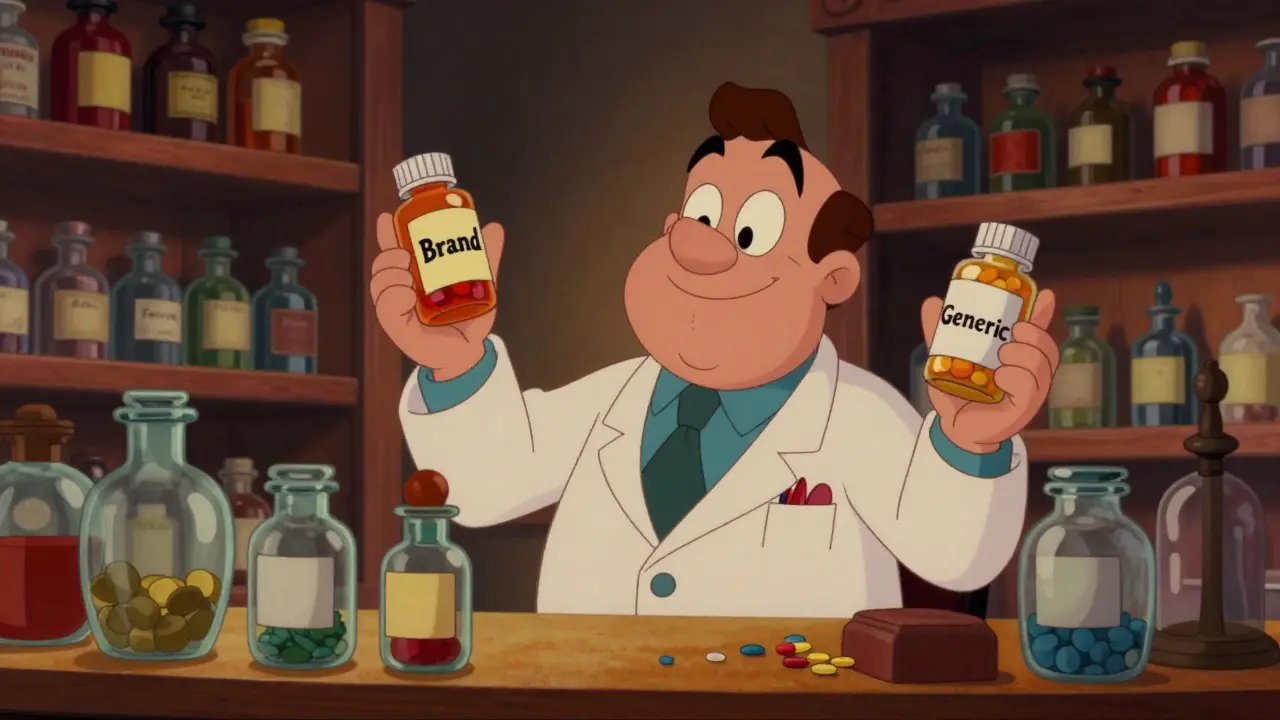
Have you ever walked into a pharmacy, handed over a prescription for a brand-name drug, and walked out with a different pill in a different box? That swap isn't random. It’s the result of a rigorous scientific evaluation system managed by the U.S. Food and Drug Administration (FDA). At the heart of this process are therapeutic equivalence codes. These alphanumeric labels tell pharmacists and doctors exactly which generic drugs are safe to substitute for their brand-name counterparts without changing clinical outcomes.
If you’ve ever wondered why your pharmacist didn’t just give you the exact drug prescribed, or why some generics cost significantly less than others despite having the same active ingredient, the answer lies in these codes. They are the backbone of the American healthcare system’s ability to save billions while maintaining patient safety. Understanding them helps demystify the generic drug market and empowers patients and providers to make informed decisions about medication management.
The Foundation: The Orange Book and Hatch-Waxman
To understand therapeutic equivalence, you first need to know where these ratings live. The primary resource is the Orange Book, officially titled "Approved Drug Products with Therapeutic Equivalence Evaluations". First published in 1980, it became legally significant following the Drug Price Competition and Patent Term Restoration Act of 1984, commonly known as the Hatch-Waxman Amendments. This legislation created a pathway for generic manufacturers to prove their products were equivalent to brand-name drugs without repeating costly clinical trials from scratch.
The Orange Book serves as the definitive reference for approved drug products. It lists every generic drug that has received FDA approval. For each product, it assigns a therapeutic equivalence code. This code is not just an administrative label; it is a scientific determination based on three pillars: pharmaceutical equivalence, bioequivalence, and consistent safety and efficacy profiles. According to the FDA's 2022 draft guidance, these codes provide healthcare providers with the assurance that a substituted product will produce the same clinical effect as the prescribed one when used under specified conditions.
Decoding the Alphabet: What A and B Mean
The TE code system uses a multi-letter classification. The first letter is the most critical part of the code, indicating whether the drug is considered therapeutically equivalent to other pharmaceutically equivalent products. You will primarily encounter two categories: 'A' rated and 'B' rated drugs.
'A' Rated Drugs: If a drug starts with the letter 'A', it means the FDA considers it therapeutically equivalent to the reference listed drug (the original brand-name product). The most common code you’ll see is AB. An AB rating indicates that the generic meets all necessary bioequivalence requirements. Sometimes you’ll see suffixes like AB1, AB2, AB3, or AB4. These numbers appear when multiple reference listed drugs exist for the same strength under the same heading, helping distinguish between different brand origins. Essentially, if you see an 'A' code, you can expect the generic to work just like the brand name.
'B' Rated Drugs: A 'B' as the first letter signals caution. It means the FDA requires further investigation to determine therapeutic equivalence. This doesn’t automatically mean the drug is unsafe or ineffective, but it does mean there are complexities involved. Common 'B' codes include:
- BC: Extended-release dosage forms where bioequivalence data may be limited.
- BD: Active ingredients with documented bioequivalence problems.
- BP: Potential bioequivalence problems identified during review.
- BX: Insufficient data to determine therapeutic equivalence. This is often seen with older generics or complex formulations where modern bioequivalence standards couldn't be fully met at the time of approval.
Understanding the difference between these letters is crucial. While 'A' rated generics are widely accepted for automatic substitution, 'B' rated products often require specific prescriber authorization or pharmacist discretion, depending on state laws.
Bioequivalence: The Science Behind the Swap
Why do we trust these codes? Because they rely on bioequivalence. Bioequivalence studies compare how the body absorbs the generic drug versus the brand-name drug. For a generic to receive an 'A' rating, it must demonstrate that its rate and extent of absorption fall within an acceptable range of the reference drug-typically between 80% and 125% of the brand’s performance metrics.
This statistical range ensures that while individual responses might vary slightly, the overall clinical effect remains consistent across the population. Dr. Elizabeth Friedman, Director of the Office of Generic Drugs at FDA, emphasized in her 2022 presentation that therapeutic equivalence depends on demonstrated bioequivalence alongside pharmaceutical equivalence (same active ingredient, strength, dosage form, and route of administration). Without this rigorous testing, the swap wouldn't be scientifically justified.
However, bioequivalence isn't always straightforward. For simple immediate-release tablets, blood tests can easily measure absorption. But for complex drugs-like inhalers, topical creams, or extended-release capsules-measuring bioequivalence is much harder. This is why many complex generics end up with 'B' codes. The FDA acknowledges these challenges in its 2022 guidance, noting that traditional in vivo studies may not fully capture therapeutic equivalence for these specialized delivery systems.

How Pharmacists and Doctors Use TE Codes Daily
In practice, these codes drive daily operations in pharmacies and clinics. When a prescription arrives, the pharmacist checks the Orange Book to verify the TE status of available generics. According to a 2022 National Community Pharmacists Association survey, 87% of independent pharmacists reported that TE codes significantly streamline the substitution process. They spend an average of 2.7 minutes per prescription verifying this status, a small investment that contributes to an estimated $1.2 billion in annual healthcare savings through appropriate generic substitution.
State laws play a huge role here. Forty-nine U.S. states permit automatic substitution of 'A'-rated generics without needing to call the doctor. This legal framework relies entirely on the credibility of the FDA’s TE codes. However, confusion arises with 'B' codes. A 2022 American Medical Association survey found that 42% of physicians expressed confusion about how to interpret 'B' codes. Some doctors mistakenly believe 'B' means "bad," leading them to write "Dispense As Written" on prescriptions even when a 'B' rated generic might be clinically appropriate and more affordable for the patient.
This disconnect highlights a gap in communication. While the FDA provides comprehensive documentation, the nuances of codes like BC (extended-release) or BT (topical products) aren't always clear to non-specialists. Dr. Duxin Sun, a professor at the University of Michigan, noted in a 2022 article that current TE codes for topical and inhaled products may not adequately reflect therapeutic equivalence due to the insufficiency of standard bioequivalence measures. This creates a scenario where a potentially effective generic is sidelined due to regulatory uncertainty rather than clinical failure.
Complex Generics and Future Developments
The landscape of generic drugs is evolving. We are seeing more complex formulations enter the market, including biosimilars and novel delivery systems. The FDA reports a 22% increase in 'B'-rated applications for complex generics between 2018 and 2022. This trend reflects the difficulty in demonstrating therapeutic equivalence for products that don't fit neatly into traditional bioequivalence models.
To address this, the FDA released a draft guidance document in 2022 titled "Evaluation of Therapeutic Equivalence." This proposal seeks to modernize the system by incorporating enhanced evaluation methodologies for complex products. The agency aims to reduce the number of 'B'-rated complex generics by 30% by 2027, as outlined in its Strategic Plan. Industry analysts predict that future TE codes may incorporate real-world evidence alongside traditional lab studies, providing a more holistic view of a drug’s performance in actual patient populations.
Meanwhile, international systems differ. The European Medicines Agency (EMA) doesn't use a standardized coding system like the FDA's Orange Book. Instead, it provides detailed scientific assessments for each generic application. While the EMA's approach offers depth, the FDA's TE code system provides immediate actionability for pharmacists, making it highly efficient for high-volume dispensing environments.
Comparison of Key TE Code Categories
| Code Prefix | Meaning | Substitution Status | Common Examples |
|---|---|---|---|
| AB | Therapeutically Equivalent | Automatic in 49 states | Simple oral tablets, capsules |
| BC | Extended-Release Issues | Requires Prescriber Approval | Slow-release pain meds |
| BX | Insufficient Data | Not Recommended for Auto-Swap | Older generics, niche drugs |
| BT | Topical Bioequivalence Issues | Case-by-Case Evaluation | Creams, ointments, patches |
Practical Tips for Patients and Providers
If you’re a patient, don’t hesitate to ask your pharmacist about the TE code of your generic medication. If you have a sensitive condition or are on a narrow therapeutic index drug (where small changes in dose matter greatly), understanding whether your generic is 'A' rated can provide peace of mind. Remember, 'A' rated generics are statistically proven to perform identically to brand names in terms of absorption and effect.
For providers, staying updated on the Orange Book is essential. The FDA updates it monthly, adding new approvals and revising codes as new evidence emerges. Utilizing electronic prescribing systems that integrate Orange Book data can help automate checks and reduce errors. When dealing with 'B' rated products, engage in shared decision-making with the patient. Explain that while the data is less robust than for 'A' rated drugs, the product is still FDA-approved and may offer significant cost benefits.
Finally, recognize that the TE code system is a living framework. As science advances, so too will our methods for evaluating equivalence. The goal remains constant: ensuring access to safe, effective, and affordable medications for everyone.
What does an AB rating mean in the FDA Orange Book?
An AB rating means the generic drug is considered therapeutically equivalent to the brand-name reference drug. It has demonstrated pharmaceutical equivalence (same active ingredient, strength, dosage form) and bioequivalence (similar absorption rate and extent in the body). In 49 U.S. states, pharmacists can automatically substitute an AB-rated generic for the prescribed brand without contacting the doctor.
Are B-rated generic drugs unsafe?
No, B-rated drugs are not necessarily unsafe. They are FDA-approved. However, a B rating indicates that the FDA lacks sufficient data to confirm therapeutic equivalence with the same certainty as A-rated drugs. This often applies to complex formulations like extended-release capsules or topical creams. They may still be clinically effective but require more careful consideration before substitution.
Why do some generics have suffixes like AB1 or AB2?
Suffixes like AB1, AB2, AB3, and AB4 are used when multiple reference listed drugs (brand names) exist for the same strength and dosage form under the same heading in the Orange Book. These numbers help distinguish which specific brand-name product the generic was compared against during bioequivalence testing, though all AB-rated generics are considered therapeutically equivalent to each other.
Can pharmacists substitute any generic drug?
Pharmacists can only substitute generics that are therapeutically equivalent (usually A-rated) and allowed by state law. Over-the-counter drugs are not included in the TE code system. Additionally, if a doctor writes "Dispense As Written" or "Brand Medically Necessary," the pharmacist cannot substitute a generic, regardless of the TE code.
How often is the FDA Orange Book updated?
The FDA updates the Orange Book monthly. These updates include new generic approvals, patent expirations, and changes to therapeutic equivalence codes based on new scientific evidence. Healthcare providers should check the latest version online to ensure they have current information for substitution decisions.