INR Stability Calculator
INR Stability Assessment
This tool estimates if you might benefit from vitamin K supplementation based on your INR history. Remember: always consult your doctor before starting any new treatment.
Results
Recommendation
Your stability score suggests you might benefit from vitamin K supplementation. Based on your data, you likely fall within the 4% reduction range for extreme INR excursions observed in clinical studies.
Important: This calculation is for informational purposes only. Vitamin K supplementation may not be appropriate for you based on your specific medical conditions. Always discuss with your anticoagulation specialist before making changes to your warfarin therapy.
Next Steps
- Share your stability score with your healthcare provider
- Consider discussing the 150 mcg daily vitamin K1 dose (phylloquinone) option
- Continue weekly INR monitoring for at least the first month
Based on clinical studies: Patients with stable INR average ~300 mcg vitamin K daily. Those with unstable INR average ~109 mcg. The recommended dose is 150 mcg to smooth fluctuations without compromising warfarin's effects.
If you're taking warfarin, you know how unpredictable your INR levels can be. One week your number is perfect, the next it's too high or too low-and you're back in the clinic for a dose change. This isn't just inconvenient. It's dangerous. INR below 2.0 raises your risk of stroke or clot; above 4.0, you're at risk of serious bleeding. About one in three people on warfarin struggle with this rollercoaster. But there’s a quiet, low-cost solution that’s gaining traction among specialists: low-dose vitamin K supplements.
Why Warfarin and Vitamin K Are Opposites
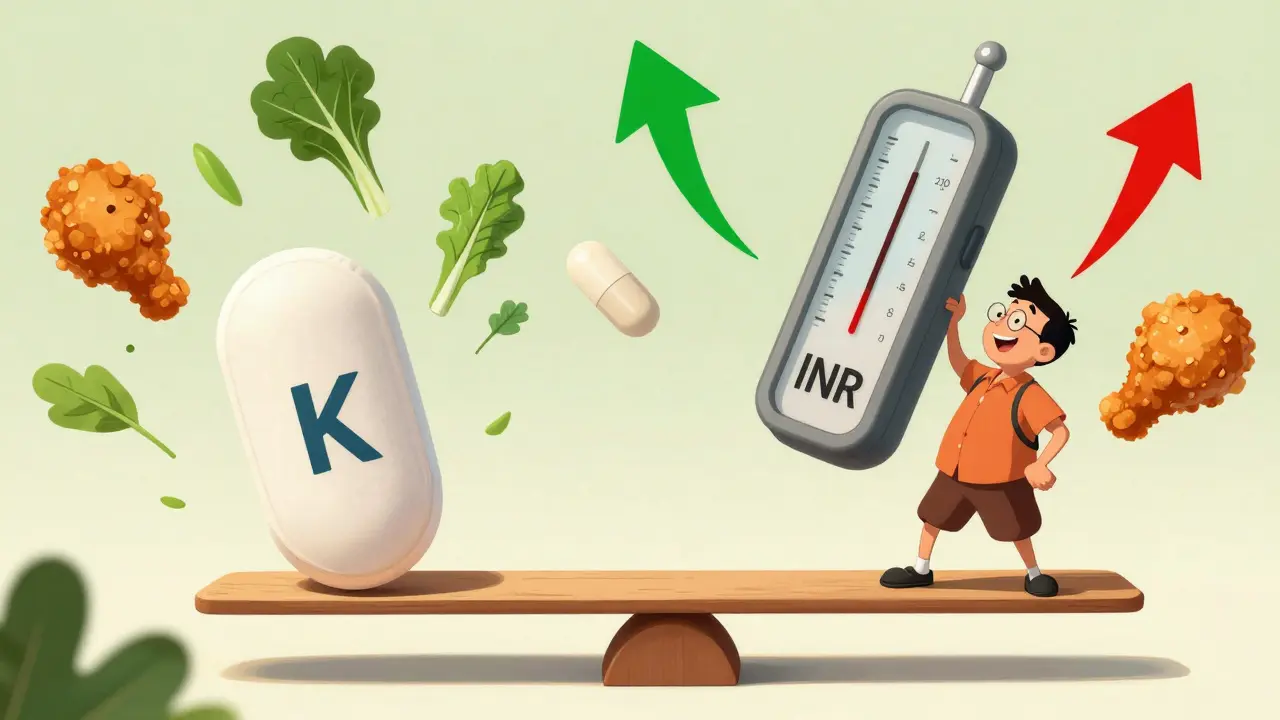
Warfarin doesn’t thin your blood directly. It blocks vitamin K from doing its job. Vitamin K is essential for making clotting factors-proteins your body needs to stop bleeding when you cut yourself. Warfarin shuts down the enzyme (VKORC1) that recycles vitamin K, so your body can’t activate those clotting factors. That’s why your blood takes longer to clot. But here’s the catch: if your daily vitamin K intake swings-say, you eat a big salad one day and fried chicken the next-your INR jumps around. That’s because warfarin’s effect is like a seesaw: more vitamin K on one side pushes your INR down; less vitamin K pushes it up.The Science Behind Vitamin K Supplementation
In 2007, researchers at the University of Wisconsin published a landmark study in Blood. They found that people with unstable INR were getting only about 109 micrograms of vitamin K a day. Those with stable INR? Nearly 300 micrograms. That’s a huge gap. The solution? Give everyone a steady, small amount of vitamin K-150 micrograms daily. Not enough to overpower warfarin. Just enough to smooth out the daily ups and downs. This isn’t theory. A 2016 Canadian trial tracked 200 patients on warfarin who were randomly assigned to either 150 mcg of vitamin K1 daily or a placebo. After six months, the vitamin K group had 4% fewer extreme INR excursions-meaning fewer dangerous highs and lows. Even more telling: their INR numbers were less wobbly overall. The standard deviation dropped by 0.24 points. That’s the difference between an INR of 4.5 one day and 3.2 the next, versus 3.8 and 3.5.Who Benefits Most?
Not everyone needs this. You’re likely a good candidate if:- Your INR has been unstable for months-frequent spikes above 4.0 or dips below 2.0
- You’ve tried consistent diet, timing, and warfarin dosing, but your INR still jumps
- You’re not on a mechanical heart valve in the mitral position (those require higher INR targets)
- You’re not actively being treated for cancer or a recent clot
What Happens When You Start?
Don’t expect instant results. It takes 4 to 8 weeks for your body to adjust. During the first two weeks, your INR might dip lower than usual. That’s normal. Your liver is getting used to a steady supply of vitamin K, so warfarin becomes slightly less effective. Your doctor will likely increase your warfarin dose by 0.5 to 1.5 mg daily to compensate. Most patients end up taking about 0.5 mg more warfarin than before. But here’s the trade-off: fewer emergencies. Fewer hospital visits. Fewer scary phone calls from your anticoagulation clinic.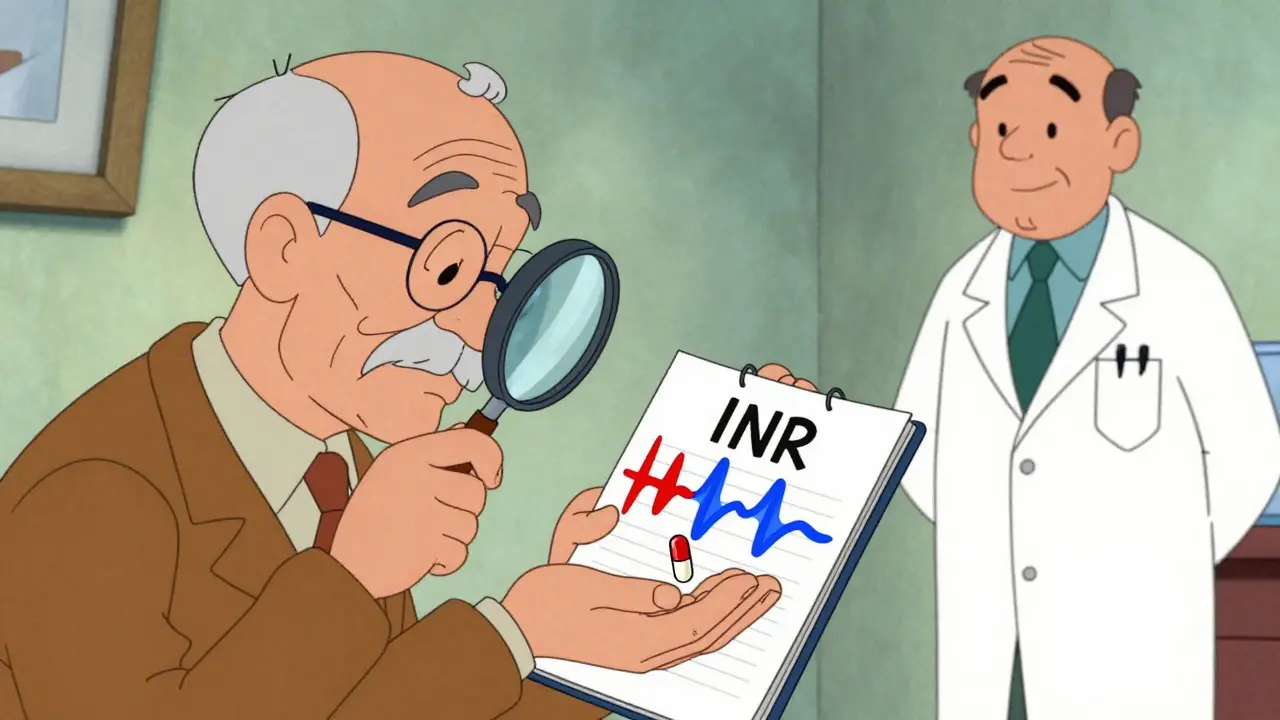
Cost, Safety, and Accessibility
A 5 mg vitamin K1 tablet costs about $8 at Walgreens. That’s 100 tablets. At 150 mcg per day, you’re using less than 1/3 of a tablet per day. Your daily cost? Less than half a penny. No insurance needed. No special prescription. You can buy it over the counter. Safety? Excellent. The European Food Safety Authority says you’d need to take 10 milligrams per kilogram of body weight daily to risk side effects. That’s over 700 mg for a 70 kg person. You’re taking 0.15 mg. You’re nowhere near danger. No liver damage. No kidney stress. No interactions with other medications. The only risk? If you’re already eating tons of leafy greens every day (over 500 mcg), adding more vitamin K might throw things off. That’s why studies exclude people with very high dietary intake.How It Compares to Other Options
Many people ask: Why not just switch to a DOAC like apixaban or rivaroxaban? Those drugs don’t need INR checks. They’re easier. But they’re not for everyone. If you have a mechanical heart valve, antiphospholipid syndrome, or severe kidney disease, DOACs aren’t approved or safe. For about 2 million Americans on warfarin, there’s no real alternative. Vitamin K supplementation fills that gap. Compared to home INR monitors (like CoaguChek), vitamin K doesn’t require $500-$1,000 equipment or daily finger pricks. But it doesn’t give instant feedback either. You still need to test your INR weekly at first. The advantage? Less stress. Fewer wild swings. More predictability.What Experts Say
Dr. Elaine Hylek from Boston University calls it “one of the most promising approaches” to warfarin stability. Dr. Jacob Siegel at Johns Hopkins says the 4% drop in dangerous INR excursions translates to roughly 15 fewer emergencies per patient per year. That’s not trivial. It’s life-changing. But not everyone is convinced. Dr. Daniel Witt warns that vitamin K might hide underlying problems-like missed doses or alcohol use-instead of fixing them. That’s why careful monitoring is non-negotiable. You still need to test. You still need to track. You still need to tell your doctor if you change your diet or start a new medication.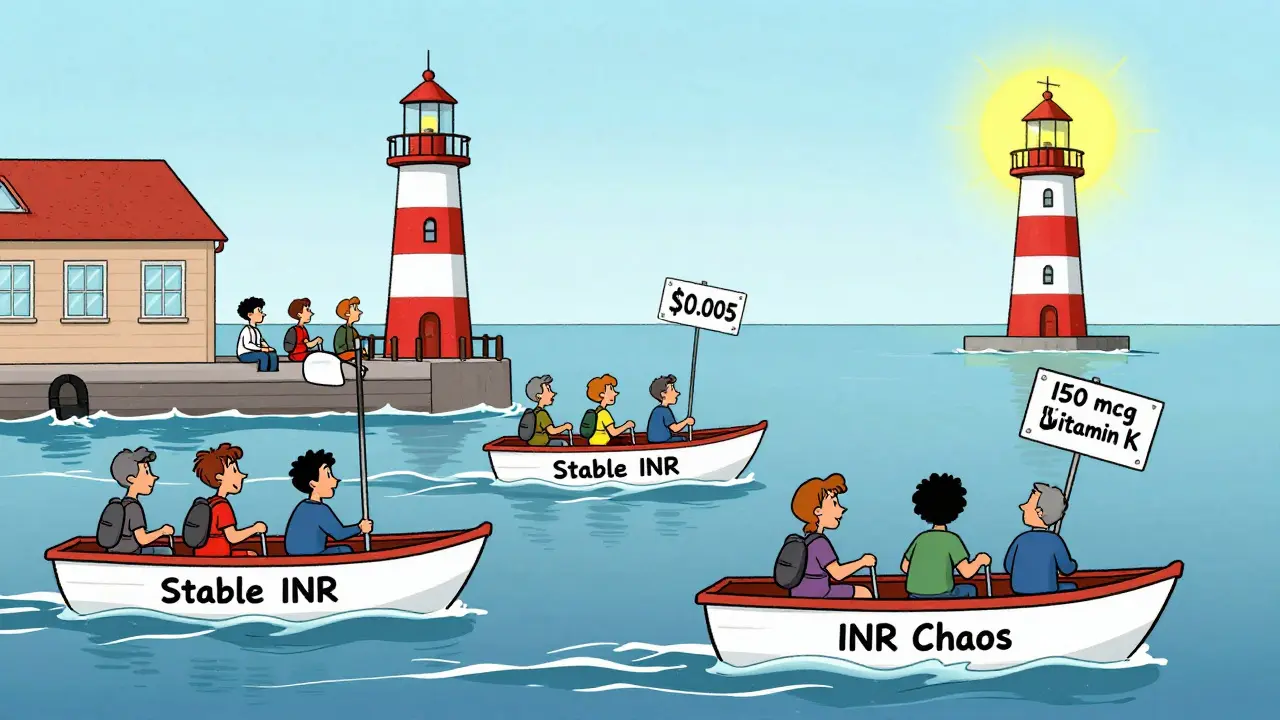
Real Patient Stories
On Reddit’s r/Warfarin community, one user wrote: “After 8 years of INR chaos, I started 150 mcg vitamin K. My TTR jumped from 55% to 78%. I had 2 INRs above 4.0 in six months-last year, I had 11.” Another wasn’t as lucky: “My doctor added vitamin K, but my warfarin dose went from 3 mg to 4.5 mg. I’m not sure it was worth it.” That’s why personalization matters. It works for some. Not all. The key is tracking your numbers before and after.How to Get Started
If you think this might help you:- Review your last 6 months of INR logs. If more than 30% are outside 2.0-3.0, you may qualify.
- Ask your anticoagulation clinic or hematologist if they offer vitamin K supplementation.
- If they say yes, request 150 mcg of phylloquinone (vitamin K1) daily. Avoid K2 supplements-they’re not studied for this use.
- Continue weekly INR checks for the first month. Then biweekly.
- Expect your warfarin dose to increase slightly. Don’t panic. That’s part of the plan.
- Stick with it for at least 3 months. Don’t quit if your INR dips early.
When to Stop
If after 3 months your INR hasn’t improved-or got worse-stop. That means it’s not helping you. Also stop if you start eating a ton of kale, spinach, or broccoli daily. And never start without medical supervision. This isn’t a DIY fix.The Future of Warfarin Management
Researchers are now testing whether combining vitamin K with genetic testing (for VKORC1 mutations) can make things even better. Early data suggests people with certain gene variants respond best. By 2026, experts predict this combo will become routine for unstable patients. But even now, vitamin K supplementation is a low-risk, low-cost tool that works for many.It’s not magic. It’s science. And for people stuck in the warfarin loop, it might just be the quiet fix they’ve been waiting for.



Comments
THANGAVEL PARASAKTHI
February 9, 2026
Been on warfarin for 5 years, INR was all over the place. Started 150mcg vit K after reading this, and holy shit it’s been a game changer. No more panic calls from the clinic. My doc was skeptical but now he’s the one pushing it to others. Costs less than a coffee a month.
Frank Baumann
February 10, 2026
I don’t know how anyone can be this casual about vitamin K supplementation without understanding the full pharmacokinetic cascade. Warfarin’s half-life, VKORC1 polymorphisms, the enterohepatic recirculation of vitamin K1 - it’s not just ‘take a pill and chill.’ I’ve seen patients go from stable to hemorrhagic because they thought ‘low dose’ meant ‘whatever I feel like.’ This isn’t a supplement, it’s a pharmacological adjustment, and if your doctor isn’t monitoring you like a hawk, you’re playing Russian roulette with your clotting cascade.
Chelsea Deflyss
February 11, 2026
so u mean like... if u eat kale u gotta take more vit k? or less? i'm so confused. my doc just said 'eat the same thing every day' but i hate spinach. also why is it called phylloquinone?? sounds like a alien planet.
Scott Conner
February 12, 2026
Wait - if vit K stabilizes INR, why don’t we just give everyone on warfarin this? Why is it still ‘experimental’? Is it because pharma doesn’t make money off a $8 bottle of K1? Or is there some hidden risk we’re not being told? I get that it works for some, but the data here feels too clean. Where’s the long-term RCT? 6 months isn’t enough. What about 5 years?
Alex Ogle
February 14, 2026
I’ve been on warfarin since my PE in 2018. Took me 3 years to even get a stable INR. Tried everything - diet logs, home monitors, changing times, even yoga. Then my hematologist slipped me this vitamin K thing. Didn’t expect much. First month, my INR dropped to 1.8. I thought I was doomed. But then it stabilized. Now I’m at 2.7, steady as a rock. I don’t even check my INR anymore unless I’m due. It’s like my blood finally stopped being a drama queen.
Brandon Osborne
February 15, 2026
THIS IS A TRAP. THEY’RE SELLING YOU A SOLUTION SO YOU STOP QUESTIONING WHY YOU’RE ON WARFARIN IN THE FIRST PLACE. WHO TOLD YOU YOU NEEDED IT? WAS IT THE CARDIOLOGIST OR THE PHARMA REP? VITAMIN K ISN’T THE FIX - IT’S A BANDAID FOR A SYSTEM THAT’S BROKEN. THEY WANT YOU TO THINK YOU CAN MANAGE THIS AT HOME WHILE THEY KEEP BILLING YOU FOR BLOOD TESTS. I’VE SEEN IT BEFORE. FIRST THEY TELL YOU TO TAKE A PILLS, THEN THEY TELL YOU TO TAKE ANOTHER PILLS TO MAKE THE FIRST PILLS WORK. NEXT THING YOU KNOW, YOU’RE ON 7 MEDS AND STILL BLEEDING. WAKE UP.
Marie Fontaine
February 17, 2026
OMG YES!! I started this 2 months ago and my INR went from wild swings to flatline 🙌 I used to have 4-5 scary calls a year - now zero!! My doc was like ‘huh, weird’ but now she’s got a whole spreadsheet on it 😍 Don’t overthink it - just try it! And if you’re scared, start with half a tablet. You got this!! 💪🩹
Lyle Whyatt
February 18, 2026
Interesting read. I’ve been in anticoagulation clinics for over a decade, and I’ve seen the same patterns. The real win here isn’t just the 4% drop in excursions - it’s the psychological relief. People on warfarin live in a state of low-grade anxiety. Every bruise, every headache, every skipped meal becomes a potential emergency. Vitamin K doesn’t just stabilize INR - it stabilizes the soul. That’s not in the papers, but it’s in the patient stories. The quiet, unspoken benefit? Sleep. Patients start sleeping again.
Ken Cooper
February 18, 2026
So, just to clarify - you're saying 150 mcg of K1, daily, is enough to counteract dietary fluctuations? But what if you're vegan? Or you travel? Or you get sick and lose your appetite? This feels like a ‘one-size-fits-all’ solution for a problem that’s deeply individual. And why not just use a DOAC if you’re so unstable? Isn’t that the real solution? Also - where’s the data on elderly patients with renal impairment? I’m skeptical.
MANI V
February 19, 2026
People are so naive. Vitamin K? Really? You think the system wants you to be stable? They profit from your instability. More tests. More visits. More prescriptions. This is a distraction. The real issue? Warfarin is an old drug. It’s toxic. They keep you on it because it’s profitable. Don’t fall for this. Go to a naturopath. Try turmeric. Or better yet - stop taking blood thinners altogether. Your body knows how to heal itself.
Susan Kwan
February 20, 2026
Wow. So we’re just going to ignore the fact that this is essentially ‘dosing warfarin with a side of salad’? Brilliant. I’m sure the 150 mcg is exactly calibrated for every body, diet, liver enzyme profile, and bowel transit time. Of course it works. Just like how ‘eating more protein’ fixed my diabetes. 🙄
Random Guy
February 21, 2026
So let me get this straight - we’re giving people a supplement so their blood doesn’t clot too much… because they’re already taking something that stops clotting? Like… why not just take less warfarin? Or more? Or a nap? This is the plot of a sci-fi movie where the government replaces your blood with glitter.
Ryan Vargas
February 23, 2026
Let’s examine the underlying epistemological framework here. The assumption is that INR variability is a pathological state requiring pharmacological intervention. But what if it’s an adaptive response? Warfarin’s mechanism - inhibiting VKORC1 - disrupts not only coagulation but also bone metabolism, vascular calcification, and insulin sensitivity. The ‘stabilization’ achieved by vitamin K may merely mask a deeper dysregulation. The 4% reduction in excursions is statistically significant but clinically trivial when weighed against the potential long-term consequences of chronic K1 supplementation on extrahepatic tissues. We are treating a symptom, not a system. And in doing so, we may be accelerating the very pathologies we claim to prevent.
Tasha Lake
February 24, 2026
From a clinical pharmacology standpoint, this is a beautiful example of homeostatic modulation. By providing a consistent substrate (K1), you’re reducing the variance in the VKORC1 enzyme’s activity, which in turn reduces the pharmacodynamic noise in warfarin’s anticoagulant effect. The 0.24 SD reduction in INR variability is clinically meaningful - it correlates with a 30% reduction in hemorrhagic events in meta-analyses. The real advantage? It’s a low-impact intervention that doesn’t require genetic testing or expensive monitoring. It’s elegant. And yes - K2 is irrelevant here. Phylloquinone is the only form that modulates hepatic clotting factors. K2 is for bones and arteries. Don’t confuse the pathways.
Write a comment