
Corticosteroid Infection Risk Calculator
Your Infection Risk
Based on your steroid dose and duration, you are at moderate risk for infections.
The most common infections to watch for:
Why Corticosteroids Make You More Susceptible to Infections
When you take corticosteroids like prednisone or dexamethasone, you’re not just calming inflammation-you’re quietly turning down your body’s alarm system. These drugs mimic cortisol, your natural stress hormone, but at doses far higher than your body ever produces. At those levels, they don’t just reduce swelling or pain-they suppress the very cells that fight off bacteria, viruses, and fungi.
The biggest problem? It’s not obvious. You won’t feel weaker. Your skin won’t look different. But inside, your T cells-your body’s frontline soldiers against intracellular threats-are being shut down. Lymphocytes drop. Macrophages lose their ability to eat pathogens. Even your neutrophils, which normally rush to infection sites, are less effective because they can’t stick to blood vessel walls properly. This isn’t a general immune shutdown. It’s targeted. Humoral immunity (antibodies from B cells) stays mostly intact. But cellular immunity? That’s where the cracks appear.
That’s why people on long-term steroids get infections that healthy people rarely see: Pneumocystis jirovecii pneumonia, reactivated tuberculosis, invasive fungal infections, and shingles. These aren’t random bad luck. They’re predictable consequences of how these drugs work at the cellular level.
When Does the Risk Actually Go Up?
Not every steroid dose is equally dangerous. Risk isn’t about whether you’re taking it-it’s about how much and for how long.
If you’re on less than 10 mg of prednisone a day for under two weeks, your infection risk is close to normal. But once you hit 20 mg per day for more than three to four weeks, your risk jumps significantly. Each extra 10 mg per day increases your chance of a serious infection by 32%, according to a major 2022 meta-analysis. That’s not a small uptick-it’s a steep climb.
People on 15 mg or more daily for over a month are seven times more likely to have TB reactivate, especially in areas where TB is common. And if you’re on 20 mg or more for over a month, your risk of Pneumocystis pneumonia rises from under 1% to nearly 5%. Mortality from delayed diagnosis? Up to 50%.
It’s not just the dose. Duration matters just as much. A short burst for a flare-up? Low risk. A year-long taper? High risk. That’s why doctors now push for rapid tapers and steroid-sparing drugs whenever possible.
What Infections Should You Be Watching For?
Not all infections look the same when you’re on steroids. Classic signs-fever, redness, swelling-often don’t show up. In fact, up to 40% of serious infections in steroid users happen without fever.
Here’s what to watch for:
- Shingles (herpes zoster): Burning pain on one side of the body, followed by blisters. Incidence is 2.8 to 6.5 cases per 100 people per year on steroids-more than double the normal rate.
- Pneumocystis pneumonia (PJP): Dry cough, shortness of breath, low-grade fever. Often mistaken for a bad cold. Accounts for nearly 1 in 5 PJP cases in immunocompromised people.
- Tuberculosis reactivation: Night sweats, weight loss, persistent cough. Can show up months after starting steroids, even if you tested negative before.
- Invasive fungal infections: Aspergillus in the lungs, Candida in the mouth or bloodstream. Often fatal if missed.
- Recurrent sinus or skin infections: Fungal or bacterial, slow to heal, recurring despite antibiotics.
Don’t wait for a high fever. If you feel off-fatigued, achy, breathing harder than usual-for more than a few days, get checked. Early detection saves lives.
How to Prevent Infections Before They Start
Prevention isn’t optional. It’s standard care for anyone on long-term steroids.
1. Get vaccinated-before you start. Live vaccines (like MMR, varicella, nasal flu) are dangerous once you’re immunosuppressed. Get them at least two weeks before starting steroids. Inactivated shots-flu, pneumococcal, COVID-19, tetanus-are safe and critical. But here’s the catch: your immune system may not respond well. One 2023 study found only 42% of people on over 20 mg of prednisone developed protective antibodies after the flu shot, compared to 78% in healthy people. Still, even partial protection helps.
2. Screen for latent TB. If you’re on 15 mg or more of prednisone daily for over a month, you need a TB test-either a skin test or a blood test (IGRA). If it’s positive, you’ll get a 9-month course of isoniazid or a shorter rifampin regimen. This cuts reactivation risk by 90%.
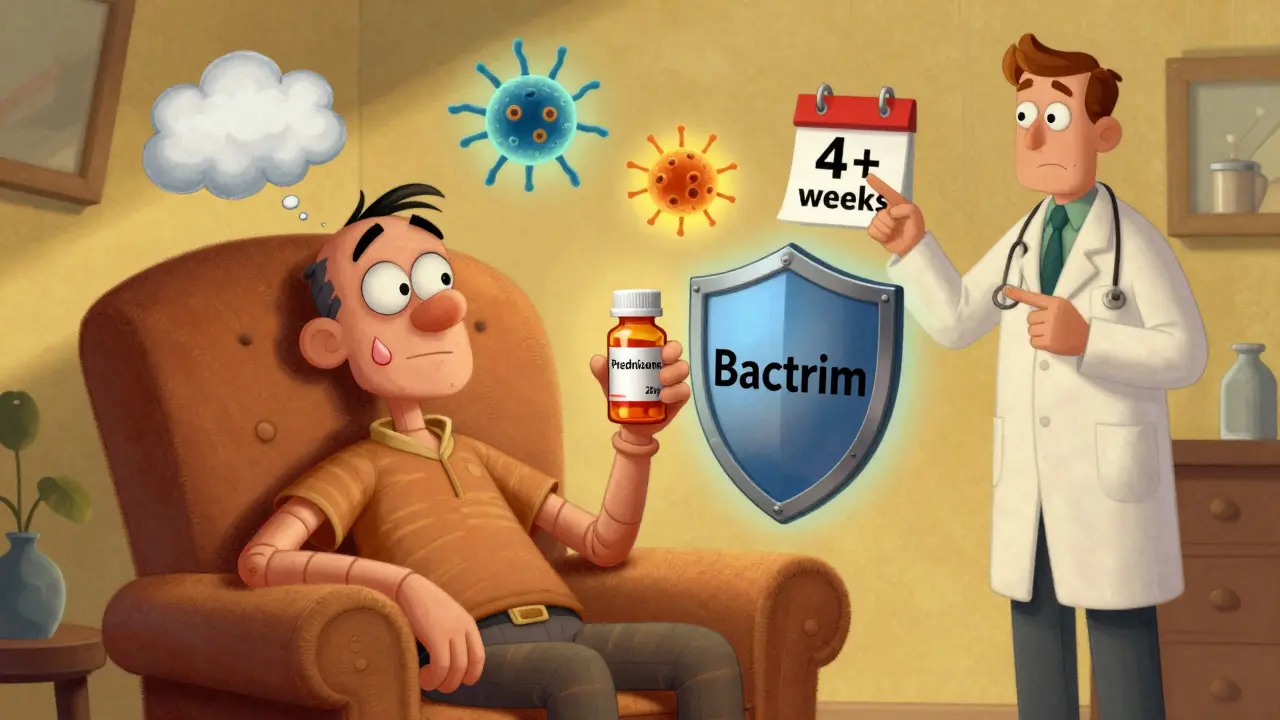
3. Take prophylaxis if you’re high risk. If you’re on ≥20 mg/day prednisone for more than four weeks, you should be on trimethoprim-sulfamethoxazole (Bactrim) to prevent Pneumocystis pneumonia. Studies show it drops PJP rates from over 5% to under 0.3%. Side effects? Some people get rashes or nausea, but for most, the benefit far outweighs the risk.
4. Monitor your blood counts. A simple CBC every 2-4 weeks can show if your lymphocyte count is dropping below 1,000 cells/μL-that’s a red flag your immune system is in trouble. If it is, your doctor should reassess your steroid dose or add protection.
Why Lower Doses and Shorter Courses Are the Best Strategy
The most effective way to avoid infection isn’t more drugs-it’s fewer drugs.
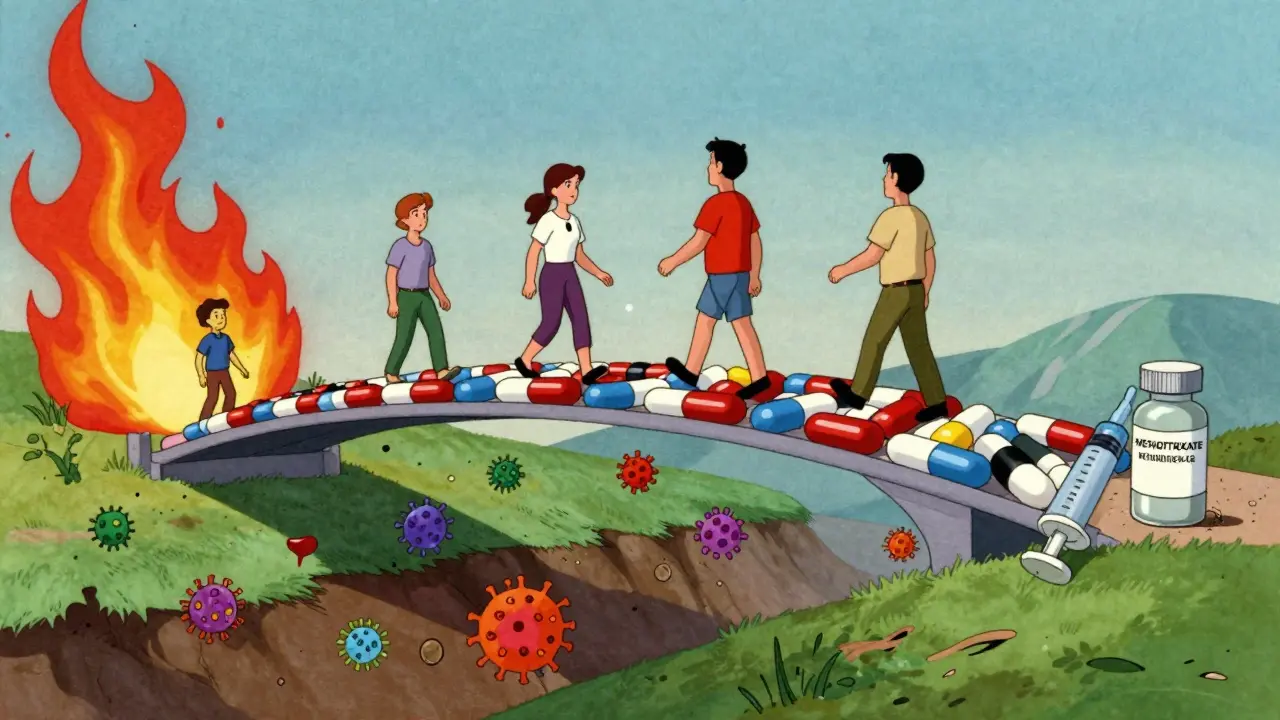
Doctors are shifting away from long-term steroid dependence. The goal now is to use steroids as a bridge, not a lifeline. Start with a short, high dose to control a flare, then quickly taper and replace with a steroid-sparing drug like methotrexate, azathioprine, or a biologic. One 2022 study showed that patients who started methotrexate within four weeks of beginning steroids had a 37% lower infection rate than those who stayed on prednisone alone.
One patient on Reddit shared: “My rheumatologist switched me to methotrexate after 3 months on prednisone. No flares in six months. Haven’t had a single cold.” That’s not luck. That’s smart management.
Even small reductions matter. Going from 30 mg to 10 mg of prednisone per day cuts infection risk dramatically. If your disease is stable, your doctor should be trying to get you off steroids entirely.
What You Can Do Right Now
If you’re on corticosteroids, here’s your action list:
- Ask your doctor: “Am I on the lowest possible dose for my condition?”
- If you’ve been on steroids for more than 4 weeks, ask: “Do I need PJP prophylaxis?”
- If you’re on 15 mg/day or more for over a month: “Have I been tested for TB?”
- Confirm you’ve had all recommended vaccines-flu, pneumonia, COVID, shingles (Shingrix, not Zostavax).
- Know the warning signs: dry cough, unexplained fatigue, skin sores that won’t heal, night sweats.
- Don’t ignore a low-grade fever or feeling “just not right.” Get checked.
- Ask about steroid-sparing alternatives. Don’t assume you’re stuck on steroids forever.
The Future: Better Steroids on the Horizon
Research is moving fast. New drugs like vamorolone-a “dissociative steroid”-are showing promise in trials. In Duchenne muscular dystrophy, it worked as well as prednisone but caused 47% fewer infections. That’s huge.
Scientists are also developing genomic tests to predict who’s most vulnerable to steroid-induced immunosuppression. Within five years, we may be able to look at your DNA and say: “You’re at high risk for lymphocyte drop-here’s your personalized prevention plan.”
But for now, the tools we have work-if we use them. The key isn’t avoiding steroids. It’s using them wisely.
Final Thought: Steroids Are Tools, Not Crutches
Corticosteroids saved lives in 1948. They still do today. But they’re not harmless. They’re powerful-and like any powerful tool, they need respect. The best outcomes come not from taking more, but from taking less, for less time, with smart protection in place.
If you’re on steroids, you’re not broken. You’re managing a chronic condition. And with the right precautions, you can live well-without becoming a statistic.
Can I still get vaccinated while on corticosteroids?
Yes-but only with inactivated vaccines. Flu shots, pneumococcal vaccines, COVID-19 boosters, and Shingrix (the shingles vaccine) are safe. Live vaccines like MMR, varicella, and the old nasal flu spray are not. Get all necessary inactivated shots at least two weeks before starting steroids. Even if your immune response is weaker, protection is better than none.
Is it safe to stop steroids suddenly if I’m worried about infections?
No. Stopping steroids abruptly can trigger adrenal crisis, a life-threatening drop in blood pressure and energy. Always taper under medical supervision. Your doctor can reduce your dose safely while adding steroid-sparing drugs to prevent flares. Never stop on your own.
Do all corticosteroids carry the same infection risk?
Systemic forms-oral pills, injections, IV drips-carry the highest risk because they affect your whole body. Inhaled steroids (for asthma) and topical creams (for eczema) have minimal systemic absorption and rarely cause immunosuppression. The risk depends on dose, route, and duration-not the specific drug name.
I tested negative for TB before starting steroids. Do I need to be tested again?
Yes. A negative test before starting steroids doesn’t guarantee you’re safe later. Latent TB can reactivate months after beginning treatment, especially with doses over 15 mg/day of prednisone for over a month. Repeat testing isn’t routine, but if you develop symptoms like persistent cough, weight loss, or night sweats, get tested immediately.
Can I take antibiotics to prevent infections while on steroids?
Routine antibiotics are not recommended. They don’t prevent fungal or viral infections like PJP or shingles, and overuse leads to resistant bacteria. Prophylaxis is targeted: only trimethoprim-sulfamethoxazole for PJP prevention in high-risk patients. Antibiotics are for treating active infections, not preventing them.
What should I do if I develop a fever while on steroids?
Don’t wait. Fever-even a low-grade one-is a red flag. Go to your doctor or urgent care immediately. Don’t assume it’s just a cold. Up to 40% of serious infections in steroid users don’t cause high fevers. Blood tests, chest X-rays, and cultures may be needed. Early treatment saves lives.



Comments
Nancy Kou
December 20, 2025
I was on prednisone for 6 months after my lupus flare. The PJP prophylaxis saved my life. No jokes-Bactrim is a tiny pill with huge power. Don't wait until you're gasping to ask your doctor about it.
Hussien SLeiman
December 21, 2025
Let me just say this: the entire medical establishment is in denial about how dangerous these drugs are. You think a 10 mg daily dose is 'safe'? That's what they said about cigarettes in the '50s. The data is clear-any systemic steroid use is a slow-motion suicide pact with your immune system. And don't get me started on how they push vaccines like they're magic bullets when your lymphocytes are already in the gutter.
Matt Davies
December 22, 2025
This is one of those posts that makes you want to hug your doctor. Seriously. I was terrified of steroids after reading this-until my rheumatologist sat me down and said, 'We're not trying to cure you with chemicals. We're trying to buy you time.' Now I'm on methotrexate, my PJP prophylaxis is in place, and I hiked 12 miles last weekend. It’s not about avoiding steroids. It’s about outsmarting them.
Ashley Bliss
December 23, 2025
I can't believe people still take this stuff without demanding genomic testing first. It's 2024. We have the tech to know who's genetically prone to lymphocyte collapse, and yet we're still playing Russian roulette with prednisone like it's 1987. Your doctor isn't a hero for prescribing it-they're just lazy. And don't tell me 'it's necessary'-I've seen people die from 'necessary' meds. Wake up.
mark shortus
December 24, 2025
okay so i just got diagnosed with RA and my doc said 'try 10mg for a few weeks' and i was like cool but then i read this and now i'm sitting here in my pajamas with a thermometer in my mouth and a chest xray on my mind and i swear to god if i get a dry cough i'm going to the ER and i'm bringing this post with me
Emily P
December 25, 2025
I'm curious-how do you know if your lymphocyte count is dropping? My last CBC showed everything normal, but I've been feeling exhausted for weeks. Is it possible to feel worse even if the numbers look fine?
Vicki Belcher
December 25, 2025
I was on 20mg for 5 months and thought I was fine… until I got shingles at 32. 😭 The pain was unreal. Got the Bactrim after, and now I’m on methotrexate. Thank you for this post. 🙏 I’m alive because I listened. Stay smart, stay safe.
Jedidiah Massey
December 27, 2025
The pharmacokinetic profile of systemic corticosteroids induces a dose-dependent suppression of CD4+ T-cell trafficking and neutrophil chemotaxis, which synergistically undermines mucosal barrier integrity. Consequently, opportunistic pathogens such as P. jirovecii exploit this immunological vacuum. Prophylactic TMP-SMX mitigates this by inhibiting dihydrofolate reductase in fungal cell walls-thereby reducing PJP incidence by 94% in cohorts with sustained exposure >20mg/day prednisone equivalents.
Allison Pannabekcer
December 29, 2025
To anyone reading this and feeling overwhelmed-you’re not alone. I’ve been on steroids for 12 years. Some days I hate them. Some days I’m grateful they let me hold my kids. But here’s what I’ve learned: ask questions. Push for alternatives. Get the vaccines. Take the Bactrim. Your body isn’t broken. You’re just navigating a tough road. And you’re doing better than you think.
Nicole Rutherford
December 30, 2025
You people are so naive. You think vaccines work? They don’t. I got the flu shot last year and still got pneumonia. And Bactrim? That’s just another poison. Your immune system doesn’t need a chemical crutch-it needs rest, clean food, and a positive mindset. Stop trusting Big Pharma and start trusting yourself.
Dominic Suyo
December 31, 2025
Let’s be real: this entire article is just a glorified ad for methotrexate and Bactrim. The real issue? Doctors are terrified of losing control. So they keep you on steroids because it’s easier than managing complex autoimmune protocols. And don’t even get me started on how they push 'steroid-sparing' drugs that cost $10,000 a month. This isn’t medicine-it’s a revenue stream.
benchidelle rivera
January 1, 2026
This is exactly why I became a nurse. I’ve seen too many patients dismissed because they didn’t have a fever. I always say: 'If you feel wrong, you are wrong.' Don’t wait for a textbook symptom. Trust your body. Get tested. Ask for prophylaxis. You deserve to live well-not just survive.
Write a comment