Carbamazepine Drug Interaction Checker
No drugs selected
Select medications above to check for potential interactions with carbamazepine.
- Results are based on published pharmacokinetic data
- Always consult current guidelines before making clinical decisions
- Individual patient factors may alter interaction severity
- Therapeutic drug monitoring is essential for all high-risk combinations
Imagine taking your epilepsy medication faithfully every day, only to find that your birth control stops working or your blood thinner becomes dangerously weak. This isn’t a hypothetical scenario; it is the daily reality for many patients prescribed Carbamazepine, which is a potent anticonvulsant and mood stabilizer known for its significant impact on liver enzymes. As one of the most powerful cytochrome P450 (CYP) enzyme inducers in clinical use, this drug doesn't just treat seizures-it actively changes how your body processes dozens of other medications. Understanding these interactions is not just academic; it is a matter of safety.
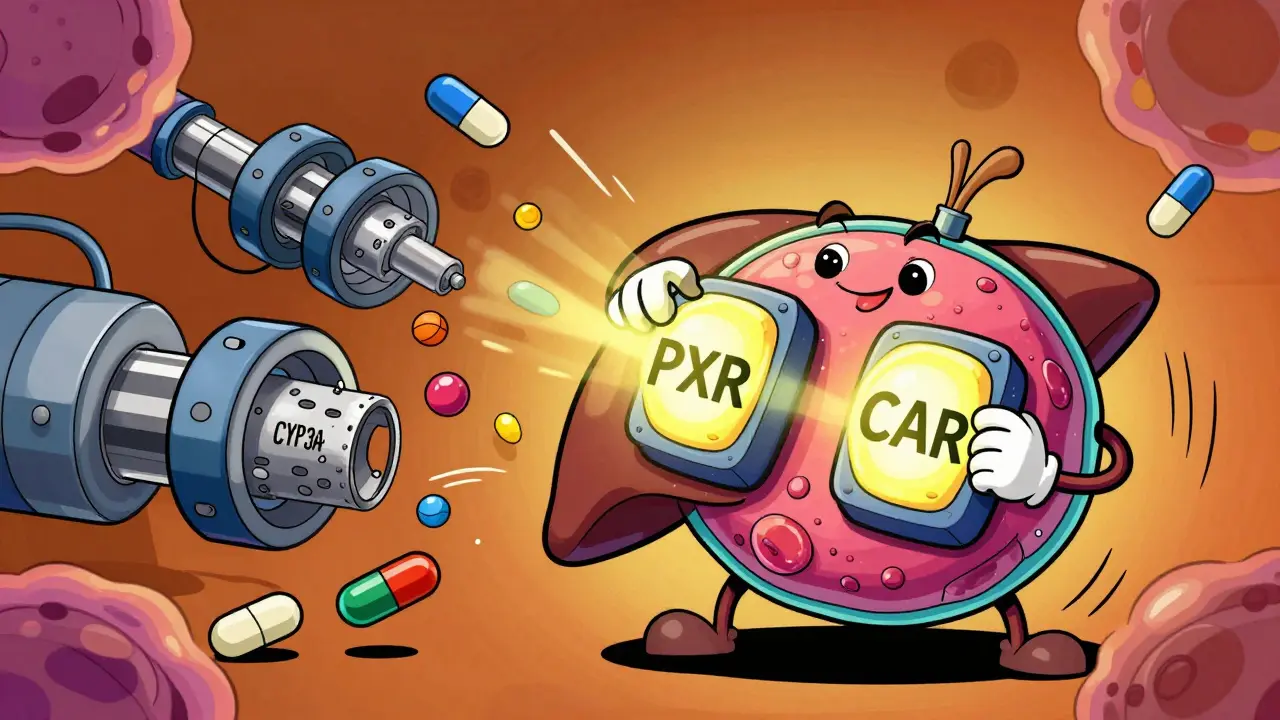
When you take carbamazepine, you are essentially turning up the volume on your liver’s metabolic machinery. The drug activates specific nuclear receptors, namely the pregnane X receptor (PXR) and constitutive androstane receptor (CAR). This activation triggers the production of more CYP3A4 and CYP2B6 enzymes. Since roughly half of all clinically used drugs are metabolized by these pathways, carbamazepine can drastically lower the effectiveness of co-administered treatments. But there is another layer to this complexity: carbamazepine induces its own metabolism. This "autoinduction" means the drug clears from your system faster over time, requiring careful dose adjustments that often catch new practitioners off guard.
The Mechanism Behind the Interaction
To understand why carbamazepine causes such widespread issues, we need to look at what happens inside the cells. Carbamazepine binds to nuclear receptors like PXR and CAR. Think of these receptors as light switches in the nucleus of liver cells. When carbamazepine flips them on, the cell starts manufacturing more copies of the CYP3A4 and CYP2B6 enzymes. These enzymes act like shredders, breaking down drugs so they can be excreted. More enzymes mean faster shredding.
Research published in *Pharmaceutics* by Fuhr et al. (2021) highlights that carbamazepine achieves this induction with an EC50 value of approximately 20 µM for CYP3A4. In practical terms, this means even standard therapeutic doses significantly boost enzyme levels. The result? Drugs that rely on CYP3A4 for breakdown are metabolized much quicker than intended. Their concentration in the blood drops, often falling below the therapeutic window where they work effectively. This is why a patient might suddenly experience breakthrough seizures or a return of depressive symptoms-not because the disease has worsened, but because their medication levels have plummeted.
Furthermore, carbamazepine undergoes its own transformation. It is metabolized by CYP3A4 into carbamazepine-10,11-epoxide, an active metabolite that contributes to both efficacy and toxicity. This epoxide is then converted into inactive diol forms. Because the parent drug creates its own metabolite, which also interacts with receptors, the pharmacokinetic picture becomes incredibly complex. Therapeutic drug monitoring (TDM) is essential here, as plasma concentrations must be kept within a narrow range of 4-12 µg/mL to avoid toxicity while maintaining seizure control.
Autoinduction: The Moving Target
One of the trickiest aspects of carbamazepine therapy is autoinduction. When you first start the drug, your body hasn’t yet ramped up enzyme production. Over the next three to four weeks, however, the induced enzymes begin clearing carbamazepine from your bloodstream much faster. Studies by Patsalos et al. (2008) show that clearance rates can jump from 0.065 L/h/kg to 0.095 L/h/kg during this period.
This leads to a paradoxical situation: as your body gets better at processing the drug, the amount of drug in your blood drops by 30-50%. If you do not adjust the dose upward, you risk under-treatment. Clinicians typically start with a low dose, such as 200 mg twice daily, and gradually titrate up to maintenance doses of 800-1,200 mg daily. The American Academy of Neurology recommends checking blood levels at baseline, two weeks, and four weeks after starting or changing doses to account for this shift. Without this monitoring, patients may experience a false sense of stability followed by sudden clinical deterioration as levels fall.

Critical Drug Interactions Across Classes
The reach of carbamazepine’s induction extends across numerous drug classes. Here are some of the most critical interactions clinicians and patients must watch for:
- Oral Contraceptives: Carbamazepine can reduce ethinyl estradiol exposure by 50-70%. This has led to cases of unintended pregnancy in women who relied solely on hormonal birth control. Alternative non-hormonal methods or higher-dose contraceptives are often necessary.
- Anticoagulants: Warfarin metabolism is accelerated, leading to decreased INR values. Patients may require 50-100% increases in warfarin dosing to maintain therapeutic anticoagulation, necessitating frequent INR checks.
- Immunosuppressants: Drugs like tacrolimus and cyclosporine are heavily metabolized by CYP3A4. Carbamazepine can slash their blood levels, risking organ rejection in transplant patients. Dose adjustments are mandatory and must be closely monitored.
- Antidepressants: Many SSRIs and TCAs are CYP substrates. Reduced levels can lead to relapse of depression or anxiety. Conversely, some antidepressants may inhibit carbamazepine metabolism, raising toxicity risks.
- Benzodiazepines: Drugs like midazolam and alprazolam see reduced efficacy due to faster clearance. However, when carbamazepine is discontinued, benzodiazepine levels can spike, causing sedation or respiratory depression.
| Inducer | Onset of Induction | Reduction in Victim Drug AUC | Key Clinical Consideration |
|---|---|---|---|
| Carbamazepine | 14 days | 60-80% | Autoinduction complicates dosing; requires TDM |
| Rifampicin | 5 days | 70-90% | Faster onset; higher risk of hypersensitivity |
| Phenytoin | Variable | ~64% | Less selective induction; nonlinear kinetics |
Compared to rifampicin, another strong inducer, carbamazepine takes longer to reach maximal effect-about 14 days versus five. While rifampicin produces a more rapid and complete reduction in victim drug area under the curve (AUC), carbamazepine offers better tolerability for long-term use. However, its autoinduction property makes it less predictable than rifampicin in the short term. Phenytoin, another anticonvulsant inducer, shows less selective induction of CYP3A4 compared to carbamazepine, making carbamazepine a more potent disruptor of CYP3A4-dependent therapies.

Clinical Management Strategies
Managing carbamazepine interactions requires a proactive approach. First, always review a patient’s full medication list before prescribing. Look for red flags like oral contraceptives, warfarin, or immunosuppressants. If co-prescription is unavoidable, plan for dose adjustments from day one. For example, if adding carbamazepine to a patient on simvastatin, anticipate a 74% reduction in simvastatin exposure and consider switching to a statin not primarily metabolized by CYP3A4, such as pravastatin.
Therapeutic drug monitoring is non-negotiable. Measure carbamazepine levels at regular intervals, especially during the first month of therapy or after any dose change. Remember that the active metabolite, carbamazepine-10,11-epoxide, also contributes to effects, so interpret results in context. When discontinuing carbamazepine, taper slowly and reduce doses of concomitant CYP3A4 substrates by 25-50% over 2-4 weeks to prevent toxicity. A case report in the *Journal of Clinical Psychopharmacology* (2021) highlighted alprazolam toxicity following abrupt carbamazepine cessation, underscoring the need for careful withdrawal planning.
Emerging tools like physiologically based pharmacokinetic (PBPK) models can help predict interactions, though they require specialized training. The Open Systems Pharmacology model developed by Fuhr et al. provides a public resource for estimating DDI magnitudes, but clinicians should use these predictions cautiously due to inter-individual variability in nuclear receptor activation. As Dr. Robert R. Bies noted, prediction errors can exceed 30% in a quarter of cases, so clinical judgment remains paramount.
Future Directions and Alternatives
Despite its interaction profile, carbamazepine remains widely prescribed, with 4.2 million prescriptions in the US in 2022. Its market share in focal seizure treatment stands at 18%, though use in bipolar disorder has declined to 7% due to safety concerns. Newer agents offer promising alternatives. Eslicarbazepine acetate, for instance, shows 80% lower CYP3A4 induction potential according to Phase III trials, making it a safer option for patients on multiple medications. Extended-release formulations like carbamazepine-ASP aim to provide more stable plasma levels, potentially reducing interaction severity.
Pharmacogenetic testing is also emerging as a tool to personalize therapy. Polymorphisms in PXR and CAR receptors influence induction magnitude, and ongoing trials (NCT05678901) explore how genetic profiling can guide dosing. While carbamazepine prescriptions are projected to decline by 3.2% annually through 2030, it will remain essential for specific epilepsy syndromes where newer agents fall short. Until then, vigilance around its enzyme-inducing properties is crucial for patient safety.
How long does it take for carbamazepine to induce liver enzymes?
Maximal enzyme induction typically occurs after about 14 days of continuous therapy. However, significant changes can begin within the first week, and autoinduction continues to evolve over 3-4 weeks, leading to increased drug clearance.
Can carbamazepine make birth control pills ineffective?
Yes. Carbamazepine accelerates the metabolism of ethinyl estradiol, reducing its exposure by 50-70%. This can lead to contraceptive failure and unintended pregnancy. Women should use alternative non-hormonal methods or consult their doctor for higher-dose options.
What is carbamazepine autoinduction?
Autoinduction refers to carbamazepine’s ability to increase its own metabolism by inducing the enzymes that break it down. This causes plasma concentrations to drop by 30-50% over 3-4 weeks, requiring dose increases to maintain therapeutic levels.
Why is therapeutic drug monitoring important with carbamazepine?
Due to its narrow therapeutic index (4-12 µg/mL) and variable metabolism influenced by autoinduction and drug interactions, regular blood level checks ensure efficacy while minimizing toxicity risks. Monitoring helps adjust doses accurately during initiation, changes, or discontinuation.
Are there safer alternatives to carbamazepine with fewer interactions?
Yes. Eslicarbazepine acetate has significantly lower CYP3A4 induction potential (about 80% less) and may be preferable for patients on multiple medications. Other anticonvulsants like levetiracetam or lamotrigine also have minimal enzyme-inducing effects.
How should I manage warfarin if my patient starts carbamazepine?
Expect warfarin levels to drop due to accelerated metabolism. Increase the warfarin dose by 50-100% and monitor INR frequently until stable. Close coordination between neurology and cardiology/hematology teams is essential to prevent clotting events.
What happens when carbamazepine is stopped abruptly?
Abrupt cessation can lead to rebound seizures and toxicity from other drugs previously suppressed by induction. For example, benzodiazepine levels may rise sharply. Taper carbamazepine gradually and adjust concomitant medication doses downward over 2-4 weeks.
Does carbamazepine interact with immunosuppressants?
Yes, significantly. Drugs like tacrolimus and cyclosporine are CYP3A4 substrates. Carbamazepine can drastically reduce their blood levels, increasing the risk of organ rejection. Frequent monitoring and substantial dose adjustments are required.