Drug Safety Risk Checker
Check Your Medication Risk
Results will appear here
Select your medication and factors above to see specific warning details
When you pick up a prescription, you might not notice the small black rectangle on the drug label. But that box isn’t just design-it’s a red flag. The FDA’s black box warning is the strongest safety alert they can give a medication. It means the drug carries a risk so serious, it could kill you or cause permanent harm. And it’s not rare. Over 400 prescription drugs in the U.S. carry one right now.
What Exactly Is a Black Box Warning?
A black box warning isn’t a suggestion. It’s a legal requirement. The U.S. Food and Drug Administration (FDA) mandates that this warning appear at the very top of a drug’s prescribing information, surrounded by a thick black border. It’s meant to jump out-no matter how many pages of fine print come before it. This isn’t about mild side effects like dizziness or a dry mouth. These warnings flag risks that can lead to death, organ failure, severe birth defects, or life-threatening conditions. For example, some antidepressants carry a black box warning for increased suicide risk in young adults. Others warn of sudden heart problems, liver damage, or dangerous interactions with other drugs. The FDA doesn’t slap these on lightly. They’re added only after clear evidence shows the risk is real, serious, and not rare enough to ignore. Once a warning goes in, it stays until new data proves the risk has changed.Why Do These Warnings Exist?
You might think the FDA approves a drug and that’s it. But approval is just the start. Most black box warnings aren’t added during clinical trials. They come later-after thousands or even millions of people have taken the drug. That’s because rare but deadly side effects often don’t show up in small trial groups. The FDA watches for patterns through the FDA Adverse Event Reporting System (FAERS), which collects over 1.3 million reports each year from doctors, patients, and drugmakers. When a trend emerges-like a spike in heart attacks linked to a specific medication-the agency investigates. If the data confirms a life-threatening pattern, they require a black box warning. Take rosiglitazone (Avandia), a diabetes drug. After studies linked it to heart attacks, the FDA added a black box warning in 2007. Prescriptions dropped by 70% in just a year. But even then, millions kept taking it because doctors and patients weighed the risks against the lack of alternatives. This shows the real purpose of the warning: not to ban a drug, but to force a conversation. It says, “This drug can kill. But for some people, the benefits still outweigh the danger.”What Kind of Risks Trigger a Black Box Warning?
Not all black box warnings are the same. They usually fall into a few key categories:- Death or organ failure-Drugs like clozapine can cause fatal bone marrow suppression. Patients need weekly blood tests to catch it early.
- Severe birth defects-Isotretinoin (Accutane) for acne carries a warning that it can cause catastrophic fetal abnormalities. Women must use two forms of birth control and enroll in a special registry.
- Drug interactions-Certain antibiotics and heart medications can trigger fatal heart rhythms when taken together.
- High-risk populations-Some antidepressants warn of suicide risk in teens and young adults. Opioids warn against use in people with sleep apnea.
- Delayed dangers-Some drugs, like certain antipsychotics, increase the risk of tardive dyskinesia-a permanent movement disorder-after long-term use.
Does a Black Box Warning Mean You Shouldn’t Take the Drug?
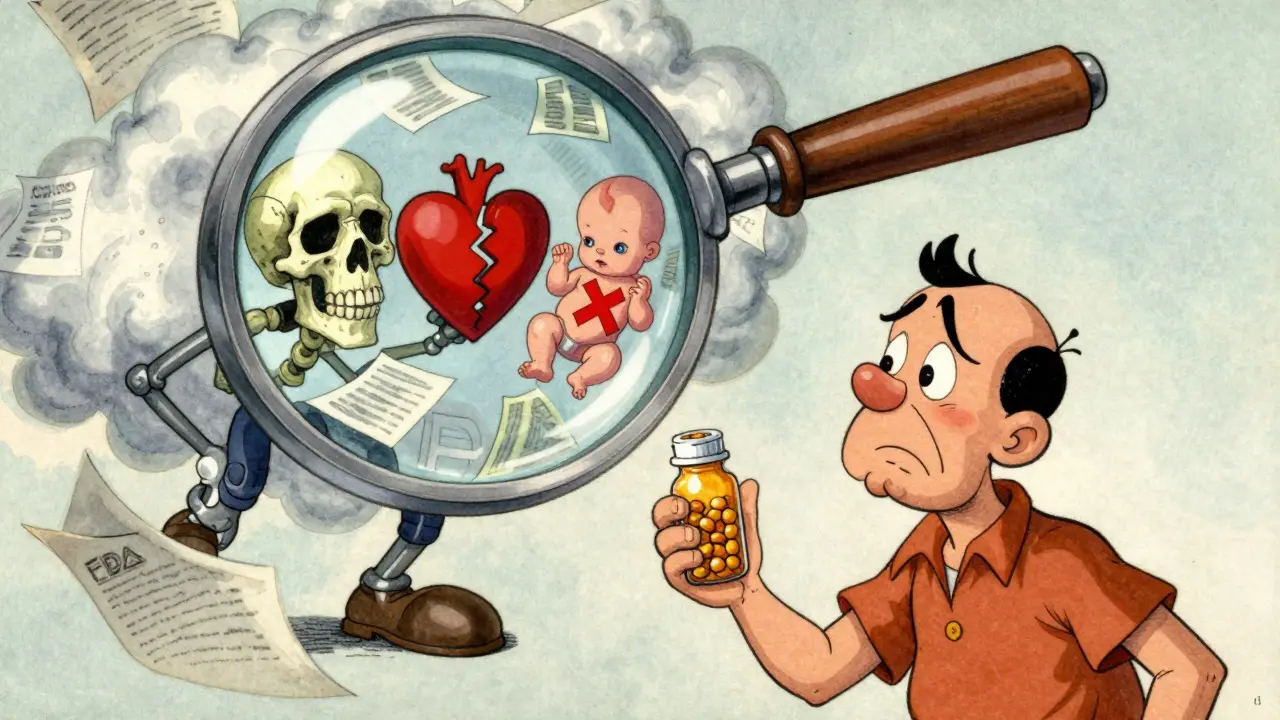
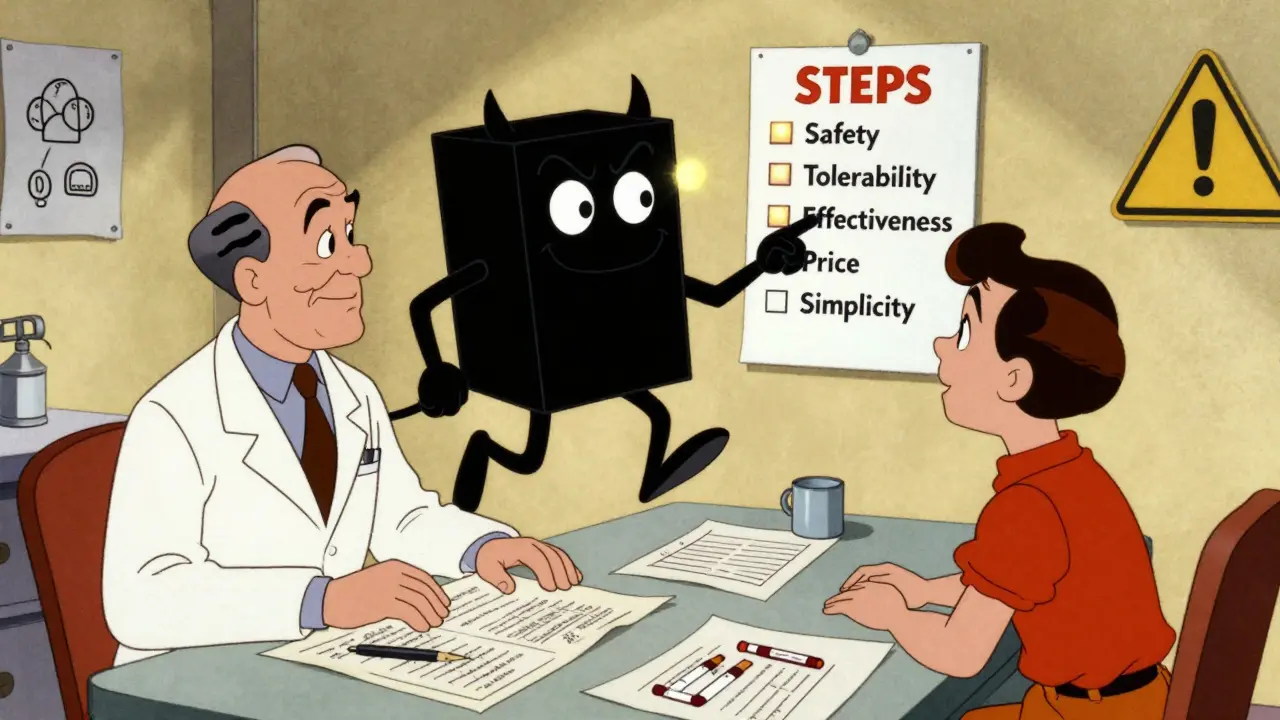
No. And that’s where people get confused. A black box warning doesn’t mean “never use.” It means “use with extreme caution.” For many patients, the alternative is worse. Someone with treatment-resistant depression might have no other options besides an antidepressant with a suicide risk warning. A person with severe rheumatoid arthritis might rely on a drug that carries a risk of serious infection-but without it, they can’t walk. The decision isn’t about avoiding risk. It’s about managing it. Your doctor should explain:- What the specific danger is
- How likely it is to happen
- What signs to watch for
- What tests or monitoring you’ll need
- What other options exist
What Should You Do If Your Medication Has a Black Box Warning?
If you’re prescribed a drug with this warning, don’t panic. But don’t ignore it either. Here’s what to do:- Ask your doctor to explain the warning in plain language. Don’t accept vague answers like “it’s just a precaution.” Ask: “What’s the worst thing that could happen? How often does it happen?”
- Know the warning signs. If the warning says “watch for jaundice,” know what that looks like-yellow eyes, dark urine. If it says “report chest pain,” don’t wait.
- Follow monitoring rules. If you need blood tests, liver scans, or EKGs, don’t skip them. These aren’t bureaucracy-they’re lifesavers.
- Don’t mix medications without checking. Many black box warnings are triggered by drug interactions. Even over-the-counter painkillers or herbal supplements can be dangerous.
- Report side effects. Use the FDA’s MedWatch program to report anything unusual. Your report could help save someone else’s life.
How Do These Warnings Affect Prescribing and Access?
Black box warnings change how doctors think. Many avoid prescribing drugs with them unless absolutely necessary. Some hospitals won’t stock them. Insurance companies may require prior authorization or step therapy-forcing you to try safer drugs first. Pharmaceutical companies also feel the impact. After a black box warning, sales often drop 25-40%. But for drugs treating serious conditions, demand doesn’t vanish. People still need them. That’s why drugs like warfarin, lithium, and clozapine still exist-they work, and the risks are manageable with proper care. Some drugs go even further. The FDA adds Risk Evaluation and Mitigation Strategies (REMS) on top of black box warnings. These can include:- Special training for prescribers
- Patient enrollment in a registry
- Only dispensing through certified pharmacies
What’s Changing With Black Box Warnings?
The FDA is moving toward smarter, more personalized warnings. Right now, a black box warning applies to everyone taking the drug. But research shows that risk isn’t the same for everyone. New advances in genetics are changing that. Scientists now know that certain gene variants make people more likely to have severe reactions to specific drugs. For example, people with the HLA-B*15:02 gene are at high risk of a deadly skin reaction from carbamazepine. In the future, black box warnings might say: “Avoid if you carry the HLA-B*15:02 allele.” The FDA’s 2023-2027 plan includes using electronic health records and insurance data to spot risks faster. The Sentinel Initiative now tracks safety for over 300 million Americans. That means warnings could be added-or removed-more quickly based on real-world use.Where to Find Current Black Box Warnings
You don’t need to guess. The FDA makes this information public:- Go to Drugs@FDA (searchable database of all approved drug labels)
- Check the drug’s official website (pharmaceutical companies must list warnings)
- Ask your pharmacist for the full prescribing information
- Use trusted resources like Consumer Reports’ Best Buy Drugs or the Drug Effectiveness Review Project

Comments
fiona vaz
January 29, 2026
Just wanted to say I appreciate how clear this breakdown is. I was on clozapine for years and the black box warning scared me at first-but my doctor walked me through the blood monitoring, and it saved my life. Knowledge really is power.
John Rose
January 30, 2026
Interesting how the FDA waits for real-world data before acting. Clinical trials are great, but they’re like testing a car on a track-real roads reveal the cracks. The FAERS system is underfunded though. We need more funding to catch these signals faster.
Howard Esakov
January 31, 2026
LMAO 😂 so now we’re trusting the FDA to protect us from Big Pharma? 🤡 They approved OxyContin and now they’re acting like saints. Black box warnings? More like PR spin after the bodies pile up.
Rhiannon Bosse
February 1, 2026
OMG I KNEW IT!! 🚨 The FDA is just letting pharma companies murder people slowly and then slap a black box on it like it’s a ‘Sorry, our bad’ sticker. My cousin died from that antidepressant-no one told her family the suicide risk was HIGHER than the depression itself. This is a cover-up. 🕵️♀️💔
Lance Long
February 2, 2026
Hey, I get it-you’re scared. I was too when I got my first black box drug. But here’s the thing: you’re not alone. Thousands of us are walking this tightrope. The key? Don’t shut down. Don’t panic. Ask questions. Show up for your labs. Be your own advocate. You’ve got this. 💪
Timothy Davis
February 3, 2026
Let’s be real-most people don’t read the black box. They see ‘FDA-approved’ and assume it’s safe. The real problem isn’t the warning-it’s the lack of patient education. Medical schools don’t teach how to explain risk, and pharmacists are rushed. It’s a systemic failure.
Colin Pierce
February 4, 2026
I’m a pharmacist and I see this every day. People panic when they see the black box and quit meds cold turkey. Then they end up in the ER. The warning isn’t a stop sign-it’s a caution sign. Talk to your provider. Don’t self-diagnose from Reddit. You’re not helping yourself.
SRI GUNTORO
February 5, 2026
How can you trust Western medicine when they poison people with chemicals? In my village in India, we use turmeric and neem-no black boxes, no side effects. This is what happens when you worship science over nature.
Kevin Kennett
February 7, 2026
For anyone reading this who’s scared: you’re not broken. You’re not weak. You’re just trying to survive. And if you’re on one of these meds? You’re already stronger than you think. Keep asking questions. Keep showing up. Your life matters. 🙏
Jess Bevis
February 8, 2026
Accutane saved my skin. The birth defect warning? Scary. But my doctor made me sign forms, get monthly tests, and use two birth controls. I did it. I’m fine. Warnings work when you take them seriously.
Rose Palmer
February 10, 2026
It is imperative that patients be made fully aware of the potential for life-threatening adverse events associated with pharmaceutical interventions. The ethical obligation to inform extends beyond mere regulatory compliance and into the realm of patient autonomy and informed consent.
Sue Latham
February 10, 2026
Oh honey, the black box is just the tip of the iceberg. Did you know the FDA gets paid by pharma to approve drugs? 😏 And those ‘monitoring tests’? They’re just there to make you feel safe while they keep raking in cash. Wake up, queen.
Mark Alan
February 11, 2026
AMERICA IS BEING POISONED BY BIG PHARMA 🇺🇸💥 I’m not even kidding. I saw a guy on TikTok die from a black box drug. They don’t care. They just want your money. #PharmaMurder #FDAComplicit 🤬
Write a comment