
Have you ever looked up at a clear blue sky and seen tiny dots, strings, or cobwebs drifting across your vision? Or maybe you’ve noticed sudden bursts of light in the corner of your eye, like a camera flash going off in the dark? These aren’t hallucinations or signs of stress-they’re floaters and flashes, and they’re more common than you think. But while they’re often harmless, they can also be a warning sign of something serious. Knowing the difference could save your vision.
What Are Floaters and Flashes?
Floaters are small, shadowy shapes that drift through your field of vision. They look like specks, threads, or spiderwebs that move when you move your eyes. They’re most noticeable against bright backgrounds-like a white wall or the sky-because they cast shadows on the retina, the light-sensitive layer at the back of your eye. Flashes, on the other hand, are brief streaks or sparks of light you see even when your eyes are closed. They usually appear in your peripheral vision and can feel like a quick flicker or a lightning strike inside your eye. These aren’t coming from outside-they’re caused by your retina being tugged or stimulated from within. Both happen because of changes in the vitreous, the clear, gel-like substance that fills the space between your lens and retina. In youth, the vitreous is thick and firm, holding the retina in place. But as you age, it starts to break down. Water separates from collagen fibers, the gel liquefies, and it begins to shrink. This process, called vitreous syneresis, is normal. Around age 50, it becomes common. By 70, about two out of three people experience it.Why Do They Happen?
The vitreous isn’t just sitting there quietly. It’s physically attached to the retina in several places. As it shrinks and pulls away, it can tug on the retina. That tug is what causes flashes. Think of it like pulling on a blanket tied to a wall-the wall doesn’t move, but you feel the tension. Floaters form when bits of collagen or other debris clump together inside the liquefied vitreous. These clumps cast shadows on the retina, which your brain interprets as objects floating in front of your eye. Sometimes, the vitreous pulls away cleanly from the retina. That’s called posterior vitreous detachment (PVD). It’s the most common cause of floaters and flashes-and it’s usually harmless. But not always.When Is It Just Aging-and When Is It Dangerous?
Here’s the key: isolated floaters with no flashes are almost always just part of aging. Many people live with them for years without any problems. The brain eventually learns to ignore them, and they often settle out of your central vision over six to twelve months. But if you suddenly get many new floaters, especially if they’re accompanied by repeated flashes, that’s a red flag. So is a dark curtain or shadow creeping across your vision, or a sudden loss of side vision. These are signs of a retinal tear or detachment. A retinal tear happens when the vitreous pulls so hard on the retina that it creates a small rip. If fluid leaks through that tear, it can lift the retina off the back of the eye-that’s a detachment. Without treatment, it can cause permanent blindness. The numbers tell the story: PVD alone has a 10-15% chance of leading to a retinal tear. But if there’s bleeding in the vitreous (vitreous hemorrhage), that risk jumps to nearly 70%. That’s why sudden changes matter.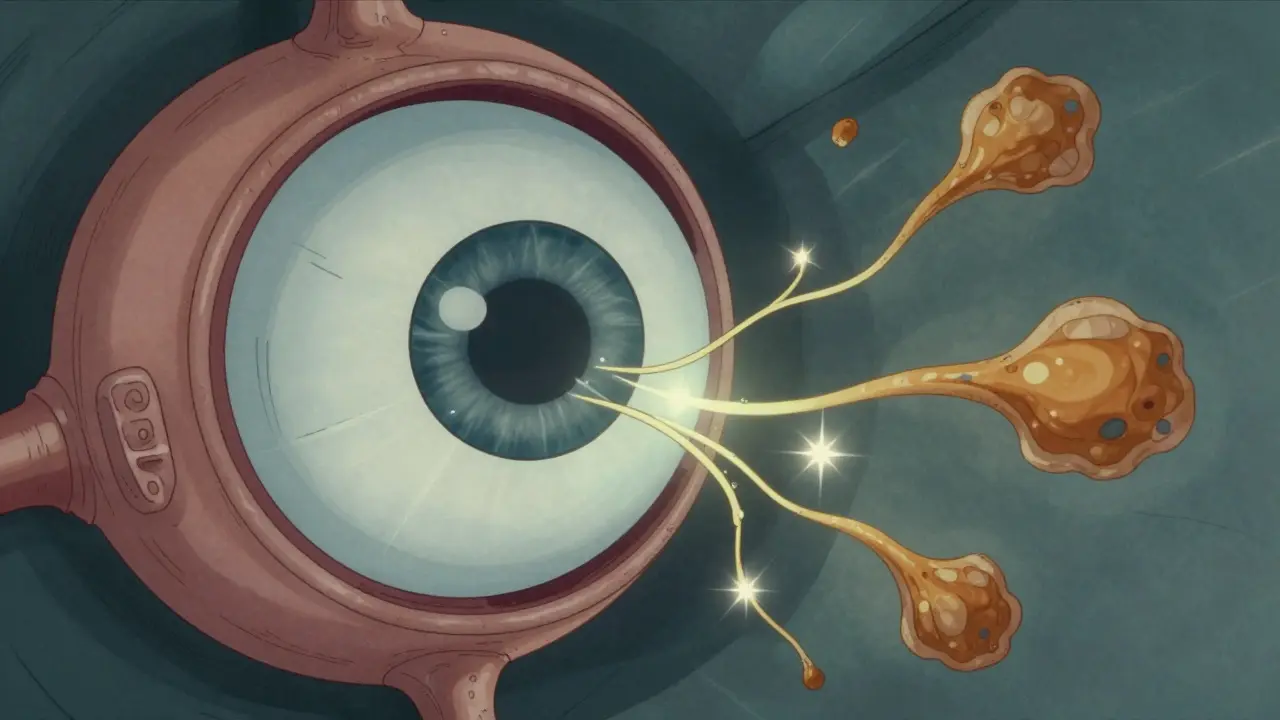
Who’s at Higher Risk?
Not everyone develops PVD at the same time. Nearsighted people (myopia) are more likely to get it earlier-sometimes in their 40s-because their eyes are longer, putting more stress on the vitreous-retina connection. People with diabetes are also at higher risk. High blood sugar damages tiny blood vessels in the eye, making them more likely to bleed into the vitreous, which can mimic or worsen floaters. Eye injuries, previous eye surgery, or inflammation (like uveitis) can also trigger early vitreous changes. If you’re under 50 and suddenly notice floaters or flashes, it’s more likely to be something other than normal aging-and that’s worth checking out.What Should You Do If You Notice New Symptoms?
Don’t wait. Don’t assume it’s just “old age.” If you get:- Sudden increase in floaters (like a shower of new dots or threads)
- Flashes that keep happening over seconds or minutes
- A dark shadow spreading across your vision
- Loss of side vision
Call an eye doctor the same day. If you can’t get in right away, go to an emergency eye clinic or hospital. Retinal detachments are treatable-but only if caught early. Studies show that prompt treatment can prevent vision loss in up to 90% of cases.
If you have a single floater or occasional flash with no other symptoms, schedule an appointment within 24-48 hours. Your eye doctor will dilate your pupils and examine the retina with a special lens. It’s quick, painless, and could prevent disaster.
Can You Treat Floaters?
For most people, no treatment is needed. Floaters fade over time. Your brain adapts. You stop noticing them. There are two procedures that exist-but they’re rarely recommended:- Laser vitreolysis uses a laser to break up large floaters. It’s not widely covered by insurance, and results vary. Some people see improvement; others get no change-or worse, retinal damage.
- Vitrectomy is surgery to remove the vitreous and replace it with fluid. It’s reserved for extreme cases where floaters severely block vision and don’t improve after a year.
Neither is a first-line solution. The risks often outweigh the benefits. Observation is still the gold standard.
What About Prevention?
You can’t stop aging. But you can reduce risks:- Control your blood sugar if you have diabetes-this lowers the chance of bleeding in the eye.
- Wear protective eyewear during sports or DIY projects to avoid trauma.
- Get regular eye exams, especially after 50. Even if you feel fine, a yearly checkup can catch early signs of vitreous changes before they turn dangerous.
There’s no supplement, eye drop, or diet that clears floaters. Don’t waste money on products that claim to “dissolve” them. They don’t work.
Real Stories, Real Outcomes
One patient in Wellington, 68, noticed a few new floaters after reading in bed. He thought it was just tired eyes. Two days later, he saw a flash. He waited another week before calling his optometrist. By then, he had a small retinal tear. A simple laser procedure sealed it. He kept his vision. Another woman, 52, had a sudden shower of floaters and flashes after a coughing fit. She panicked, rushed to the clinic, and was diagnosed with a retinal detachment. Surgery saved her sight. She says the fear was worse than the procedure. Most people who come in with new floaters and flashes turn out to have benign PVD. They leave relieved. But those who delay? They’re the ones who end up in surgery-or worse.Bottom Line
Floaters and flashes are common. They’re usually nothing. But sometimes, they’re your eye screaming for help. The difference isn’t in the symptoms-it’s in how quickly you act. If you’re over 50 and notice a few new floaters? Keep an eye on them. If they’re alone and don’t change? You’re probably fine. But if they come with flashes, or a curtain, or a flood of new spots? Don’t wait. Don’t hope it goes away. Get checked-today.Your vision doesn’t come with a second chance.



Comments
Marie-Pier D.
January 25, 2026
OMG I had this happen last year and I thought I was having a stroke 😭 I rushed to the ER and turned out it was just PVD. My doctor said if I’d waited another week, I might’ve lost 30% of my peripheral vision. Don’t ignore it, folks. Your eyes are not replaceable. 🙏
Alexandra Enns
January 25, 2026
Oh please. Another ‘see a doctor’ fear-mongering article. I’ve had floaters since I was 28. I’m 57 now. Still see them. Still see perfectly. You people treat aging like a medical emergency. It’s just biology. Not every weird sensation needs a scan. Stop monetizing normalcy.
Chloe Hadland
January 26, 2026
i used to get flashes all the time after i got my contacts replaced and i thought it was the lenses but turns out it was just my brain adjusting. now i just ignore them. if they dont get worse i dont stress. its like tinnitus for your eyes lol
Vatsal Patel
January 28, 2026
So let me get this straight. You’re telling me that after 50, your eyeballs start to liquefy like old cheese and you’re supposed to just accept it? What a beautiful metaphor for modern life. We age, our bodies turn to mush, and the only solution is to pay a stranger with a fancy lens to poke around in your soul. How very capitalist.
Sharon Biggins
January 30, 2026
i had a big floater that looked like a tiny squid and it drove me nuts for months but then one day i just stopped seeing it. like it vanished. my dr said my brain just learned to filter it out. its wild how our bodies adapt. dont panic. just watch. you got this 💪
John McGuirk
January 31, 2026
They don't want you to know this but the government adds fluoride to water to make your vitreous gel more brittle so you need more eye doctors. That's why it's worse in cities. Also, your phone screen is making them worse. You're being slowly blinded by the system.
Michael Camilleri
February 2, 2026
People are so lazy now they won't even wait a week to see a doctor. Back in my day we had floaters and we liked it. We didn't have all these fancy scans. We just blinked harder and called it a day. Now everyone wants a pill for everything. You think your eyes are special? They're not. Just live with it.
lorraine england
February 2, 2026
My mom had a retinal detachment at 61 and it was terrifying but the laser surgery was quick and painless. She’s 72 now and still reads books without glasses. Don’t wait. Seriously. I know it’s scary but the doctor visit is less scary than losing your vision.
Kevin Waters
February 4, 2026
Just wanted to add-diabetics, please get yearly retinal screenings even if you think your vision is fine. I had zero symptoms for years, then one day I saw a spiderweb that didn’t go away. Turns out I had microbleeds from high sugar. Got treated early, no damage. This post saved my sight.
Kat Peterson
February 4, 2026
Ugh I had a floater that looked like a tiny ghost and I was convinced it was a spirit trying to communicate with me 🌌👁️🗨️ I posted about it on TikTok and got 80k likes. My therapist says it’s just collagen. I say it’s my third eye opening. Either way, I’m not going to the doctor. I have a vibe.
Darren Links
February 5, 2026
So let me get this straight-your body is naturally aging, but if you don’t run to a doctor within 24 hours, you’re gonna go blind? That’s not science. That’s a sales pitch for eye clinics. I’ve seen this same article three times. Same fear. Same urgency. Same ads for laser surgery. Who’s paying you to write this?
Write a comment