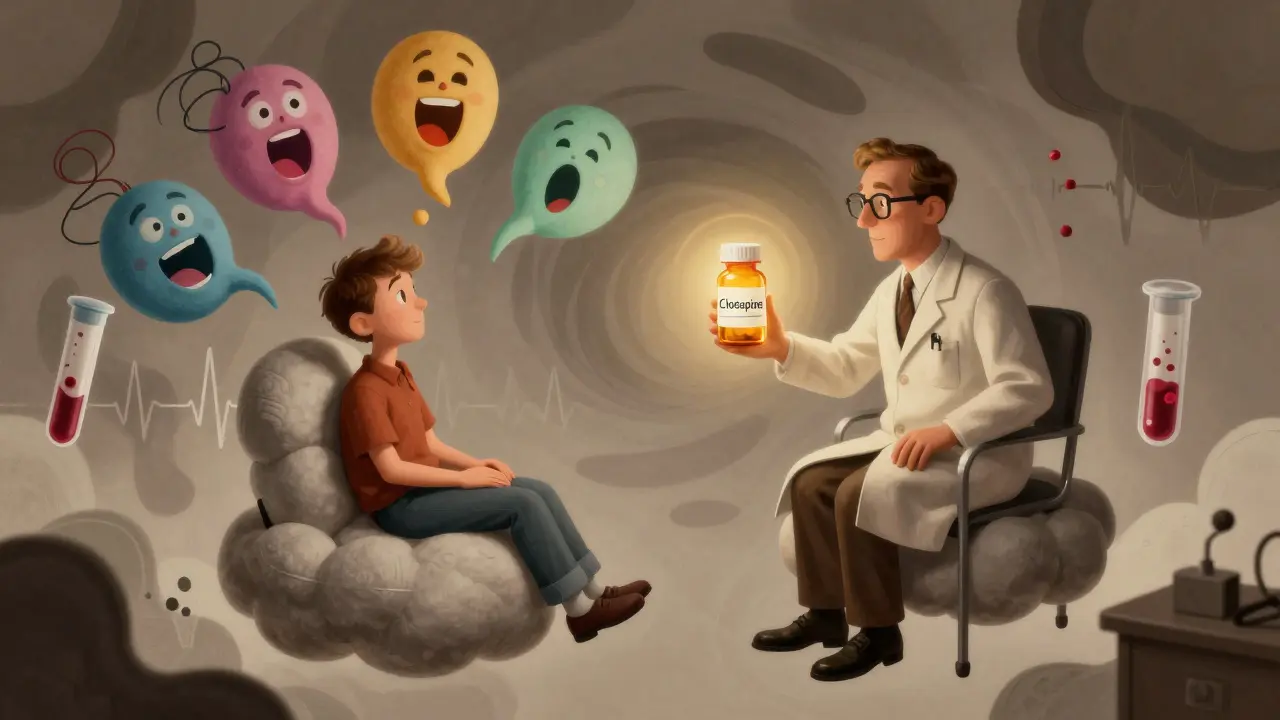
When someone is diagnosed with schizophrenia, the first question most people ask is: what medication will help? The answer isn’t simple. There are dozens of antipsychotic drugs, each with different effects, side effects, and costs. Some work better for certain people, while others cause problems that make patients stop taking them. The truth is, choosing the right antipsychotic isn’t about finding the ‘best’ drug-it’s about finding the right fit for your body, symptoms, and lifestyle.
Two Kinds of Antipsychotics: Old vs. New
There are two main groups of antipsychotic medications: first-generation (FGAs) and second-generation (SGAs), also called atypical antipsychotics. FGAs came out in the 1950s. Chlorpromazine was the first. It helped calm hallucinations and delusions but came with a heavy price: stiff muscles, tremors, and uncontrollable movements. About half of people taking these drugs developed these side effects, known as extrapyramidal symptoms. Drugs like haloperidol and fluphenazine are still used today, but mostly when newer options fail or cost is a major barrier. SGAs arrived in the 1980s and changed everything. Clozapine, the first of this group, was approved in 1990. Unlike older drugs that mainly blocked dopamine, these new medications also affected serotonin. This shift meant fewer movement problems-but introduced other risks, like weight gain, high blood sugar, and high cholesterol. Today, SGAs make up 85% of all antipsychotic prescriptions worldwide. They’re the go-to for most doctors because they’re easier to tolerate, even if they’re more expensive.Which Atypical Antipsychotics Actually Work Best?
Not all second-generation drugs are the same. Some are better at preventing relapses. Others are gentler on the body. A 10-year study of over 17,000 patients found that clozapine kept people on treatment the longest-over 16 months on average. Aripiprazole came in second, followed by paliperidone and olanzapine. Haloperidol, even though it’s an older drug, had the shortest time before patients stopped taking it-just under five months. Why does this matter? Because stopping medication is one of the biggest reasons people with schizophrenia end up back in the hospital. Relapse rates tell the story: in one study, 29.7% of people on haloperidol had a psychotic episode within a year. Only 18.2% of those on aripiprazole did. That’s a 42% lower risk. But effectiveness isn’t everything. A drug that works great can still be a bad fit if it causes too many side effects.Side Effects: The Hidden Cost of Treatment
Weight gain is the most common complaint. Clozapine and olanzapine are the worst offenders-people gain an average of 4.5 kilograms and 4.2 kilograms respectively over a year. Quetiapine adds about 2.8 kg. Risperidone? Around 1.9 kg. But aripiprazole and ziprasidone? Just 0.6 kg. That’s barely a change. Movement problems? They’re the opposite. Aripiprazole causes them in only 4.1% of users. Clozapine? Just 1.8%. But risperidone? Nearly 1 in 5 people have tremors or muscle stiffness. Olanzapine and quetiapine are better, but still cause issues in 6-10% of cases. Then there’s sedation. Olanzapine and quetiapine make people sleepy. Some patients say it helps them sleep, which is good-but others say it leaves them too tired to work, study, or even get out of bed. Aripiprazole, on the other hand, tends to keep people alert. That’s why many patients prefer it, even if it causes restlessness (akathisia) in about 40% of new users.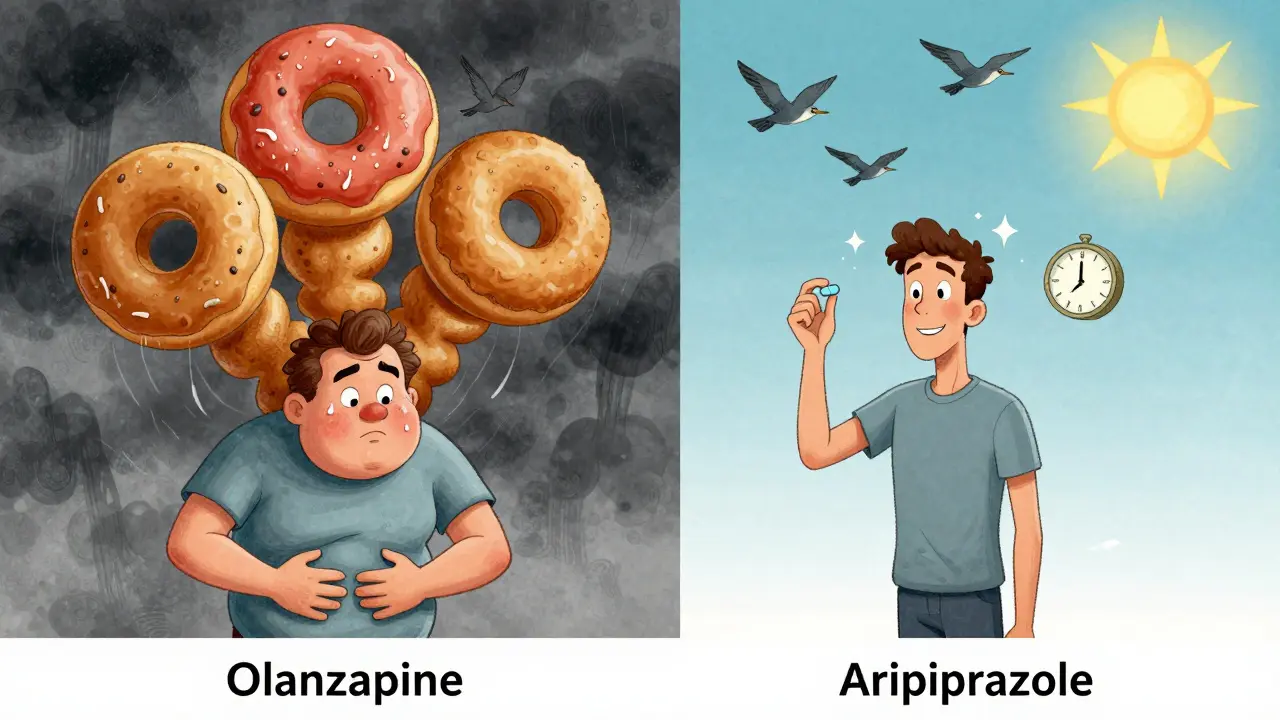
Clozapine: The Last Resort That Works
Clozapine is the most effective antipsychotic for treatment-resistant schizophrenia. When two or more other drugs fail, clozapine still works for 30-50% of people. But it’s not easy to use. It can cause agranulocytosis-a dangerous drop in white blood cells-that happens in 1-3% of users. That’s why anyone taking clozapine must get a blood test every week for the first six months. After that, it drops to every two weeks, then monthly. Despite the hassle, many patients say it’s life-changing. One person on Reddit wrote: “After five failed meds, clozapine gave me my life back despite the blood tests.” That’s why adherence is higher with clozapine than with any other antipsychotic-71% of users stick with it after a year. But not everyone can access it. In the U.S., the Clozapine REMS program requires doctors and pharmacies to register, and patients must go through strict monitoring. Rural areas struggle with this. In Finland, where the system is more streamlined, 40% of treatment-resistant patients get clozapine. In the U.S., it’s closer to 25%.Long-Acting Injections: A Game Changer
Taking a pill every day is hard. For people with schizophrenia, forgetfulness, paranoia, or lack of motivation can make daily medication a challenge. That’s where long-acting injectables (LAIs) come in. These are shots given every 2 to 4 weeks, or even every 3 months. Paliperidone palmitate, given once a month, reduces relapse risk by 22% compared to oral risperidone. LAIs now make up 30% of prescriptions in Europe and 25% in the U.S. They’re especially helpful for people who’ve been hospitalized before or who’ve stopped taking pills in the past. The catch? Not all antipsychotics come in injectable form. And some patients hate needles. But for those who’ve tried pills and failed, LAIs can be the difference between staying stable and ending up back in the hospital.What Doctors Don’t Tell You About Drug Trials
You might think all drug studies are fair. They’re not. A 2021 analysis found that 82% of head-to-head antipsychotic trials showed the sponsor’s drug performed better. That’s not coincidence-it’s bias. Companies fund most research, and they have a financial interest in showing their product works best. That’s why independent studies matter. The CATIE trial, funded by the U.S. government, found no single antipsychotic was clearly superior across all measures. It’s why the American Psychiatric Association says: “No single drug is best for everyone.” The real goal? Match the drug to the person. If someone is overweight and has diabetes, avoid olanzapine. If they’re young and active and hate feeling sleepy, skip quetiapine. If they’ve tried three drugs already and still hear voices, clozapine might be their only hope.

Comments
Lethabo Phalafala
January 13, 2026
Man, I wish someone had told me this before I got stuck on olanzapine for a year. Gained 30 pounds, felt like a zombie, and my mom cried every time I walked into the kitchen. Aripiprazole? Changed my life. Still get the jitters sometimes, but at least I can hold a job now. No more ‘I’m too tired to shower’ days.
Also, LAIs saved me. I used to hide my pills. Now I get a shot once a month and actually feel like I’m in control. If you’re struggling with adherence, just try it. No shame.
And yes, clozapine is a nightmare with the blood tests-but if you’ve tried everything else and still hear voices? It’s worth the hassle. I’d rather be monitored than locked up.
sam abas
January 14, 2026
lol so the article says ‘no one drug is best’ but then lists clozapine as the ‘most effective’ and aripiprazole as ‘second best’? That’s not neutrality, that’s marketing. Also, the CATIE trial was funded by the government but still didn’t prove anything because they used outdated dosing protocols. Everyone knows you can’t compare a 5mg starting dose of aripiprazole to a 15mg starting dose of olanzapine. That’s like comparing a bicycle to a tank and saying the tank’s worse because it uses more gas.
Also, why no mention of the fact that 70% of antipsychotic prescriptions are written by PCPs? Not psychiatrists. Just some guy who Googled ‘schizophrenia meds’ after his cousin’s friend’s dog died. It’s a mess.
Scottie Baker
January 14, 2026
Y’all act like meds are the only thing that matters. Nah. My brother was on clozapine for 8 years. Blood tests every week. Weight up 50 lbs. Still heard voices. Then he started doing yoga, got a service dog, and found a therapist who didn’t talk like a textbook. The meds kept him alive. But the dog? The dog kept him human.
Also, stop acting like everyone has access to these fancy LAIs. In rural Ohio? You’re lucky if your pharmacy has a working fridge. And don’t even get me started on insurance denying the damn shots because ‘oral is cheaper.’ Like, bro, I can’t afford to be in the hospital again. Pick your poison.
Trevor Whipple
January 15, 2026
Typo in the article: ‘agranulocytosis-a dangerous drop’ should be ‘agranulocytosis-a dangerous drop’. Also, the CATIE trial didn’t show ‘no drug was superior’-it showed that people stopped taking meds because they were lazy, not because the drugs didn’t work. People with schizophrenia are just bad at self-care. That’s the real problem. Not the pharma companies. Not the doctors. THEM.
Also, why is everyone so obsessed with weight gain? I’d take 10 extra pounds if it meant I could stop hearing my dead grandma screaming at me. Priorities, people.
Damario Brown
January 16, 2026
Let me break this down like you’re 5: Clozapine = magic bullet but your blood dies. Aripiprazole = works but you feel like a caffeinated hamster. Olanzapine = makes you look like a marshmallow. LAIs = good if you hate pills but hate needles more. And yeah, pharma is shady but so is your cousin who says ‘just pray and it’ll go away.’
Also, the 42% lower relapse rate with aripiprazole? That’s statistically significant but clinically? Who cares if you’re too jittery to leave the house. Effectiveness ≠ usability. Stop acting like science is a vending machine. You don’t just insert symptoms and get a perfect pill.
And yes, I’ve been on 6 different meds. I know.
vishnu priyanka
January 18, 2026
Back home in Kerala, my uncle took a cheap generic haloperidol for 15 years. No blood tests. No LAIs. Just a tiny bottle and a prayer. He still walks to the temple every morning. He still feeds the stray dogs. He still laughs at bad Bollywood movies.
Medication isn’t the whole story. Community is. Routine is. Someone remembering your name when you’re lost in the noise. I’ve seen people in the U.S. with all the fancy drugs still die alone. Meanwhile, my uncle has 17 neighbors who bring him chai every Sunday.
Maybe the real ‘treatment’ isn’t in the pill bottle. Maybe it’s in the cup of tea.
Alan Lin
January 19, 2026
It is imperative to underscore that the efficacy of antipsychotic regimens must be evaluated within the context of longitudinal adherence, metabolic profiling, and psychosocial support structures. While pharmacological interventions remain foundational, the absence of integrated care models significantly undermines therapeutic outcomes. Furthermore, the commercialization of clinical research introduces profound conflicts of interest that compromise evidence-based decision-making.
That said, the data presented herein are methodologically robust, and the emphasis on individualized treatment planning aligns with contemporary best practices in psychiatric therapeutics. I commend the author for synthesizing a complex body of literature with clarity and nuance.
However, the omission of pharmacogenetic testing as a routine standard of care is a critical oversight. In my clinical practice, genetic profiling has reduced adverse events by over 40%.
Anny Kaettano
January 21, 2026
Hey-if you’re reading this and you’re on your third med and you’re tired, I see you. You’re not broken. You’re not lazy. You’re not failing. You’re just trying to survive in a system that treats your brain like a software bug that needs a patch.
Try metformin if you’re gaining weight. Try a pill app. Try a support group. Try a therapist who doesn’t make you feel like a case study. And if you’re scared to ask for clozapine? Talk to your doctor. Say: ‘I’ve tried everything. I’m ready to try the hard one.’ You deserve to feel like yourself again.
You’re not alone. We’re here. We’ve been there. And we’re still here.
Love you. Keep going.
Jesse Ibarra
January 22, 2026
Oh wow. So the article is just a glorified pharma ad with a side of woke platitudes? ‘Personalization’? That’s what they say when they don’t know what else to do. Meanwhile, the real issue is that we’ve turned human suffering into a profit-driven algorithm. Clozapine works? Great. But it’s only available to those who can navigate the bureaucratic hellscape of REMS. That’s not medicine. That’s discrimination dressed up as safety.
And don’t get me started on LAIs. They’re not ‘game changers’-they’re chemical leash systems. We call it ‘treatment.’ I call it control. The system doesn’t want you healed. It wants you manageable.
Also, ‘digital tools’? You mean apps that track your psychosis like a fitness tracker? Pathetic.
lucy cooke
January 24, 2026
Ah, the metaphysics of antipsychotics-how the pharmakon, in its dual capacity as cure and poison, mirrors the Derridean paradox of the supplement: that which both completes and corrupts. We are not merely treating dopamine receptors; we are negotiating the very ontological boundaries of the self. The body becomes a site of colonial biopower, where pharmaceutical governance reconfigures subjectivity through the ritual of daily ingestion.
And yet-what is ‘normal’? Is the absence of voices a triumph, or merely the silencing of a different epistemology? Perhaps schizophrenia is not a disease, but a misreading of the world’s signal. And the drugs? Just static generators.
Still, I take my aripiprazole. Because even philosophy needs to eat.
Trevor Davis
January 25, 2026
I've been on 4 meds. 3 failed. Clozapine saved me. Blood tests suck but I'm alive. Thanks for the article.
Write a comment