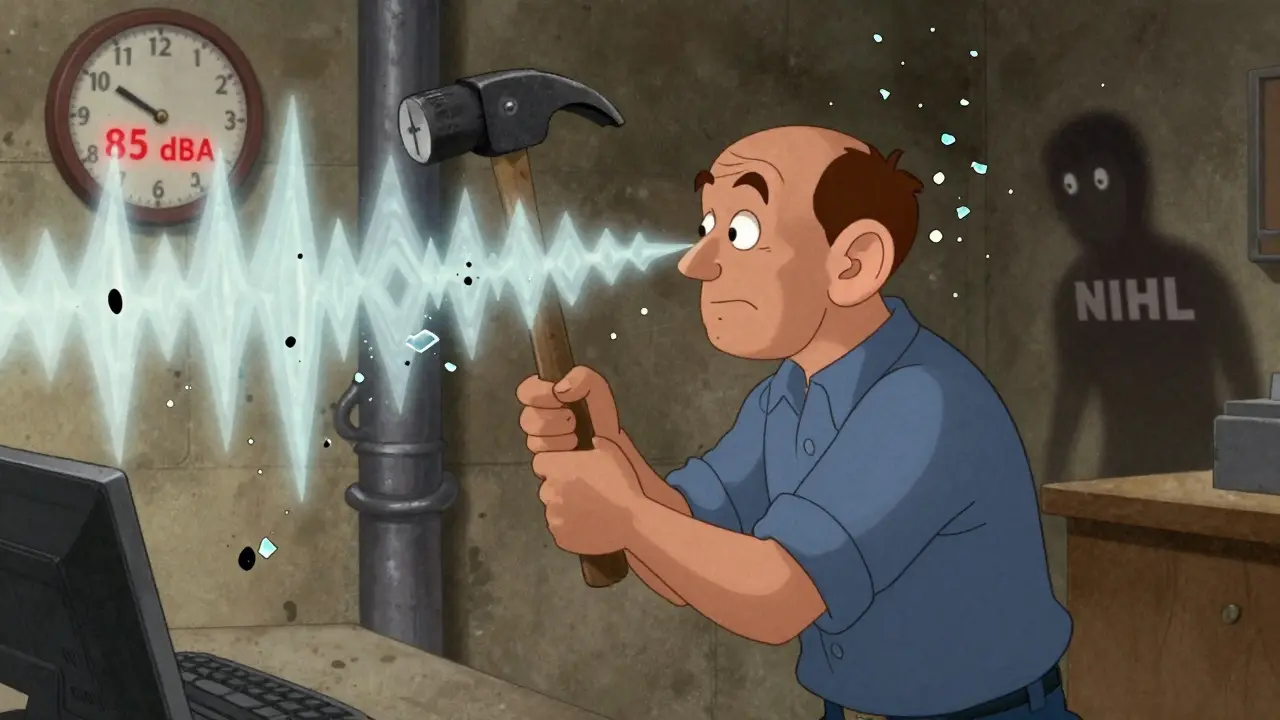
Every day, millions of workers are exposed to sounds that slowly, silently, and permanently damage their hearing. It doesn’t happen overnight. No one wakes up deaf. But after years of working near jackhammers, saws, presses, or fans without proper protection, the damage adds up. This isn’t just about being annoyed by loud noise. This is about noise-induced hearing loss - a condition that’s 100% preventable, yet still affects millions of people worldwide.
What Exactly Is Noise-Induced Hearing Loss?
Noise-induced hearing loss (NIHL) happens when the tiny hair cells in your inner ear get destroyed by loud sounds. These cells don’t grow back. Once they’re gone, the hearing loss is permanent. It usually starts with trouble hearing high-pitched sounds - like birds chirping, children’s voices, or the ‘s’ and ‘th’ sounds in speech. Over time, it spreads to other frequencies. Many people don’t notice it until they’re already halfway to significant hearing loss.
The Centers for Disease Control and Prevention (CDC) says about 22 million U.S. workers are exposed to dangerous noise levels each year. The Bureau of Labor Statistics recorded nearly 20,000 cases of hearing loss in 2022 that forced workers to take time off. That’s not just a health issue - it’s an economic one. Each workers’ compensation claim for hearing loss costs an average of $14,700. And those are just the cases that get reported.
How Loud Is Too Loud?
Many people think if you can talk normally over the noise, it’s safe. That’s not true. The problem isn’t just how loud something sounds - it’s how long you’re exposed and how much energy the sound carries.
Regulatory agencies use a unit called dBA (A-weighted decibels) to measure workplace noise. Here’s what the numbers mean:
- 85 dBA - This is the level where hearing protection becomes mandatory under U.S. OSHA rules. But here’s the catch: even at 85 dBA, hearing damage can start after just 8 hours of exposure. It’s not a safe limit - it’s a warning sign.
- 90 dBA - OSHA requires engineering controls at this level. But NIOSH, the research arm of the CDC, says this is still too high. They recommend keeping exposure below 85 dBA.
- 100 dBA - At this level, damage can happen in under 15 minutes. Think chainsaws, power drills, or metal stamping presses.
The real danger? The 3-dB exchange rate. Every time noise increases by 3 dB, the safe exposure time cuts in half. So if 85 dBA is safe for 8 hours, then:
- 88 dBA = 4 hours
- 91 dBA = 2 hours
- 94 dBA = 1 hour
- 97 dBA = 30 minutes
- 100 dBA = 15 minutes
That’s why a jackhammer operator who works 4 hours a day at 94 dBA is at higher risk than someone who works 8 hours at 88 dBA. The energy adds up fast.
Why Current Standards Aren’t Enough
OSHA’s rules were set in 1983. NIOSH updated its recommendations in 2018 - and they’re much stricter. OSHA allows 90 dBA for 8 hours. NIOSH says 85 dBA is the limit. That difference might sound small, but it’s huge in real terms. A 2024 study in Nature found that OSHA’s standard allows 16 times more noise energy than NIOSH’s recommendation. That’s like driving 80 mph in a zone where the limit is 50 mph - you’re not just breaking the rules, you’re putting yourself at much greater risk.
Europe is even more protective. The EU’s 2003 directive sets the action level at 80 dBA. California’s 2023 rules now require employers to use engineering controls before relying on earplugs. That’s the right direction. Because hearing protection alone? It’s not enough.
The Hierarchy of Controls: What Actually Works
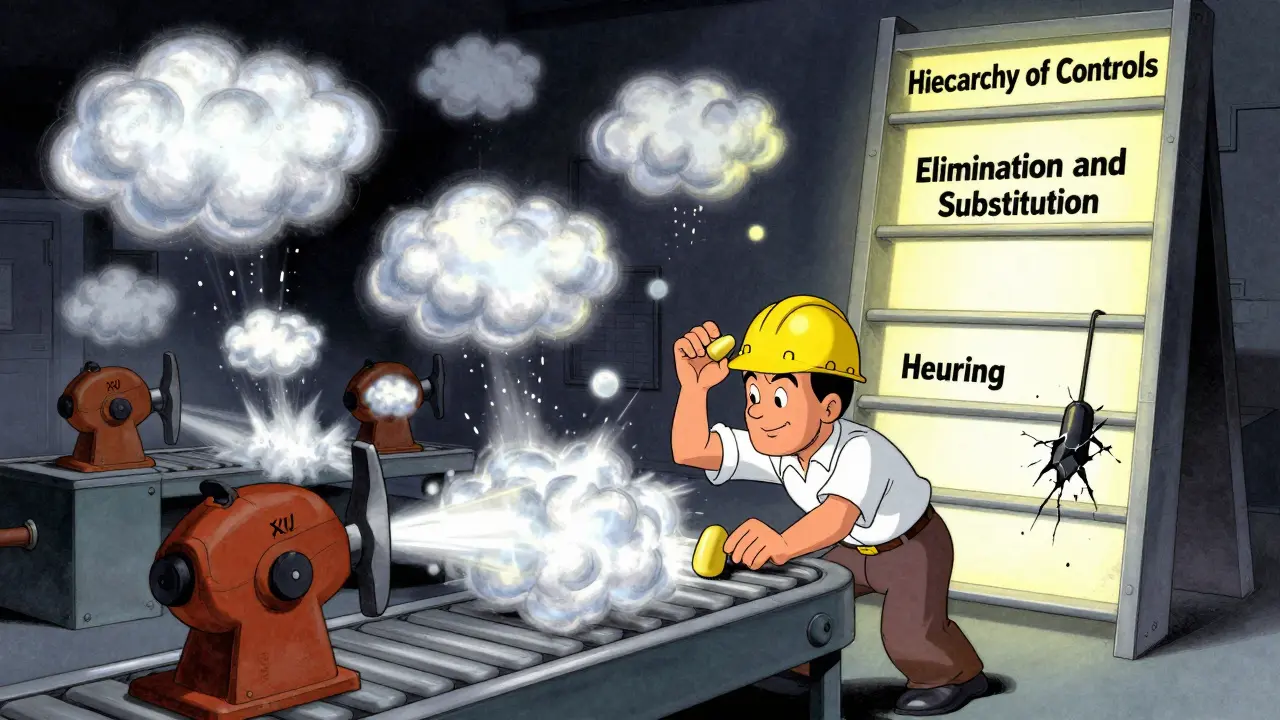
There’s a proven system for stopping workplace hazards - called the hierarchy of controls. It’s not a checklist. It’s a priority list. And it starts at the top.
- Elimination - Remove the noise source. Can you replace a noisy machine with a quieter one? This is the most effective solution.
- Substitution - Swap out loud equipment for quieter models. NIOSH’s ‘Buy-Quiet’ initiative, launched in 2023, lists over 1,200 low-noise tools and machines. A drill that runs at 88 dBA instead of 98 dBA? That’s a 10-dB drop - meaning exposure time can double.
- Engineering Controls - Build barriers, enclosures, or sound-absorbing materials. In mining, installing acoustic enclosures around drills cut noise from 98 dBA to 82 dBA. Workers reported less fatigue and better concentration. This isn’t theoretical - it’s proven.
- Administrative Controls - Limit exposure time. Rotate workers. Schedule loud tasks for low-traffic hours. But studies show these only work 25-75% of the time. If people don’t follow the schedule, it fails.
- Hearing Protection Devices (HPDs) - Earplugs and earmuffs. This is the last line of defense. And it’s the most unreliable.
Here’s the truth: most workplaces stop at step five. They hand out foam earplugs and call it done. But that’s not prevention - that’s damage control.
Why Earplugs Often Fail
Manufacturers claim foam earplugs block 30+ dB of noise. But real-world testing tells a different story. A 2017 Cochrane review found that most workers insert them wrong. The average attenuation? Just 15-20 dB. That’s half the rated protection.
Why? Because people don’t know how to use them. Most push the plug in too shallow. They don’t roll it properly. They take them out to hear warnings or talk to coworkers. A Reddit user with 15 years in construction wrote: “Most guys take their earplugs out because they can’t hear equipment warnings.”
Custom-molded earplugs perform better - 25-30 dB of consistent attenuation. But they cost more. And if workers aren’t trained to use them, even the best gear fails.
NIOSH found only 38% of workers in high-noise jobs wear hearing protection the whole shift. The top reasons? Discomfort (67%), communication problems (58%), and thinking it’s not necessary (42%).
What a Real Hearing Conservation Program Looks Like
Successful programs don’t just hand out earplugs. They follow a 5-step system:
- Noise monitoring - Use calibrated sound level meters (Type 2) to measure noise levels across the job site. Don’t guess. Measure.
- Engineering controls first - If noise exceeds 85 dBA, fix the source. Install barriers, enclosures, or replace equipment.
- Fit-tested hearing protection - Don’t just give out foam plugs. Use Real Ear Attenuation at Threshold (REAT) testing. This measures how much noise each worker actually blocks - not what the box says.
- Annual audiograms - Test hearing every year. Look for a ‘standard threshold shift’ - a 10 dB drop at 2000, 3000, and 4000 Hz compared to baseline. That’s early warning.
- Training - Train workers how to insert earplugs correctly. A 10-15 minute one-on-one session cuts incorrect use by 75%. Train them on why it matters. Not just ‘wear these’ - but ‘this protects your ability to hear your kids laugh.’
Companies that do this right see results. A 2021 NIOSH analysis found a $5.50 return for every $1 spent on a full program - through fewer claims, less absenteeism, and higher productivity.
Who’s at Risk?
It’s not just factory workers. High-risk industries include:
- Construction - 22% of workers exposed to over 85 dBA
- Manufacturing - 19%
- Mining - 17%
- Agriculture - 15%
Even truck drivers, firefighters, and landscapers face daily noise above safe levels. If you’re working near engines, saws, blowers, or power tools - you’re at risk.
What’s Changing in 2026?
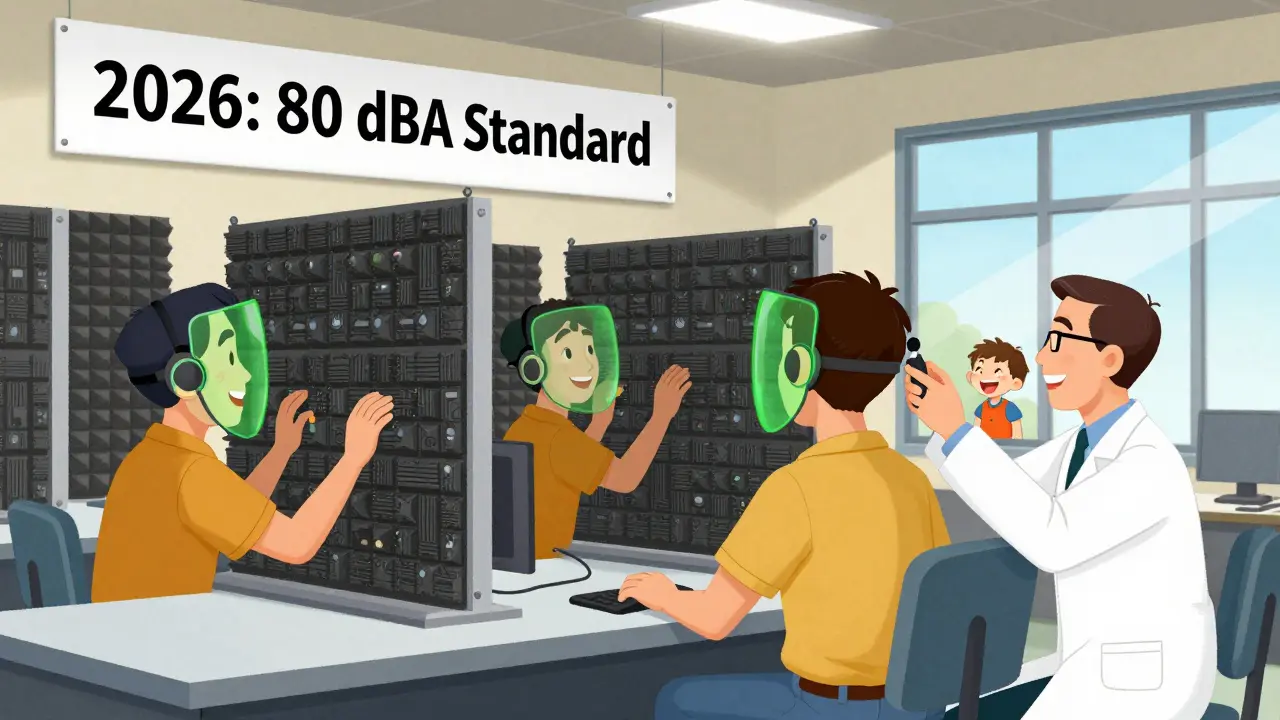
The science is clear: current standards aren’t preventing hearing loss. NIOSH is drafting new guidelines targeting 80 dBA by 2025. The European Union’s 2024 update lowers the action level to 80 dBA. California’s 2023 rules require engineering controls before hearing protection.
Technology is helping too. Smart hearing protection like 3M’s PELTOR TS3+ now records exposure data, so employers can track compliance. Researchers at USC are testing biomarkers that can detect early damage before audiograms show changes. That could mean catching NIHL before it’s permanent.
But technology alone won’t fix this. The biggest barrier? Management commitment. A 2023 survey found 89% of safety professionals say leadership buy-in is the #1 factor in success. If managers don’t prioritize it, workers won’t either.
The Bottom Line
Noise-induced hearing loss is not an accident. It’s a failure of systems - of policies, training, and leadership. It’s preventable. But it won’t be stopped by handing out cheap earplugs and hoping for the best.
The solution is simple, but not easy: reduce noise at the source. Invest in quieter tools. Install barriers. Train workers properly. Test their hearing. And most of all - listen to them. When workers say they can’t hear warnings or feel discomfort, don’t ignore it. Fix it.
Your hearing is not replaceable. Once it’s gone, there’s no cure. But if you act now - before the damage sets in - you can protect it for life.



Comments
Pranay Roy
March 5, 2026
This is all just a government scam to make companies buy expensive equipment. Real talk? If you can't hear over the noise, you're not cut out for the job. I worked in a factory for 12 years and never wore earplugs. My hearing's fine. They just want to scare you into compliance so they can charge more.
And don't even get me started on NIOSH. That's just a branch of the CDC - same folks who said masks worked for COVID. Science is just a tool for control.
Joe Prism
March 7, 2026
Hearing is the first sense we lose. But we treat it like an afterthought.
Think about it - we install smoke detectors in every bedroom. We mandate seatbelts. We track air quality. But when it comes to the sound that carries our memories - our kids' laughter, our partner's voice - we hand out foam plugs and call it a day.
It’s not about cost. It’s about what we value.
Bridget Verwey
March 8, 2026
Oh sweet mercy. Another ‘hand out earplugs and call it prevention’ post.
Let me guess - the boss is still like, ‘Just wear your plugs, Karen.’ Meanwhile, the guy on the drill is deaf in one ear and can’t hear his own kid say ‘Dad’ because he took his plugs out to yell over the noise.
Engineering controls aren’t optional. They’re the bare minimum. If your safety plan ends with ‘here’s a pair of foam,’ you’re not a safety officer. You’re a liability.
Andrew Poulin
March 10, 2026
Stop treating hearing like a luxury. It’s a biological right.
Factories don’t need more training videos. They need quieter machines. Period.
If you’re still using 1980s equipment and blaming workers for not wearing plugs, you’re the problem. Replace the gear. Or shut it down.
Weston Potgieter
March 10, 2026
Lmao 16x more noise energy? That’s just math. What’s next? They’ll say 85 dBA is the new 90 because climate change?
Meanwhile, my uncle’s a welder. Wears plugs. Still hears everything. He says the real issue is lazy HR departments who’d rather spend $10 on earplugs than $10k on new tools.
So yeah. It’s not the noise. It’s the cheap bastards running things.
Vikas Verma
March 10, 2026
The hierarchy of controls is not a suggestion - it is a systemic imperative. Engineering controls must precede administrative and PPE interventions. This is not opinion. This is occupational health doctrine.
NIOSH 2023 guidelines align with ISO 45001 and ILO conventions. Failure to implement is not negligence - it is a breach of duty of care.
ROI is not a bonus. It is a moral obligation. Every dollar invested in noise abatement yields 5.5 in reduced attrition, injury, and liability.
Compliance is not enough. Excellence is the baseline.
Sean Callahan
March 10, 2026
i hate how everyone acts like this is new. i’ve been in this industry 20 years. my ears ring every night. i used to think it was normal. then i realized i couldn’t hear my girlfriend when she whispered.
we need to stop pretending this is about ‘compliance.’ it’s about dignity. and no one cares until it’s too late.
Ferdinand Aton
March 11, 2026
Wait, so you’re saying the government is lying about noise levels to push a corporate agenda?
But then why did OSHA change the rules in 1983? And why did the EU lower theirs? Sounds like the *real* conspiracy is that we’re supposed to trust scientists and engineers. Which, obviously, is ridiculous.
Maybe the noise isn’t the problem - maybe it’s the *idea* of noise.
William Minks
March 13, 2026
This is so important 😊 I work in a warehouse and we just got new forklifts - 12 dB quieter. My coworkers actually talk to each other now. No more shouting.
It’s not magic. Just better tools. 🙌
Jeff Mirisola
March 14, 2026
I’ve seen this play out in three different plants. The ones that invested in real engineering controls? Their turnover dropped. Productivity went up. Workers were happier.
It’s not a cost center. It’s a culture shift.
And yeah - if your manager thinks earplugs are a solution, they’re not just wrong. They’re dangerous.
Write a comment