
Your liver is working overtime. It filters toxins, processes nutrients, and manages energy storage. But for millions of people, it is also storing too much fat. This condition, once known as Non-Alcoholic Fatty Liver Disease (NAFLD), has been renamed Metabolic Dysfunction-Associated Steatotic Liver Disease (MASLD) to better reflect its roots in metabolic health rather than just alcohol use or simple fat accumulation. The shift in terminology isn't just semantics; it highlights a critical link between your liver health and conditions like type 2 diabetes, obesity, and high blood pressure. If you have been told you have "fatty liver," understanding the new name and the powerful tools available today-specifically weight loss strategies and GLP-1 medications-is essential for reversing the damage before it becomes permanent.
The global prevalence of MASLD is staggering, affecting roughly 25% to 30% of the general population. For those with obesity, the risk skyrockets, with about 20% developing the more severe inflammatory form known as Metabolic Dysfunction-Associated Steatohepatitis (MASH). Without intervention, MASH can progress to cirrhosis in 20% to 30% of patients over a decade, significantly increasing the risk of liver cancer. The good news? The disease is reversible in its early stages. The key lies in targeting the root cause: metabolic dysfunction.
Understanding the New Diagnosis: Why MASLD Matters
In 2023, major medical bodies including the American Association for the Study of Liver Diseases (AASLD) officially adopted the term MASLD. This change was driven by the need for a positive diagnostic criterion. Previously, NAFLD was diagnosed by exclusion-you had to rule out other causes of liver injury. Now, MASLD is diagnosed by inclusion: you must have evidence of liver fat (steatosis) plus at least one marker of metabolic dysfunction, such as a BMI over 30 kg/m², type 2 diabetes, hypertension, or abnormal lipid levels.
This reclassification matters because it shifts the focus from "what doesn't you have" to "what do you have." It acknowledges that liver fat is rarely an isolated issue. It is part of a systemic metabolic problem. The pathophysiology involves four main drivers: excessive uptake of fatty acids from circulation, increased creation of new fats from carbohydrates (de novo lipogenesis), dietary fat intake, and impaired breakdown of fats in the liver. When these mechanisms go awry, fat accumulates in hepatocytes, triggering inflammation and fibrosis.
The Gold Standard: How Much Weight Loss Do You Need?
If there is one thing every specialist agrees on, it is this: weight loss is the cornerstone of MASLD treatment. However, not all weight loss is created equal when it comes to liver healing. Research provides specific thresholds that dictate how much improvement you can expect.
- 5-7% Body Weight Loss: This modest reduction is sufficient to significantly decrease hepatic steatosis (fat content). It is often achievable through lifestyle changes alone and marks the first step toward liver recovery.
- 10% Body Weight Loss: This is the clinical gold standard. Losing 10% or more of your total body weight is required to resolve lobular inflammation and reverse early fibrosis. Studies show that achieving this milestone can lead to MASH resolution in up to 45% of patients.
The mechanism behind this is clear. Weight loss improves insulin sensitivity in adipose tissue, which reduces the flux of free fatty acids to the liver by approximately 30-40%. It also suppresses the liver's production of new fats and enhances the burning of existing fats. The European Association for the Study of the Liver (EASL) recommends structured programs aiming for 7-10% weight loss over 6-12 months, combining calorie restriction (1200-1800 kcal/day depending on baseline needs) with 150-300 minutes of moderate-intensity exercise per week.

GLP-1 Receptor Agonists: A Game Changer for Liver Health
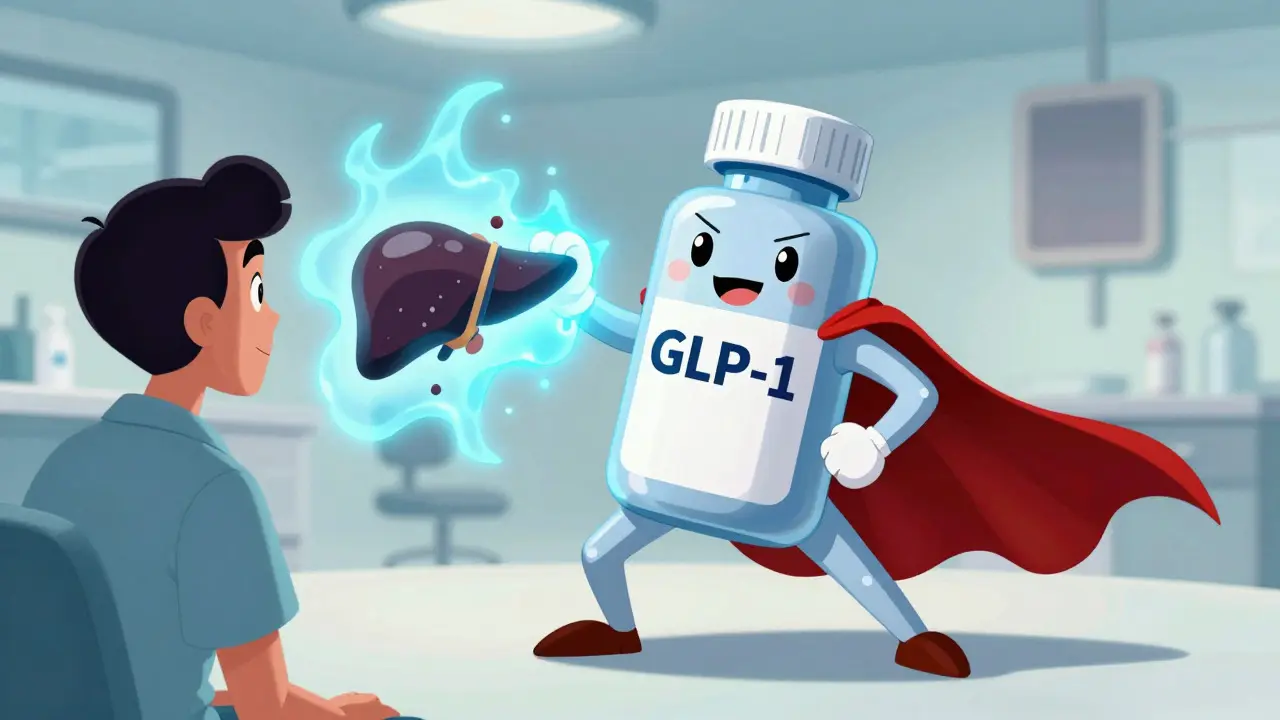
Achieving 10% weight loss through diet and exercise alone is incredibly difficult for many people. This is where GLP-1 receptor agonists (medications that mimic the glucagon-like peptide-1 hormone) enter the picture. Originally developed for type 2 diabetes, drugs like semaglutide and liraglutide have shown remarkable efficacy in reducing liver fat and inflammation.
Semaglutide, particularly at the higher dose of 2.4 mg/week (marketed as Wegovy® for weight management), has become a focal point in MASLD research. In the STEP-1 trial, participants achieved an average weight loss of 15.1%. More importantly, post-hoc analyses revealed a 55% reduction in liver fat content measured by MRI-PDFF. Another study, the REGENERATE substudy, found that semaglutide 1.0 mg/day led to a 52% MASH resolution rate compared to 22% with placebo.
Liraglutide (Saxenda®) also shows promise. In trials, 39% of MASLD patients using liraglutide achieved MASH resolution, compared to only 17% in the placebo group. These drugs work by improving insulin sensitivity, suppressing appetite, and directly inhibiting inflammatory pathways in the liver via AMPK activation and NF-κB signaling inhibition.
| Medication | Dose | Avg. Weight Loss | MASH Resolution Rate | Key Benefit |
|---|---|---|---|---|
| Semaglutide (Wegovy®) | 2.4 mg/week | 15.1% | ~52% (in T2DM/MASH studies) | Highest weight loss efficacy |
| Semaglutide (Ozempic®) | 1.0 mg/day | Variable | 52% vs 22% placebo | Strong glycemic control |
| Liraglutide (Saxenda®) | 3.0 mg/day | 7.2% | 39% vs 17% placebo | First-line option for some |
Navigating Side Effects and Real-World Challenges
While the data looks promising, real-world usage tells a more complex story. GLP-1 agonists are not without drawbacks. Gastrointestinal side effects are common. In community forums and patient registries, nausea is reported by up to 76% of users initially. While most cases are mild (grade 1), about 4% experience severe nausea, leading to a discontinuation rate of around 32% within the first six months.
Patient adherence drops significantly when support is lacking. Data from the MASLD Patient Registry shows that 65% of patients adhere to GLP-1 therapy at 12 months when combined with structured dietary counseling, compared to only 42% when prescribed medication alone. This highlights a crucial point: pills are not magic bullets. They work best when paired with behavioral changes.
Cost is another barrier. Semaglutide can cost over $1,300 per month without insurance coverage. While Medicare Part D now covers some beneficiaries for obesity indications, access remains uneven. Furthermore, while these drugs excel at reducing fat and inflammation, their ability to reverse advanced fibrosis (stage F3-F4) is limited. For patients with advanced scarring, combination therapies involving FXR agonists like resmetirom may be necessary.
Building a Sustainable Treatment Plan
Treating MASLD requires a multidisciplinary approach. Leading clinics, such as those at Duke University, mandate baseline assessments including FibroScan (transient elastography) to measure stiffness and fat, MRI-PDFF for precise fat quantification, and FIB-4 scores to assess fibrosis risk. Only then do they initiate therapy.
A robust plan includes:
- Dietary Intervention: Adopting a Mediterranean-style diet with strict limits on fructose (<25g/day). Fructose is uniquely damaging to the liver as it drives de novo lipogenesis.
- Exercise: At least 150 minutes of moderate-intensity aerobic activity per week, combined with resistance training to improve insulin sensitivity.
- Medication Titration: If using GLP-1s, start low and go slow. Titrate from 0.25 mg/week up to the target dose over 16-20 weeks to minimize nausea.
- Regular Monitoring: Follow-up scans every 6-12 months to track CAP (Controlled Attenuation Parameter) reductions and fibrosis progression.
Dr. Rohit Loomba, a leading expert in the field, emphasizes that while 10% weight loss is the goal, GLP-1 RAs have become the first-line pharmacotherapy when lifestyle changes fall short, especially for those with concurrent type 2 diabetes. However, he cautions against relying solely on medication. The synergy between drug-induced weight loss and sustained lifestyle habits is what truly heals the liver.
The Future of MASLD Care
The landscape of liver care is evolving rapidly. With MASLD projected to become the leading indication for liver transplantation in the U.S. by 2030, the urgency for effective treatments has never been higher. New drugs like resmetirom are gaining regulatory traction, offering hope for patients with advanced fibrosis who do not respond fully to GLP-1s.
For now, the message is clear: act early. Whether through aggressive lifestyle modification or guided pharmacological support, reducing liver fat is possible. By understanding the metrics-aiming for that 10% weight loss threshold-and leveraging modern tools like GLP-1 agonists under medical supervision, you can turn back the clock on liver damage and protect your long-term health.
What is the difference between NAFLD and MASLD?
NAFLD (Non-Alcoholic Fatty Liver Disease) was the old term, defined by excluding other causes of liver damage. MASLD (Metabolic Dysfunction-Associated Steatotic Liver Disease) is the new term, adopted in 2023, which positively diagnoses the condition based on the presence of liver fat plus at least one metabolic risk factor like obesity or type 2 diabetes. This shift emphasizes the metabolic nature of the disease.
How much weight do I need to lose to fix my fatty liver?
To reduce liver fat (steatosis), a 5-7% weight loss is effective. However, to resolve inflammation and reverse early fibrosis (MASH), a 10% or greater weight loss is recommended. This is considered the clinical gold standard for significant histological improvement.
Can Ozempic or Wegovy cure MASLD?
While not a "cure" in the traditional sense, GLP-1 agonists like semaglutide (Ozempic/Wegovy) can significantly reduce liver fat and resolve MASH in many patients. Studies show up to 52% MASH resolution rates with semaglutide. They are most effective when combined with lifestyle changes and are particularly beneficial for patients with type 2 diabetes.
Are there side effects to GLP-1 medications for liver patients?
Yes, gastrointestinal issues are common. Nausea affects up to 76% of users initially, though most cases are mild. About 32% of patients discontinue therapy within six months due to intolerance. Rare but serious risks include pancreatitis. Slow titration of the dose helps manage these side effects.
What diet is best for MASLD?
The Mediterranean diet is widely recommended. Key components include high intake of vegetables, whole grains, healthy fats (olive oil, nuts), and lean proteins. Crucially, limiting fructose intake to less than 25g per day is vital, as excess fructose drives fat production in the liver.
Does insurance cover GLP-1 drugs for fatty liver?
Coverage varies. As of 2023, Medicare Part D covers some beneficiaries for obesity indications, but private insurance often requires prior authorization. Costs can exceed $1,300/month without coverage. Always check with your provider and insurer regarding specific policies for MASLD or associated metabolic conditions.




Comments
Simon-Pierre Bouchard
August 14, 2026
Oh look, another medical rebranding because the old name was too honest about what causes it. "Metabolic Dysfunction-Associated Steatotic Liver Disease"? That’s a mouthful for "you ate too much and sat on your ass." I’m sure the pharmaceutical lobby loves this new terminology because it sounds so scientific and detached from personal responsibility. But hey, at least they admit now that it’s not just about alcohol, even if the root cause is still largely lifestyle choices that we all know are bad but keep making anyway.
Saher Ghattas
August 16, 2026
The mainstream narrative ignores the fact that these GLP-1 drugs are essentially chemical lobotomies designed to suppress natural hunger signals while the big pharma rakes in billions. They want you dependent on weekly injections forever because once you stop, the weight comes back, and then they sell you the next miracle cure. It’s a classic cycle of profit over health. The real issue isn't metabolic dysfunction; it's the toxic environment we live in filled with processed garbage, but telling people to just eat better is easier than regulating the food industry, right?
Marc-Alexandre Rizzo
August 16, 2026
I think it’s actually quite refreshing to see the focus shift towards inclusion rather than exclusion in diagnosis. It validates the experience of so many who were previously told their liver issues were mysterious or unrelated to their overall health. The distinction between NAFLD and MASLD helps patients understand that their liver health is deeply intertwined with their metabolic well-being. It’s a more holistic approach that encourages treating the whole person, not just isolated symptoms. We should embrace this nuance as it opens doors for earlier intervention and more personalized care plans.
Ella Mentry
August 17, 2026
You guys are missing the point entirely! It’s not just about the drugs or the names, it’s about the sheer willpower required to change your life. I’ve seen people fail miserably because they rely on these pills instead of doing the hard work. And don’t get me started on the side effects-nausea? Please. That’s just your body rejecting the artificial interference. If you can’t handle a little nausea, how do you expect to handle the discipline needed for long-term health? It’s pathetic really. Most people just want a quick fix because they’re lazy and entitled.
Josh Atkinson
August 18, 2026
Let’s break this down logically shall we? : ) The data clearly shows that achieving a 10% weight loss is the holy grail for reversing MASH, but let’s be real, most folks aren’t gonna hit that target without some serious help. Semaglutide is basically the cheat code here, giving you that 15% average drop which is huge. But you gotta remember that these meds aren’t magic wands; they’re tools. If you combine them with a solid diet plan and maybe some exercise, you’re looking at a 52% resolution rate which is insane compared to placebo. So yeah, take the shot, lose the weight, save your liver. Simple math really. : )
charlie student
August 19, 2026
There is something poetic about the way our bodies store excess energy as fat in the liver, a relic of our evolutionary past when scarcity was the norm. Now, in an age of abundance, that same mechanism becomes a silent killer. It makes you wonder about the balance we seek between convenience and health. Perhaps the solution lies not just in medication but in rethinking our relationship with food and movement. We need to find a middle ground where technology aids us but doesn’t replace our innate wisdom.
Darcy Galway
August 20, 2026
In my country, we have similar issues with liver health due to changing diets. People used to eat simple foods but now everything is processed. The new name for fatty liver disease is good because it tells doctors to look at blood sugar and pressure too. Losing 10 percent of weight is hard but possible if you start small. Walking every day helps a lot. The medicine like Ozempic is expensive but if insurance pays it might help many people. We need to teach kids early about healthy eating so they do not get sick later.
Gary Browne
August 20, 2026
I noticed the post mentions that adherence drops significantly without support. This is a critical detail often overlooked in clinical trials. Patients are prescribed these medications and sent off with a pamphlet, expecting miracles. Reality sets in quickly when nausea strikes and the scale stalls. Integrating behavioral counseling isn’t just a nice-to-have; it’s essential for long-term success. Without addressing the psychological aspects of eating and body image, any pharmacological intervention is likely to be temporary at best.
Christina Thygesen
August 21, 2026
i feel like everyone forgets how scary it is to hear you have liver damage. it feels so final. knowing that it can be reversed gives me hope though. the idea of losing just 5 percent to start helping the liver is manageable. i dont know if i could handle the injections but maybe diet changes first. its good to know there are options out there. thanks for sharing this info it really helps to understand what is going on inside the body.
Write a comment