You check the label. The box looks right. The pen feels heavy in your hand. You inject it, expecting relief or results, but instead, you get nothing-or worse, a hospital visit. This is the terrifying reality of counterfeit medications, a global crisis that has moved far beyond simple street-corner scams. In 2024 alone, law enforcement agencies across 136 countries documented over 6,400 incidents of pharmaceutical counterfeiting, illegal diversion, and theft. These aren't just empty boxes; they are sophisticated traps set by criminal networks targeting some of the most vulnerable patients on earth.
The scale of this problem is staggering. From oncology drugs to weight-loss injections, no therapeutic area is safe. But behind every statistic is a lesson learned from a failed seizure, a near-miss at the border, or a patient who survived against the odds. Understanding these cases isn't just about satisfying curiosity; it's about knowing how to protect yourself and recognizing the shifting tactics of criminals who are getting smarter, faster, and more dangerous every day.
The Evolving Landscape of Pharmaceutical Crime
Gone are the days when counterfeit pills looked like chalky discs made in a basement kitchen. Today’s fakes are manufactured in uninspected factories with industrial-grade equipment, mimicking legitimate products so closely that even experienced pharmacists can struggle to tell them apart without lab testing. The Pharmaceutical Security Institute (PSI) reported that in 2024, these crimes targeted 2,428 distinct medicines. The shift has been dramatic. Criminals are no longer just copying aspirin; they are targeting high-value biologics and specialty drugs where profit margins are massive.
One of the biggest changes we’ve seen recently is the surge in counterfeit GLP-1 agonists-drugs like Ozempic, Semaglutide, and Tirzepatide. These weight-loss medications have become the new gold rush for illicit traders. Why? Because demand is sky-high, supply is often restricted, and the price difference between a genuine prescription and a black-market fake is enormous. In August 2025, U.S. Customs and Border Protection (CBP) intercepted nearly 17,000 counterfeit pre-filled injectable pens. Most came from Hong Kong and China, destined for homes across all 50 U.S. states. This wasn’t a small operation; it was a coordinated effort to flood the market with dangerous substitutes.
The danger here isn’t just financial fraud. It’s biological. Analysis of these seized items revealed that many contained no active ingredients at all. Others were laced with heavy metals, industrial solvents, or unknown particulates. When you inject an unknown substance into your body, you’re playing Russian roulette with your health. A healthcare professional on Reddit shared a chilling case in August 2025: a patient developed severe cellulitis after using counterfeit dermal fillers bought online. The packaging was indistinguishable from the real thing, but the contents were toxic waste.
Major Enforcement Operations and Seizures
To fight this shadow industry, governments have had to step up their game. One of the most significant recent efforts was Interpol’s Operation Pangea XVI in 2025. This wasn’t a local police raid; it was a synchronized global strike involving authorities from 90 countries. The results were impressive but also sobering. They arrested 769 suspects, dismantled 123 criminal groups, and seized 50.4 million doses of unapproved and counterfeit medicines. They also shut down approximately 13,000 illegal websites and social media channels used to sell these drugs.
| Operation / Agency | Year | Key Outcome | Impact |
|---|---|---|---|
| Interpol Operation Pangea XVI | 2025 | 50.4 million doses seized; 123 groups dismantled | Global disruption of online sales networks |
| U.S. CBP (August 2025) | 2025 | 16,740 counterfeit GLP-1 pens intercepted | Prevented distribution to 40+ U.S. states |
| Pfizer Global Security (Cumulative) | Since 2004 | 302 million counterfeit doses prevented | Long-term partnership with law enforcement |
| South African Police (Gqeberha) | 2025 | R2.2 million ($118k USD) in fake meds seized | Local crackdown on regional distribution hubs |
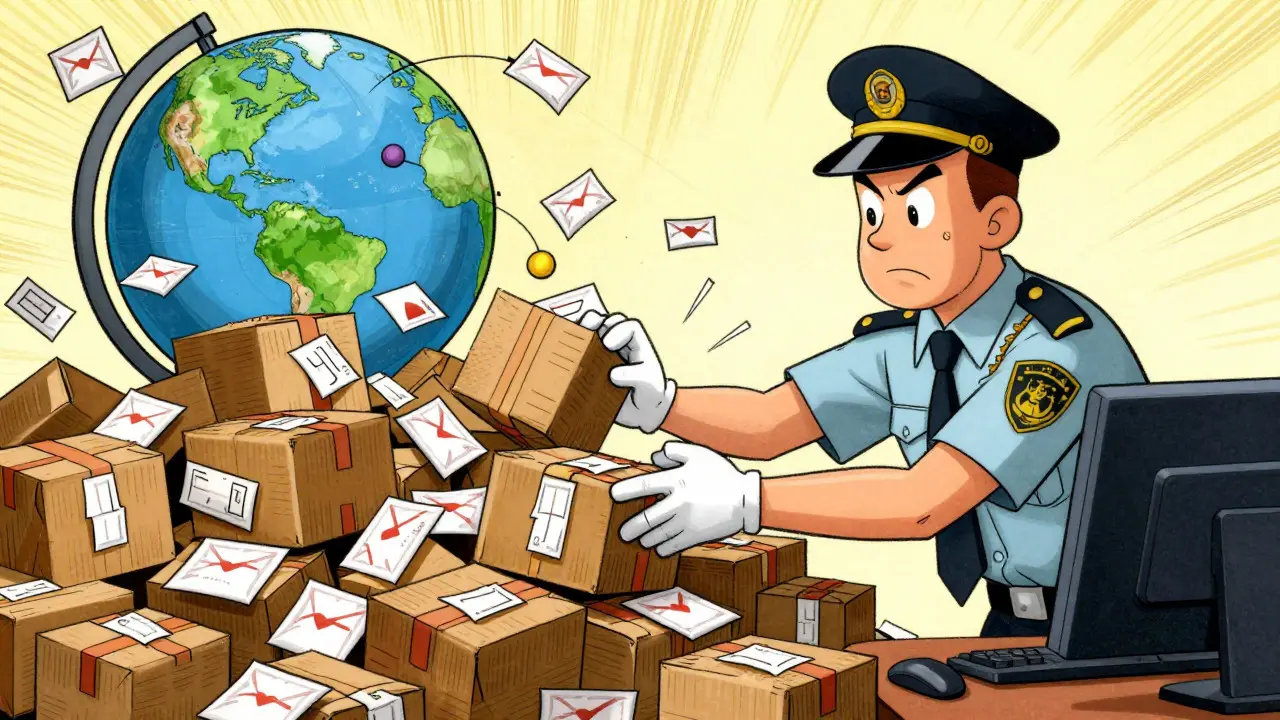
But enforcement is a cat-and-mouse game. While the DEA reported a 24% decrease in fake pill seizures in 2024 compared to 2023, experts warn this doesn’t mean the problem is shrinking-it means criminals are adapting. They are moving away from large, easily detectable shipments toward smaller parcels. According to the OECD, 65% of counterfeit seizures now involve small mail packages. This strategy lowers the risk of inspection and makes it harder for customs officers to spot patterns. It’s the "death by a thousand cuts" approach to smuggling.
Regulatory Gaps and Legal Challenges
If you think any bad drug gets stopped at the border, you might be wrong. There is a critical legal loophole that frustrates regulators and endangers patients. Dr. Carmen Catizone, Executive Director of the National Association of Boards of Pharmacy (NABP), highlighted a stark reality in August 2025: U.S. Customs and Border Protection cannot seize medications that merely violate the Federal Food, Drug, and Cosmetic Act (FDCA). To be seized, the product must be legally defined as "counterfeit."
This distinction matters immensely. If a drug is imported illegally but contains the correct active ingredient in the correct dose, it might slip through because it isn’t technically a "fake" in the eyes of customs law-it’s just unapproved. However, if it’s labeled as a brand-name drug but comes from an unauthorized source, it’s counterfeit. This nuance creates blind spots. Criminals exploit these gaps by shipping unassembled parts or generic-looking packaging that only becomes identifiable as a specific brand once assembled closer to the consumer. This "localization" strategy, noted in Interpol’s 2025 report, complicates detection efforts significantly.
In the United States, the Department of Justice recently prosecuted a case involving over 70 defendants who defrauded Medicaid of $17 million while selling $9.5 million in counterfeit medications online. Among these were $3 million worth of fake HIV medicines. For patients relying on antiretroviral therapy, a counterfeit pill isn’t just a wasted dollar; it’s a potential return to viral replication and resistance. These cases show that the stakes are life-and-death, yet the legal tools available to stop them are often blunt instruments.
How Criminals Reach Consumers: The Online Pipeline
Where do people buy these dangerous fakes? Surprisingly, not always on dark web forums. The NABP found that 47% of illicit GLP-1 sales happen on mainstream online marketplaces like Etsy. Yes, the same site where you buy handmade jewelry. Another 31% come from direct orders to illegal manufacturers, and 22% from foreign providers offering look-alike counterfeits. By 2026, forecasts suggest that 78% of these fake weight-loss drugs will be sold via social media platforms and disguised e-commerce sites.
Criminals use sophisticated marketing. They create fake testimonials, use stolen images from legitimate pharmacies, and offer prices that seem too good to refuse. The allure of buying expensive weight-loss drugs or erectile dysfunction medications at half price is powerful. But the cost is hidden in the chemistry. The FDA’s MedWatch database saw a 43% year-over-year increase in adverse event reports linked to suspected counterfeit medications in the first half of 2025. Most of these involved weight-loss drugs and cosmetic injectables.
The supply chain is fragmented and opaque. A package might start in a factory in India or China, pass through a hub in Colombia or Korea, and arrive at your doorstep in Ohio. Each handoff obscures the origin. The USTR’s 2025 Special 301 Report identified India and China (including Hong Kong) as the top countries of origin for counterfeit pharmaceuticals seized at the U.S. border. But the final mile-the last few feet before it reaches the patient-is where the deception is most complete.
Lessons Learned: Detection and Prevention
So, what can we learn from these seizures? First, trust your instincts. If the price is drastically lower than the pharmacy price, ask why. Second, look for physical inconsistencies. Pfizer Global Security, which has trained law enforcement in 183 countries since 2004, emphasizes checking for packaging inconsistencies, incorrect labeling fonts, and abnormal product appearance. Legitimate pharmaceutical companies invest heavily in tamper-evident seals and unique serialization codes. If those are missing or look poorly printed, walk away.
Technology is also playing a role in the solution. Blockchain-based tracking systems implemented by major pharmaceutical companies have reduced counterfeit incidents by 37% in pilot programs. These systems allow every step of the drug’s journey to be verified. However, adoption is still uneven. Until every drug bottle has a digital passport, consumers remain vulnerable.
For healthcare providers, vigilance is key. If a patient presents with unexpected side effects or lack of efficacy, consider the possibility of a counterfeit product. Documenting these cases helps build the evidence base needed for regulatory action. The community feedback from platforms like Reddit shows that peer-to-peer warnings are becoming a vital, albeit informal, part of the defense network. Sharing stories of bad reactions can save others from making the same mistake.
The Future of Drug Safety
The outlook is mixed. On one hand, international cooperation is stronger than ever. Operations like Pangea show that borders are less effective barriers to justice when countries work together. On the other hand, the incentives for criminals are higher than ever. With the global trade in fake goods estimated at $467 billion in 2021, pharmaceuticals represent a lucrative and growing segment. The OECD warns that without enhanced technological solutions and stricter enforcement, counterfeit medication incidents could increase by 15-20% annually.
We are entering an era where biologic counterfeiting is rising. These are complex protein-based drugs used for cancer, autoimmune diseases, and diabetes. They require cold chains and precise handling. Faking them is harder, but the payoff is huge. As the Pharmaceutical Security Institute noted, there was a 12% year-over-year increase in biologic counterfeiting incidents in 2024. This suggests that as legitimate medicine becomes more advanced, so does the crime surrounding it.
Ultimately, protecting yourself requires a combination of skepticism, verification, and advocacy. Buy from licensed pharmacies. Check for verification codes on packaging. Report suspicious products to the FDA or local health authorities. The lessons from these seized cases are clear: the enemy is evolving, and our defenses must evolve with it. Don’t let convenience override caution. Your health is worth more than a discount.
What are the most common types of counterfeit medications?
The most frequently counterfeited drugs include weight-loss medications (especially GLP-1 agonists like Ozempic and Wegovy), erectile dysfunction treatments, Botox and dermal fillers, HIV therapies, and oncology drugs. These categories are targeted due to high demand, high cost, and the difficulty in visually verifying authenticity.
How can I tell if my medication is counterfeit?
Look for subtle signs such as misspellings on the label, poor print quality, damaged or missing tamper-evident seals, and unusual color or texture of the pill or liquid. Always purchase from licensed pharmacies and verify serialization codes if available. If the price seems too good to be true, it likely is.
Why are counterfeit drugs dangerous?
Counterfeit drugs may contain no active ingredient, the wrong dosage, or harmful contaminants like heavy metals, industrial solvents, or bacteria. This can lead to treatment failure, disease progression, severe allergic reactions, infections, or even death.
Where do most counterfeit medications come from?
Recent data indicates that China (including Hong Kong) and India are the top countries of origin for counterfeit pharmaceuticals seized at the U.S. border. Other sources include Colombia and South Korea, often serving as transit points for goods destined for Western markets.
What is Operation Pangea?
Operation Pangea is an annual worldwide law enforcement operation coordinated by Interpol and the World Health Organization to combat the illegal trade of medicines. It involves simultaneous raids on internet pharmacies and physical locations to seize counterfeit drugs and arrest offenders.
Can customs always stop fake drugs at the border?
Not always. There are legal limitations; for example, U.S. Customs can only seize items defined as "counterfeit" under specific laws, not just those violating general food and drug regulations. Additionally, the shift toward small parcel shipments makes 100% inspection difficult, allowing some fakes to slip through.